Facts
The appellant, a social worker and trade union president, filed a civil suit seeking compensation for damages resulting from alleged malicious prosecution.
Source reference: para. 2The appellant claimed that the defendants, including police officials and a veterinary doctor, conspired to lodge a false complaint against him on March 31, 2005, due to his activism against their alleged corruption.
Source reference: para. 3Consequently, the appellant was prosecuted under Sections 186, 294, 386, 212, and 507 of the IPC but was eventually acquitted by the Judicial Magistrate First Class.
Source reference: para. 3, 8The defendants maintained they acted in the discharge of official duties based on a written complaint.
Source reference: para. 4Both the Trial Court (judgment dated 29.09.2012) and the First Appellate Court (judgment dated 30.07.2016) dismissed the appellant's suit, finding no evidence of malice or lack of reasonable cause.
Source reference: para. 1, 6The appellant then preferred this Second Appeal under Section 100 of the CPC.
Source reference: para. 1Issues
1. Whether the plaintiff established the essential ingredients of malicious prosecution, namely the existence of malice and the absence of reasonable and probable cause.
Source reference: para. 7, 102. Whether the concurrent findings of fact by the lower courts were perverse or gave rise to a substantial question of law under Section 100 of the CPC.
Source reference: para. 12Law Applied
The court applied the established legal principles governing the tort of malicious prosecution, which require the plaintiff to prove that the prosecution was instituted without reasonable and probable cause and was fueled by malice.
Source reference: para. 7, 10Regarding procedural law, the court applied Section 100 of the Code of Civil Procedure (CPC), which restricts the High Court’s jurisdiction in second appeals to "substantial questions of law".
Source reference: para. 7, 9The court further relied on the precedent in State of Rajasthan and others v. Shiv Dayal and another (2019) 8 SCC 637, which holds that concurrent findings of fact should not be disturbed unless they are recorded de hors the pleadings, based on a misreading of evidence, or are legally perverse.
Source reference: para. 11Reasoning
The High Court observed that the appellant failed to provide cogent evidence to prove that the respondents acted with malice or lacked reasonable cause.
Source reference: para. 7, 10While the appellant relied on a subsequent affidavit by Defendant No. 1 (Ajmer Singh) claiming the complaint was filed under pressure, the court noted that this defendant had already proved the written complaint during his deposition in the criminal trial.
Source reference: para. 10The court held that an affidavit filed after the completion of examination and cross-examination, which was not itself subject to cross-examination, cannot override substantive testimony recorded in accordance with law.
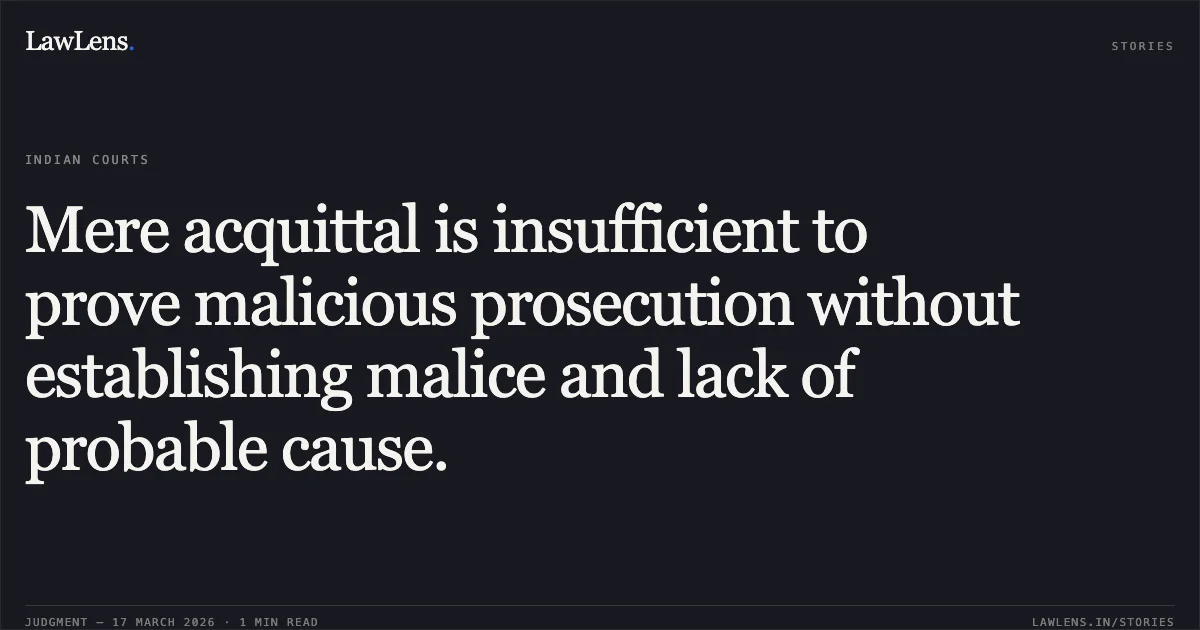
Source reference: para. 10Furthermore, the court clarified that a mere acquittal in a criminal case does not inherently establish malicious prosecution; it only signifies a failure to prove charges beyond a reasonable doubt.
Source reference: para. 10The court determined that the respondents acted in their official capacity following a formal complaint.
Source reference: para. 10Consequently, the challenges raised by the appellant were deemed questions of fact rather than substantial questions of law.
Source reference: para. 12Holding
The High Court held that the appellant failed to prove the essential elements of malicious prosecution and that no substantial question of law arose for consideration.
The court affirmed that concurrent findings of fact cannot be interfered with under Section 100 CPC unless proven perverse.
Source reference: para. 10The Second Appeal was dismissed, and the judgments of the Trial Court and First Appellate Court were upheld.
Source reference: para. 13Acts & Sections Cited
6 provisions across 2 statutes referred to in this judgment. Each provision opens on LawLens.
Code of Civil Procedure, 19081
Indian Penal Code, 18605
Original Court PDF
Abhay Narayan PandeyvsAjmer Singh
Click to open original judgment
Original judgment, available to read, download and summarize on LawLens.in