Facts
The Petitioners challenged the order dated 26 May 2026 of the learned ARC-02, Central District, Delhi, whereby their application for leave to defend was dismissed and an eviction order was passed under Section 14(1)(e) of the Delhi Rent Control Act, 1958, concerning portions of property bearing No. 481, Chatta Haji Yusuf, Chitli Gate, Chawri Bazar, Delhi.
Source reference: p.1Before the High Court, the Petitioners confined their challenge to the alleged lack of jurisdiction of the learned ARC.
Source reference: p.2They contended that the premises constituted “enemy property” because a previous owner, Haji Mohd. Muslim, had become a Pakistani national, resulting in vesting of the property in the Government of India and the Custodian of Enemy Property.
Source reference: p.2The Petitioners further claimed that they had consequently become tenants of the Government and that no landlord–tenant relationship existed between them and the Respondent.
Source reference: p.2The learned ARC rejected these objections, holding that the Respondent had demonstrated a title superior to that of the Petitioners and that any dispute regarding enemy-property vesting was a title dispute beyond the scope of the eviction proceedings.
Source reference: pp.5–8Issues
Whether the alleged status of the premises as enemy property divested the Respondent of the right to maintain an eviction petition under Section 14(1)(e) of the DRC Act or ousted the jurisdiction of the learned ARC?
Source reference: paras. 2–6, 19–23; pp.2–3, 9–10Whether the Respondent was required to establish absolute ownership, or whether a title superior to that of the Petitioners was sufficient to maintain the eviction petition?
Source reference: paras. 15–18; pp.5–9Whether the impugned order disclosed any jurisdictional error, material illegality, perversity, or error apparent on the face of the record warranting interference under the proviso to Section 25-B(8) of the DRC Act?
Source reference: paras. 8–14, 24; pp.3–5, 10–11Law Applied
The Court applied the proviso to Section 25-B(8), read with Section 25-B(9), of the Delhi Rent Control Act, 1958, holding that the High Court’s jurisdiction is supervisory and revisional rather than appellate; interference is warranted only for a jurisdictional error, manifest illegality, material irregularity, perversity, absence of adjudication, or an error apparent on the face of the record.
Source reference: paras. 8–13; pp.3–5Relying on Sarla Ahuja v. United India Insurance Co. Ltd., (1998) 8 SCC 119, Hindustan Petroleum Corporation Ltd. v. Dilbahar Singh, (2014) 9 SCC 78, and Abid-Ul-Islam v. Inder Sain Dua, (2022) 6 SCC 30, the Court reiterated that revisional jurisdiction cannot be used to substitute the High Court’s view for that of the Rent Controller.
Source reference: paras. 9–13; pp.3–5For an eviction petition under Section 14(1)(e), the landlord need not prove an absolute or indefeasible title; it is sufficient to establish a title or right superior to that of the tenant, as recognised in Jiwan Lal v. Gurdial Kaur, Ramesh Chand v. Uganti Devi, and Smt. Shanti Sharma v. Smt. Ved Prabha.
Source reference: paras. 18–23; pp.5–8Section 116 of the Indian Evidence Act, 1872, embodying tenant estoppel, prevents a tenant from denying the title of the landlord under whom the tenancy was accepted during its continuance.
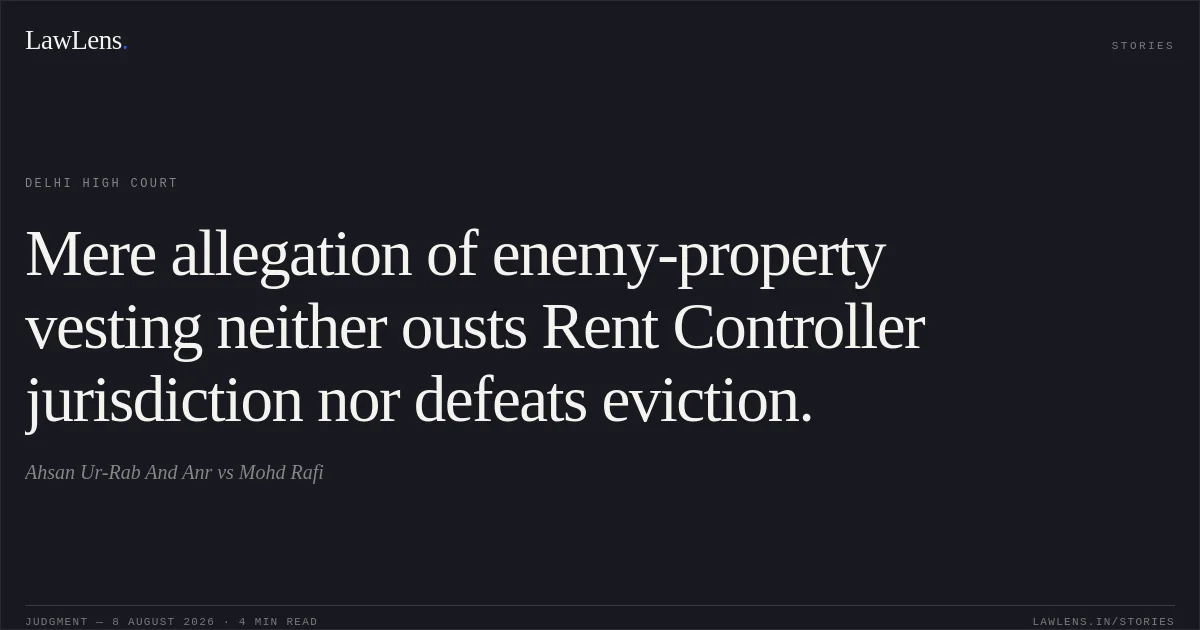
Source reference: para. 15; pp.7–8A mere assertion of enemy-property vesting does not, without adjudication or enforcement by the competent authority, defeat the landlord’s eviction proceedings or require the Rent Controller to decide complicated title questions.
Source reference: paras. 16, 20–23; pp.8–10Reasoning
The High Court found that the Petitioners had admitted that their predecessors were inducted as tenants by the erstwhile owners and that the Respondent relied upon a registered sale deed forming part of the acknowledged chain of title.
Source reference: paras. 15–18; pp.5–9Applying the settled standard under Section 14(1)(e), the Court held that the Respondent was required only to show a better title than the Petitioners, which he had done.
Source reference: no citationThe Petitioners’ plea that the property had vested in the Government as enemy property raised a disputed question of title, but the mere existence of that plea did not automatically extinguish the Respondent’s right to maintain the eviction petition or deprive the ARC of jurisdiction.
Source reference: paras. 19–23; pp.9–10If the Custodian of Enemy Property claimed an independent right or sought possession, the appropriate remedy was to initiate proceedings before the competent forum; the ARC was not required to adjudicate such complicated title questions in the summary eviction proceedings.
Source reference: paras. 20–23; pp.9–10Further, having accepted tenancy under the erstwhile owners, the Petitioners could not rely on the alleged superior title of the Government to deny the Respondent’s entitlement in the pending tenancy proceedings, particularly in view of tenant estoppel under Section 116 of the Evidence Act.
Source reference: paras. 22–23; p.10Since the ARC had considered and rejected the jurisdictional objection through a legally permissible reasoning process, no ground for revisional interference was established.
Source reference: para. 24; pp.10–11Holding
The Court held that the alleged enemy-property status of the premises did not, by itself, oust the jurisdiction of the learned ARC or prevent the Respondent from maintaining the eviction petition.
The Respondent had established a title superior to that of the Petitioners, which was sufficient for proceedings under Section 14(1)(e) of the DRC Act.
Source reference: paras. 18–24; pp.9–11The impugned order disclosed no jurisdictional error, material illegality, perversity, or error apparent on the face of the record warranting interference under Section 25-B(8).
Source reference: paras. 18–24; pp.9–11The revision petition was accordingly dismissed, and all pending applications were also dismissed.
Source reference: paras. 25–26; p.11Acts & Sections Cited
2 provisions across 2 statutes referred to in this judgment. Each provision opens on LawLens.
delhi rent control act, 19581
Bharatiya Sakshya Adhiniyam, 20231
Original Court PDF
Ahsan Ur-Rab And AnrvsMohd Rafi
Click to open original judgment
Original judgment, available to read, download and summarize on LawLens.in