Facts
The Petitioner, an election consultant, sought to quash FIR No. 94 of 2020 registered at Patliputra P.S. for offences under Sections 467, 468, 471, 420, 406, and 120-B of the IPC.
Source reference: para. 1The Informant (Respondent No. 6) alleged that a former associate, Osama Khurshid, stole a laptop containing intellectual property regarding a political campaign titled "Bihar Ki Baat".
Source reference: para. 2It was alleged that the Petitioner, acting as a conspirator, used this stolen data to launch a similar campaign titled "Baat Bihar Ki".
Source reference: para. 38The Petitioner contended the data was sourced from public records and that the dispute was civil/commercial in nature.
Source reference: para. 4-5Procedurally, the Informant had also filed a civil title suit on the same facts.
Source reference: para. 11Issues
1. Whether the allegations in the FIR prima facie satisfy the essential ingredients of forgery and cheating under Sections 420, 467, 468, and 471 of the IPC.
Source reference: para. 41, 452. Whether "intellectual property" such as political campaign themes and publicly sourced data can be the subject of theft or criminal protection under the IPC.
Source reference: para. 52-533. Whether the continuation of criminal proceedings constitutes an abuse of process when a civil remedy has already been invoked.
Source reference: para. 54-55Law Applied
"forgery" requires the creation of a "false document" as defined in Section 464 IPC—meaning the accused must have executed a document claiming to be someone else or tampered with an existing one.
Source reference: para. 39-40, 43Regarding cheating, it relied on Vesa Holdings (P) Ltd. v. State of Kerala (2015), requiring evidence of deception and dishonest inducement at the inception.
Source reference: para. 43copyright does not subsist in an idea, theme, or title, but only in the specific expression thereof.
Source reference: para. 50, 51Reasoning
The Court observed that the basic requirement for Sections 467, 468, and 471 was absent because the Petitioner did not "make" or "execute" any false document; he was merely accused of using existing data.
Source reference: para. 41Regarding Section 420, the Court found no evidence of "deception at inception" or "inducement" because there was no transaction between the Informant and the Petitioner; the laptop was allegedly taken by a third party (Osama).
Source reference: para. 45-46The Court noted that the data—sourced from census and economic surveys—lacked the "novelty" or "originality" required for intellectual property protection.
Source reference: para. 53Since the campaign concept was an "incorporeal idea," it could not be the subject of theft under IPC.
Source reference: para. 52The Court concluded the Informant was attempting to give a "criminal colour" to a dispute for which he had already sought civil recourse.
Source reference: para. 54Holding
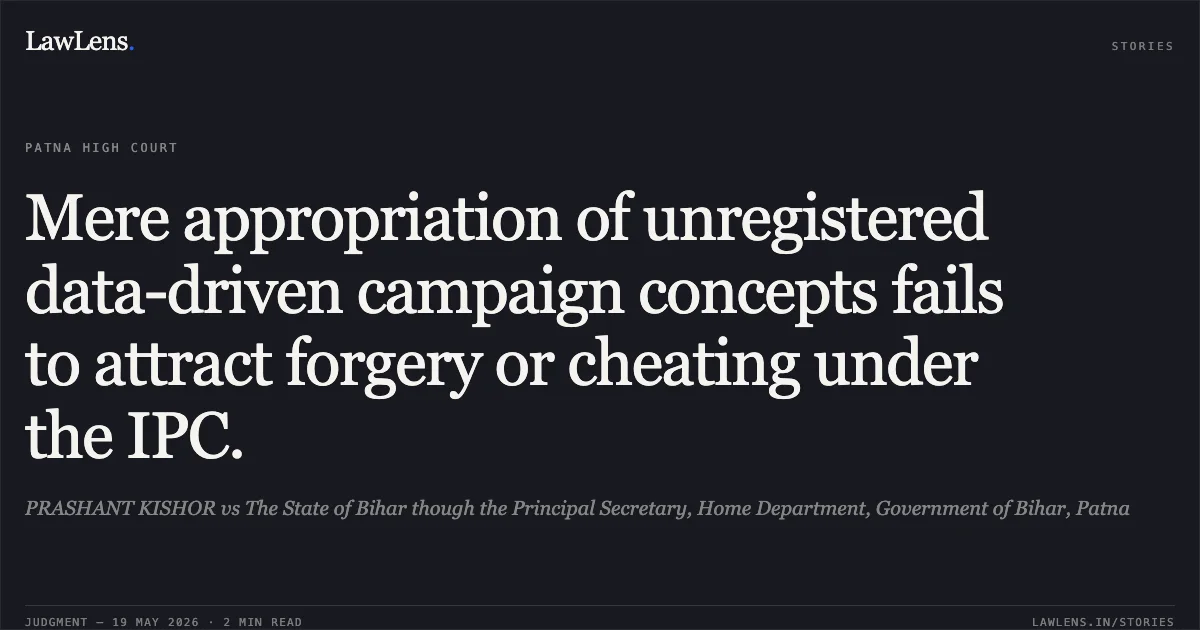
The Court answered the issues in the negative, holding that the FIR failed to disclose a cognizable offence against the Petitioner.
The Court held that the phrase "intellectual property" cannot be used as an "incantation" to invoke criminal law for what is essentially an unprotected idea. Consequently, the High Court allowed the petition and quashed Patliputra P.S. Case No. 94 of 2020 and all consequential proceedings against the Petitioner to prevent the abuse of the process of law.
Source reference: para. 53, 55Acts & Sections Cited
20 provisions across 3 statutes referred to in this judgment. Each provision opens on LawLens.
Indian Penal Code, 1860
Code of Criminal Procedure, 19733
Copyright Act, 19571
Original Court PDF
PRASHANT KISHORvsThe State of Bihar though the Principal Secretary, Home Department, Government of Bihar, Patna
Click to open original judgment
Original judgment, available to read, download and summarize on LawLens.in


