Facts
Respondent No. 2 lodged an FIR against the applicant and other accused persons alleging that Aiyaz had entered into an agreement to sell land with him on 13 May 2013 and had received ₹20 lakhs as earnest money.
Source reference: para. 2(i)It was alleged that the accused subsequently cheated him and threatened him when he demanded return of his money.
Source reference: para. 2(i)The FIR was registered on 18 September 2014 under Sections 420, 406, 506 and 120-B IPC.
Source reference: para. 2(ii)After investigation, the police filed a charge-sheet, and the Additional Chief Judicial Magistrate, Roorkee, passed the summoning order dated 11 May 2015.
Source reference: para. 2(iii)The applicant invoked Section 482 CrPC seeking quashing of the charge-sheet, summoning order and criminal proceedings.
Source reference: para. 3He contended that he was merely a witness to the agreement to sell, was neither a beneficiary nor a recipient of any money, and had no criminal role.
Source reference: para. 3It was further submitted that a sale deed had subsequently been executed by Aiyaz in favour of Suleman on 8 July 2013 pursuant to the agreement.
Source reference: paras. 4–5The State also fairly conceded that the applicant was merely a witness to the agreement to sell.
Source reference: para. 6Issues
Whether the criminal proceedings under Sections 420, 406, 506 and 120-B IPC against the applicant, who was allegedly only a witness to the agreement to sell, disclosed any criminal offence warranting his prosecution?
Source reference: paras. 3, 6–8Whether continuation of the charge-sheet, summoning order and criminal proceedings against the applicant amounted to an abuse of the process of law, justifying exercise of inherent jurisdiction under Section 482 CrPC?
Source reference: paras. 8–10Law Applied
The Court applied Section 482 of the Code of Criminal Procedure, 1973, which preserves the High Court’s inherent power to quash criminal proceedings where such intervention is necessary to prevent abuse of the process of law or otherwise secure the ends of justice.
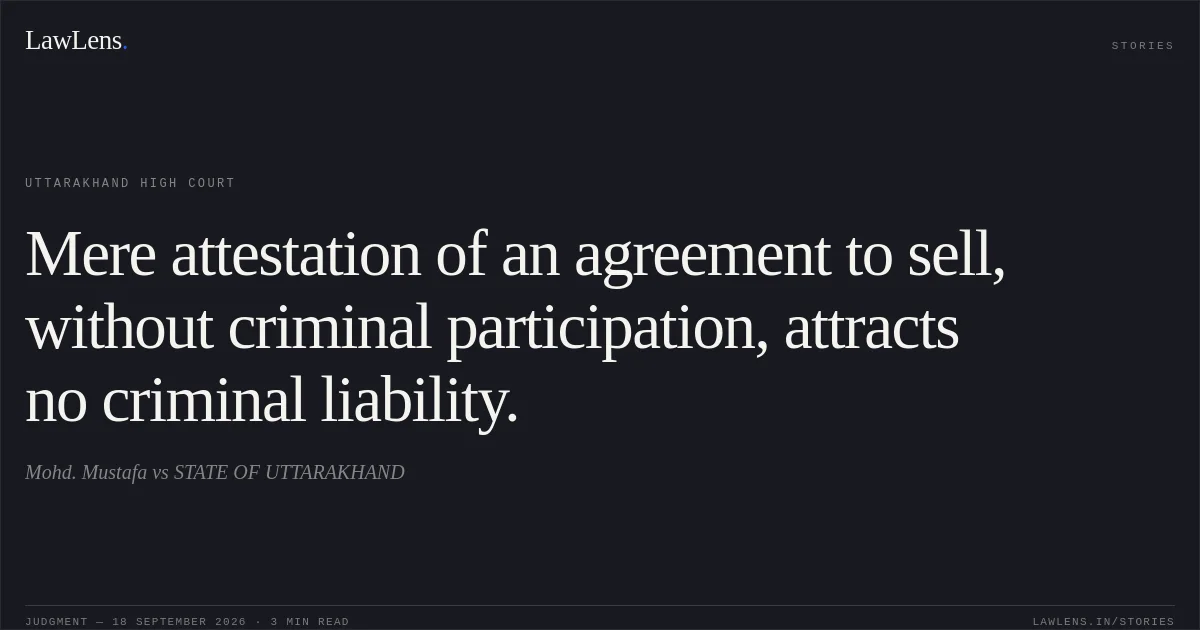
Source reference: paras. 9–10The Court considered the ingredients of the offences alleged under Sections 420, 406, 506 and 120-B IPC and held that mere presence as a witness to an agreement to sell, without evidence of receipt of money, benefit, dishonest inducement, criminal breach of trust, threat or participation in a conspiracy, does not attract criminal liability.
Source reference: paras. 7–8It also recognised that a dispute arising from land dealings, particularly where the transaction had culminated in execution of a sale deed, was essentially civil in nature on the facts presented.
Source reference: para. 8Reasoning
The Court examined the agreement to sell and found that the applicant’s role was confined to being a witness; he was not a party or beneficiary to the transaction and had not received any amount.
Source reference: para. 3The subsequent execution of the sale deed by Aiyaz in favour of Suleman further undermined the allegation that the applicant had participated in the alleged cheating or breach of trust.
Source reference: paras. 4–5, 7Since the allegations and material did not disclose any substantive criminal conduct by the applicant, and the dispute principally concerned recovery of money arising from a land transaction, the Court concluded that continuation of the prosecution against him would constitute an abuse of process.
Source reference: para. 8The State’s concession that the applicant was merely a witness reinforced this conclusion.
Source reference: para. 6Holding
The Court held that no criminal offence was made out against Mohd. Mustafa merely because he had witnessed the agreement to sell.
Exercising its inherent jurisdiction under Section 482 CrPC, the Court quashed the charge-sheet dated 30 March 2015, the summoning order dated 11 May 2015, and the entire proceedings in Criminal Case No. 1154 of 2015 arising from Case Crime No. 337 of 2014, insofar as they related to the applicant.
Source reference: paras. 9–12The application was accordingly allowed.
Source reference: para. 12Acts & Sections Cited
4 provisions across 2 statutes referred to in this judgment. Each provision opens on LawLens.
Code of Criminal Procedure, 19731
Indian Penal Code, 18603
Original Court PDF
Mohd. MustafavsSTATE OF UTTARAKHAND
Click to open original judgment
Original judgment, available to read, download and summarize on LawLens.in