Facts
M/s CPS Security Private Limited provided security agency and manpower supply services and was registered under the service-tax regime.
Source reference: paras. 2–4, p. 2Based principally on information obtained through Form 26AS and comparison with the assessee’s financial records, the Department alleged non-payment of service tax on receipts for October 2014 to June 2017.
Source reference: paras. 2–4, p. 2A show-cause notice dated 29.09.2020 was issued invoking the extended limitation period under the proviso to Section 73(1) of the Finance Act, 1994.
Source reference: paras. 2–4, p. 2The adjudicating authority confirmed taxable receipts of ₹3,25,92,597 and service-tax demand of ₹49,38,552, along with interest, equivalent penalty under Section 78, penalties under Section 77, and late fee.
Source reference: para. 5, pp. 2–3The Commissioner (Appeals) initially dismissed the assessee’s appeal on limitation. On remand by the Tribunal, the Commissioner (Appeals), by order dated 30.01.2026, again rejected the appeal and upheld the adjudication order.
Source reference: paras. 6–7, pp. 3–4Issues
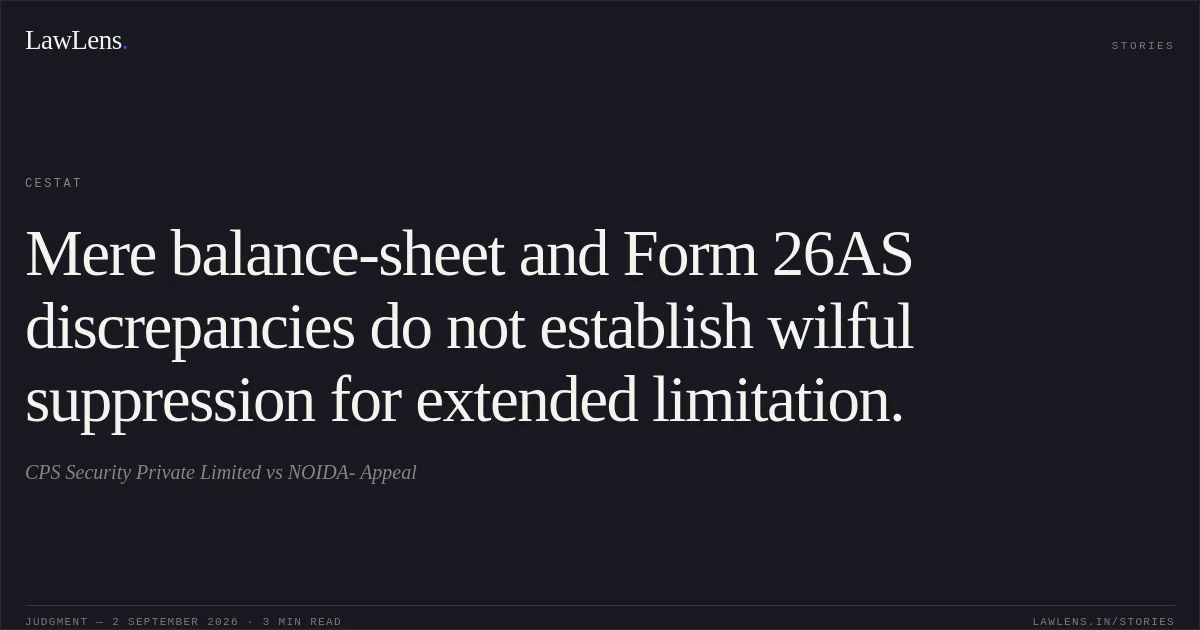
Whether the extended period of limitation under the proviso to Section 73(1) of the Finance Act, 1994 could be invoked merely on the basis of differences between the balance sheet, profit and loss account, and Form 26AS, without proof of wilful suppression or intent to evade service tax?
Source reference: paras. 12–14, pp. 5–10Whether the service-tax demand was sustainable when the Department adopted taxable values from different sources for different periods without reconciling the balance-sheet figures with Form 26AS data?
Source reference: para. 15, p. 10Whether remuneration paid to the directors, accounted for as salary and disclosed as salary income in their individual income-tax returns, could be treated as consideration for a taxable service?
Source reference: para. 16, pp. 10–11Law Applied
The Tribunal applied the proviso to Section 73(1) of the Finance Act, 1994, under which the extended limitation period requires fraud, collusion, wilful misstatement, suppression of facts, or contravention with intent to evade tax; mere omission or non-disclosure is insufficient.
Source reference: para. 14, pp. 7–10Relying on Pushpam Pharmaceuticals Co. v. Collector of Central Excise, Anand Nishikawa Co. Ltd. v. Commissioner of Central Excise, and Uniworth Textile Ltd. v. Commissioner of Central Excise, the Tribunal held that suppression must be deliberate, wilful, and intended to evade payment of duty or tax.
Source reference: para. 14, pp. 7–10It also followed International Air Charter v. Commissioner of Central Tax (Appeals-II), Delhi, which held that mere non-disclosure of receipts in service-tax returns does not establish intent to evade and cannot, by itself, justify extended limitation.
Source reference: para. 14, pp. 5–10The Tribunal referred to Firm Foundation and Housing Pvt. Ltd. v. Principal Commissioner of Service Tax and Sigma Trade Wings v. Commissioner of Central Excise, which held that reliance solely on profit and loss accounts or similar income-tax records is insufficient for confirming service-tax liability without proper evidentiary support.
Source reference: para. 17, p. 11It further applied Section 65B(44)(b) of the Finance Act, 1994, under which a relationship of employer and employee and remuneration in the nature of salary is excluded from the definition of “service”.
Source reference: paras. 8–9, pp. 4–5Reasoning
The Tribunal found that the Department’s case was based on differences noticed between the assessee’s financial statements and Form 26AS, but no independent or corroborative evidence established that the assessee had deliberately concealed receipts or intended to evade service tax.
Source reference: paras. 12–13, p. 5Since the assessee’s statutory records were available to the Department, the alleged omission did not amount to wilful suppression under the settled principles in Pushpam Pharmaceuticals, Anand Nishikawa, and Uniworth Textile.
Source reference: para. 14, pp. 7–10The demand was also considered defective because the adjudicating authority used balance-sheet turnover for one period and Form 26AS figures for other periods without reconciling the two sources.
Source reference: para. 15, p. 10Further, the director remuneration was recorded as salary, subjected to salary-based tax treatment, and disclosed as salary income by the directors in their individual returns; it therefore represented employer–employee remuneration excluded from taxable “service” under Section 65B(44)(b).
Source reference: para. 16, pp. 10–11In these circumstances, the extended limitation could not be sustained and the consequential demand and penalties were unsustainable.
Source reference: paras. 12–16, pp. 5–11Holding
The Tribunal held that the extended period of limitation was impermissible because the Department failed to prove deliberate and wilful suppression of facts with intent to evade service tax.
It further held that the demand lacked a reliable basis because the Department had not reconciled the balance-sheet and Form 26AS figures, and that salary remuneration paid to the directors was not taxable service.
Source reference: paras. 15–16, pp. 10–11The impugned Order-in-Appeal dated 30.01.2026 was set aside, the appeal was allowed, and consequential relief was granted to the appellant.
Source reference: para. 18, p. 11Acts & Sections Cited
2 provisions across 2 statutes referred to in this judgment. Each provision opens on LawLens.
Central Goods and Services Tax Act, 20171
Central Excise Act, 19441
Original Court PDF
CPS Security Private LimitedvsNOIDA- Appeal
Click to open original judgment
Original judgment, available to read, download and summarize on LawLens.in