Facts
Respondent No. 4 lodged FIR No. 5 of 2024 at Police Station Jhandutta, Bilaspur, under Sections 420 and 120-B IPC, alleging that petitioner No. 2, Shilpa Kumari, had obtained appointment as a Staff Nurse in the Health Department by relying on a forged or improperly obtained BPL/IRDP certificate.
Source reference: paras. 2–5The prosecution alleged that petitioner No. 1’s son had obtained private employment in 2018 and was earning approximately ₹13 lakh per annum, rendering the family ineligible for BPL status, yet the family continued to remain on the BPL list until 30 November 2023.
Source reference: paras. 2–5The police completed investigation and filed the charge-sheet before the petitioners invoked Section 528 BNSS seeking quashing of the FIR and consequential proceedings.
Source reference: para. 6The petitioners contended that the BPL certificate had been issued by the competent Gram Panchayat, which was aware of the family circumstances, and that the FIR had been initiated due to matrimonial discord between respondent No. 4’s son and the petitioner’s relative.
Source reference: para. 7The Gram Panchayat subsequently clarified that the family had been permitted to remain in the BPL category because petitioner No. 1 was also caring for two orphaned minor children of his deceased brother and sister-in-law.
Source reference: paras. 7, 19–20Issues
1. Whether the allegations in the FIR and the material collected during investigation prima facie disclosed the offences of cheating under Section 420 IPC and criminal conspiracy under Section 120-B IPC.
Source reference: paras. 18, 21–252. Whether the High Court should exercise its inherent jurisdiction under Section 528 BNSS to quash the FIR and consequential criminal proceedings where the BPL certificate was issued by the competent authority and the proceedings allegedly arose from a private matrimonial dispute.
Source reference: paras. 11–18, 24–27Law Applied
The Court exercised the inherent jurisdiction preserved under Section 528 BNSS, corresponding to Section 482 CrPC, to prevent abuse of the process of court and secure the ends of justice, relying on State of Karnataka v. L. Muniswamy, 1977 (2) SCC 699.
Source reference: para. 12It applied the categories in State of Haryana v. Bhajan Lal, 1992 Supp (1) SCC 335, particularly where the allegations, even if accepted in entirety, do not constitute an offence, where the uncontroverted material fails to disclose commission of an offence, or where proceedings are manifestly mala fide and instituted to wreak vengeance.
Source reference: paras. 13, 17The Court also relied on Vineet Kumar v. State of U.P., Prashant Bharti v. State (NCT of Delhi), (2013) 9 SCC 293, Rajiv Thapar v. Madan Lal Kapoor, (2013) 3 SCC 330, Anand Kumar Mohatta v. State (NCT of Delhi), AIR 2019 SC 210, Pramod Suryabhan Pawar v. State of Maharashtra, (2019) 9 SCC 608, and B.N. John v. State of U.P., 2025 SCC OnLine SC 7, on cautious exercise of the quashing power.
Source reference: paras. 13–17Sections 415 and 420 IPC require deception and fraudulent or dishonest inducement, including dishonest intention from the inception; Section 420 further requires the consequential delivery or retention of property or an act or omission causing or likely to cause harm.
Source reference: paras. 21–23Reasoning
The Court found that the BPL certificate used by petitioner No. 2 had been issued by the competent Gram Panchayat and that the prosecution did not allege that the certificate itself was forged or fraudulently procured.
Source reference: para. 20The Gram Panchayat had not complained that petitioner No. 1 or his family had deceived it; rather, its subsequent certificate indicated that it was aware of the family’s circumstances and had continued the BPL benefit because petitioner No. 1 was caring for two orphaned children.
Source reference: paras. 19–20, 22Although the family may have become ineligible under the applicable income criteria after 2018, the question of inclusion or exclusion from the BPL list was governed by the prescribed administrative procedure and fell primarily within the competence of the Gram Panchayat.
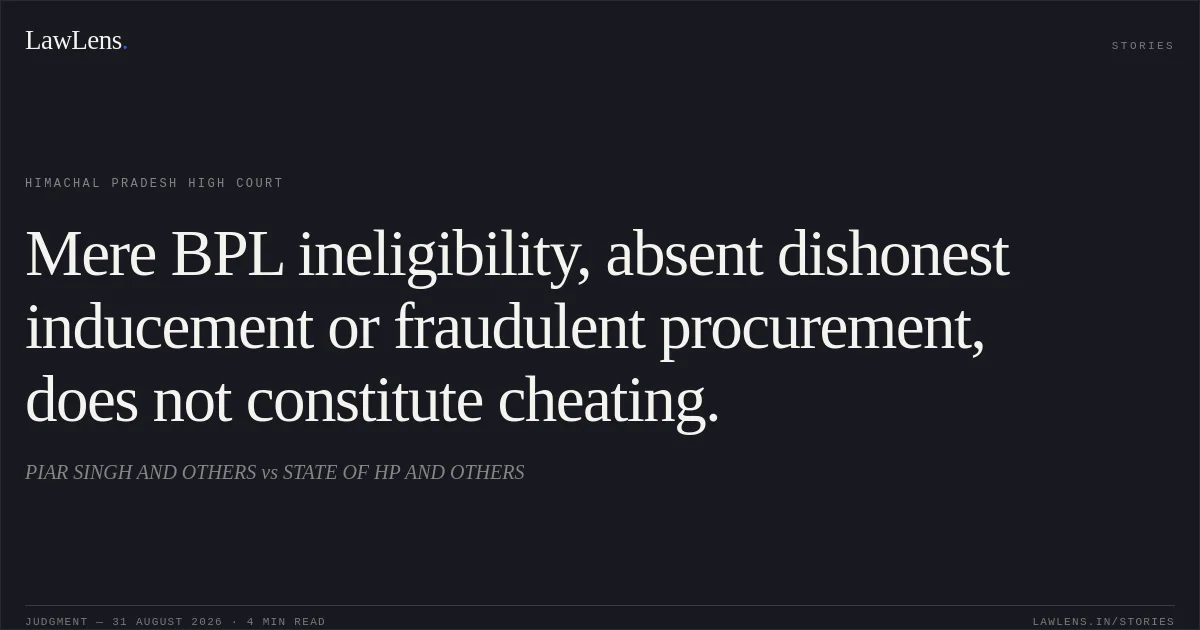
Source reference: para. 20The Court therefore held that ineligibility or continued administrative inclusion in the BPL list, without proof of deception or dishonest inducement at the time of issuance, did not satisfy the ingredients of Section 420 IPC.
Source reference: paras. 22–23The Court further considered the timing and circumstances of the complaint, noting the matrimonial dispute involving the parties’ relatives, and concluded that the criminal proceedings appeared to have been instituted to exert pressure and wreak vengeance.
Source reference: paras. 24–25Continuing the prosecution in these circumstances would amount to an abuse of process, falling within the Bhajan Lal principles.
Source reference: paras. 25–27Holding
The High Court answered the issues in favour of the petitioners, holding that the allegations and collected material did not disclose the offences under Sections 420 or 120-B IPC and that the proceedings were manifestly vexatious and mala fide.
Exercising jurisdiction under Section 528 BNSS, the Court allowed the petition and quashed FIR No. 5 of 2024 dated 8 January 2024, registered at Police Station Jhandutta, Bilaspur, together with all consequential proceedings.
Source reference: paras. 25–28The Court also recorded that the petitioners stood acquitted of the charges framed against them and disposed of all pending applications.
Source reference: para. 28Acts & Sections Cited
7 provisions across 4 statutes referred to in this judgment. Each provision opens on LawLens.
Bharatiya Nagarik Suraksha Sanhita, 20231
Indian Penal Code, 18602
Hindu Marriage Act, 19551
Code of Criminal Procedure, 19733
Original Court PDF
PIAR SINGH AND OTHERSvsSTATE OF HP AND OTHERS
Click to open original judgment
Original judgment, available to read, download and summarize on LawLens.in