Facts
The Petitioners in WP 1284/2013 ("Chougule and others") are directors/officers of Champagne Indage Limited (CIL).
Source reference: para. 3.1In 2008, CIL entered into an agreement with Indapur Winery Society to lift wine stock, agreeing to pay 50% in advance and the balance within 45 days of lifting.
Source reference: paras 3.1-3.2Respondent Jadhav filed an FIR (C.R. No. 88/2011) alleging that despite lifting 32,000 liters of wine valued at ₹42,81,567/-, CIL paid nothing, changed its corporate name to Indage Vintners Limited (IVL), and disposed of the stock with dishonest intent to cheat.
Source reference: paras 3.2-4.1Chougule and others sought to quash the FIR, arguing it was a commercial dispute.
Source reference: para 1Conversely, Jadhav filed WP 2415/2017 seeking to transfer the investigation to the CID, Pune.
Source reference: para 1.1Issues
1. Whether the FIR discloses the necessary ingredients of cheating and criminal breach of trust under Sections 420 and 407 of the IPC to sustain a criminal investigation.
Source reference: para 4.12. Whether the criminal proceedings were maliciously instituted as a tool for debt recovery in a purely contractual dispute.
Source reference: para 123. Whether the investigation should be transferred to a specialized agency like the CID.
Source reference: para 1.1Law Applied
The court primarily applied the principles for quashing an FIR established in State of Haryana v. Bhajan Lal, which allow for the exercise of inherent powers where allegations, even if taken at face value, do not constitute an offence or where proceedings are maliciously instituted with an ulterior motive.
Source reference: para 10It applied the distinction between a breach of contract and the offence of cheating (Section 420 IPC), requiring dishonest intent at the inception as per Vesa Holdings P. Ltd. v. State of Kerala.
Source reference: para 4.2It further relied on Maksud Saiyed v. State of Gujarat regarding the lack of vicarious liability for directors in the absence of specific allegations.
Source reference: para 4.7It further relied on K.D. Sharma v. Steel Authority of India regarding the effect of suppressing material facts.
Source reference: para 9Reasoning
The court observed that the FIR lacked specific particulars regarding the roles of individual directors and failed to demonstrate fraudulent intent at the time the agreement was signed.
Source reference: para 6.1Crucially, the court found that the complainant suppressed a 2010 communication showing they were aware of CIL’s name change and financial crisis, and ignored an offer by the company to return the goods.
Source reference: paras 7-8The court noted the "mechanical and unreliable nature" of the allegations, as the FIR named a person who had died before the agreement was even executed and another who had resigned years prior.
Source reference: paras 4.8, 11-12The court determined that the dispute was purely contractual and that criminal law was being invoked solely to pressure the directors for the recovery of dues.
Source reference: para 12Holding
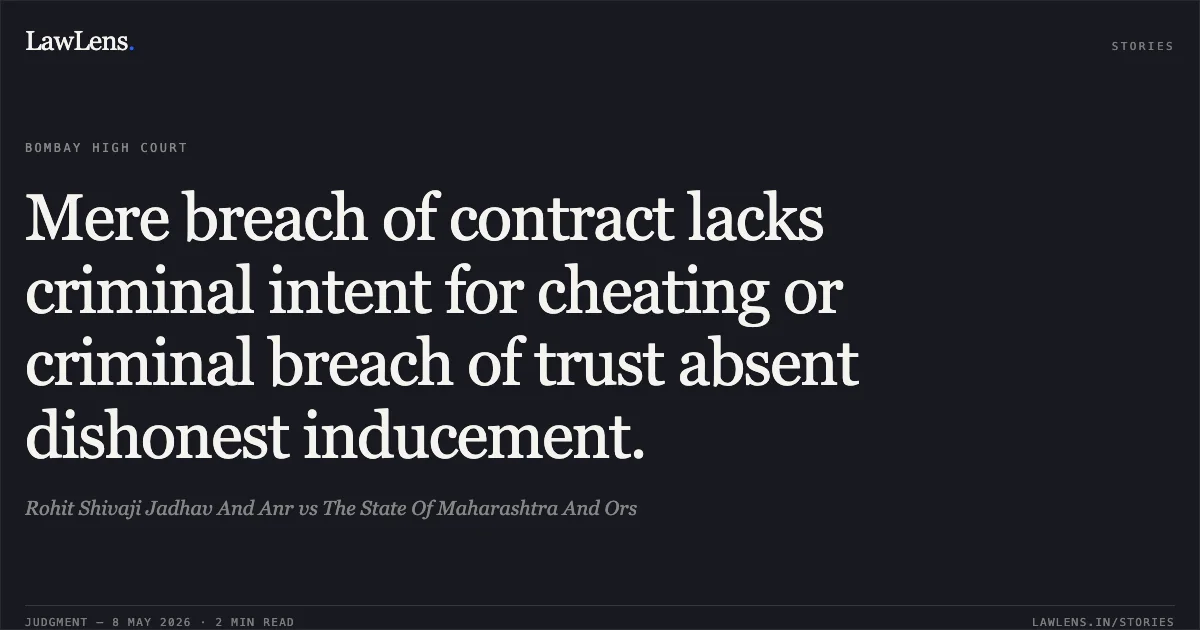
The High Court allowed Writ Petition No. 1284 of 2013 and quashed the investigation in C.R. No. 88 of 2011.
The court held that the allegations did not prima facie constitute a cognizable offence and were attended by mala fides. Consequently, Writ Petition No. 2415 of 2017 seeking the transfer of the investigation was dismissed.
Source reference: paras 13-14Acts & Sections Cited
6 provisions across 2 statutes referred to in this judgment. Each provision opens on LawLens.
Indian Penal Code, 18603
Code of Criminal Procedure, 19733
Original Court PDF
Rohit Shivaji Jadhav And AnrvsThe State Of Maharashtra And Ors
Click to open original judgment
Original judgment, available to read, download and summarize on LawLens.in