Facts
The petitioner, an automotive body technician operating as “New Pragati Coach, Indore,” was entrusted by respondent No. 2 with three Ashok Leyland bus chassis for construction of Sleeper AC Coaches.
Source reference: paras. 3–4The parties entered into contractual arrangements dated 20 July 2024 and 10 March 2025, under which respondent No. 2 paid approximately ₹55,13,290 against an agreed consideration of ₹75,00,000.
Source reference: paras. 3–4Respondent No. 2 lodged FIR No. 14/2025 dated 2 March 2025 under Section 318(4) of the Bharatiya Nyaya Sanhita, 2023 (“BNS”), alleging failure to complete and deliver the vehicles despite receipt of substantial payment.
Source reference: para. 5The petitioner was arrested on 12 April 2025 and later released on bail. After investigation, the police filed a final report dated 8 June 2025, and the Judicial Magistrate took cognizance on 10 June 2025 in RCC No. 1103/2025.
Source reference: para. 5Issues
Whether the allegations arising from the parties’ contractual dispute disclosed the essential ingredients of cheating under Section 318(4) of the BNS, particularly fraudulent or dishonest intention at the inception of the transaction?
Source reference: paras. 15–17Whether continuation of the criminal proceedings, in circumstances suggesting a predominantly commercial dispute involving delay or non-performance, amounted to an abuse of the process of law warranting exercise of inherent jurisdiction under Section 528 of the BNSS?
Source reference: paras. 20–21Law Applied
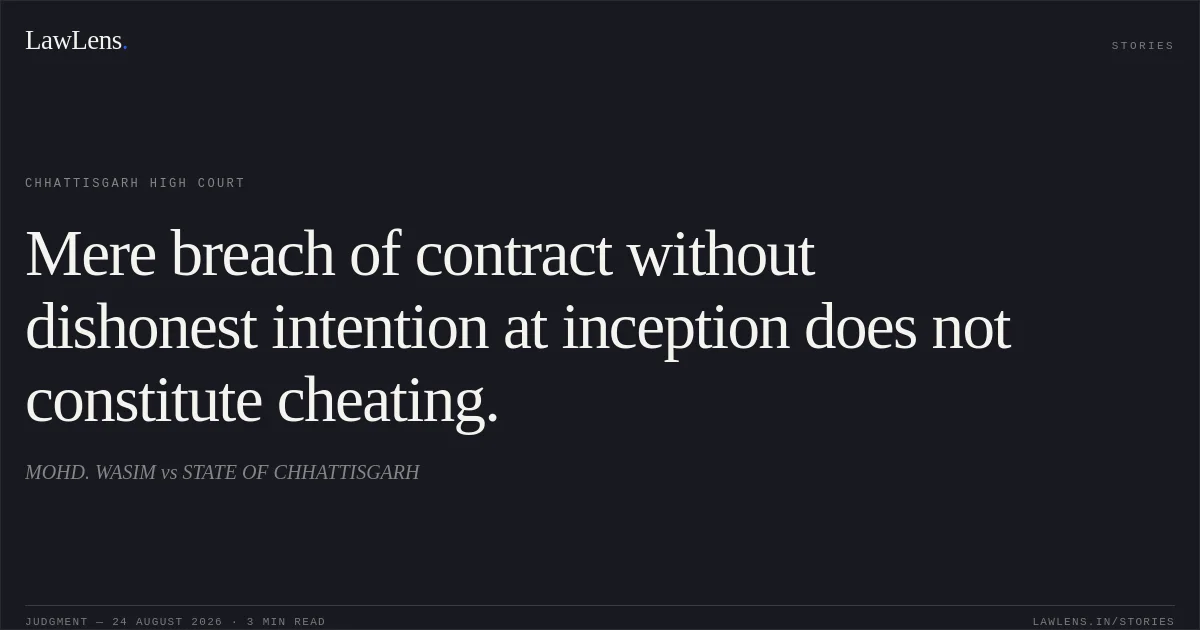
Section 318(4) of the BNS requires the foundational elements of cheating, including fraudulent or dishonest intention at the time of making the representation or entering into the transaction; mere subsequent failure to perform a contract does not, by itself, constitute cheating.
Source reference: paras. 15, 18Under Section 528 of the BNSS, the High Court may quash criminal proceedings where the allegations and material, even if accepted at face value, do not disclose the essential ingredients of the alleged offence or where continuation of the prosecution would amount to abuse of process.
Source reference: para. 21Relying on Indian Oil Corporation v. NEPC India Ltd., (2006) 6 SCC 736, the Court reiterated that purely civil or commercial disputes should not be given a criminal colour.
Source reference: para. 19Relying further on Vesa Holdings (P) Ltd. v. State of Kerala, (2015) 8 SCC 293, and Mitesh Kumar J. Sha v. State of Karnataka, (2022) 14 SCC 572, the Court held that every breach of contract is not cheating and that criminal proceedings cannot be used to exert pressure in a predominantly civil or commercial dispute.
Source reference: para. 19Reasoning
The Court found that the chassis had been voluntarily entrusted to the petitioner pursuant to admitted contractual arrangements and that respondent No. 2 had made substantial payments towards the agreed work.
Source reference: para. 14The petitioner had accepted the chassis, commenced construction, procured components, and substantially completed the coaches; the vehicles were found in a substantially completed condition.
Source reference: para. 16These circumstances militated against an inference that the petitioner possessed dishonest or fraudulent intention when the transaction was initiated.
Source reference: para. 16The subsequent agreement dated 10 March 2025, entered into while the parties continued their dealings, was also relevant to assessing the absence of initial dishonest intention.
Source reference: para. 17The alleged delayed payments, supply-related difficulties, health issues, and delay in completion constituted disputed matters of contractual performance, potentially remediable through civil proceedings.
Source reference: paras. 17–18The FIR and investigation material did not identify any specific dishonest representation made by the petitioner at the inception of the transaction or show that he had induced respondent No. 2 to part with the chassis or money through deception.
Source reference: paras. 17–18Accordingly, even accepting the allegations at their face value, the essential ingredients of Section 318(4) of the BNS were not established, and continuation of the prosecution would improperly convert a commercial dispute into a criminal case.
Source reference: paras. 20–22Holding
The High Court answered the issues in favour of the petitioner.
It held that the material did not prima facie establish dishonest or fraudulent intention at the inception of the contractual transaction and therefore did not disclose an offence under Section 318(4) of the BNS.
Source reference: para. 22The petition was allowed, and the Court quashed the final report dated 8 June 2025, FIR No. 14/2025, the cognizance order dated 10 June 2025 in RCC No. 1103/2025, and all consequential criminal proceedings qua the petitioner.
Source reference: para. 23The parties were left free to pursue any civil or other remedies available in law, without prejudice to their respective rights and contentions.
Source reference: para. 24Acts & Sections Cited
3 provisions across 3 statutes referred to in this judgment. Linked provisions open on LawLens.
Bharatiya Nyaya Sanhita, 20231
Indian Penal Code, 18601
Bharatiya Nagarik Suraksha Sanhita, 20231
Original Court PDF
MOHD. WASIMvsSTATE OF CHHATTISGARH
Click to open original judgment
Original judgment, available to read, download and summarize on LawLens.in