Facts
On October 9, 2025, a complaint was lodged alleging that Seoni Police personnel intercepted a vehicle and unlawfully misappropriated Rs. 1,45,00,000 out of Rs. 2,96,50,000 being transported.
Source reference: para. 2A preliminary inquiry implicated the petitioner, a police informer, on the grounds that he passed information regarding the cash to a constable (Pramod Soni), who informed a DSP (Pankaj Mishra), who then informed the main accused, SDOP Pooja Pandey.
Source reference: para. 4The petitioner was charged under Sections 310(2) (Dacoity), 126(2) (Wrongful Restraint), 140(3) (Kidnapping), 61(2) (Criminal Conspiracy), and 238(b) (Causing disappearance of evidence) of the Bharatiya Nyaya Sanhita (BNS), 2023.
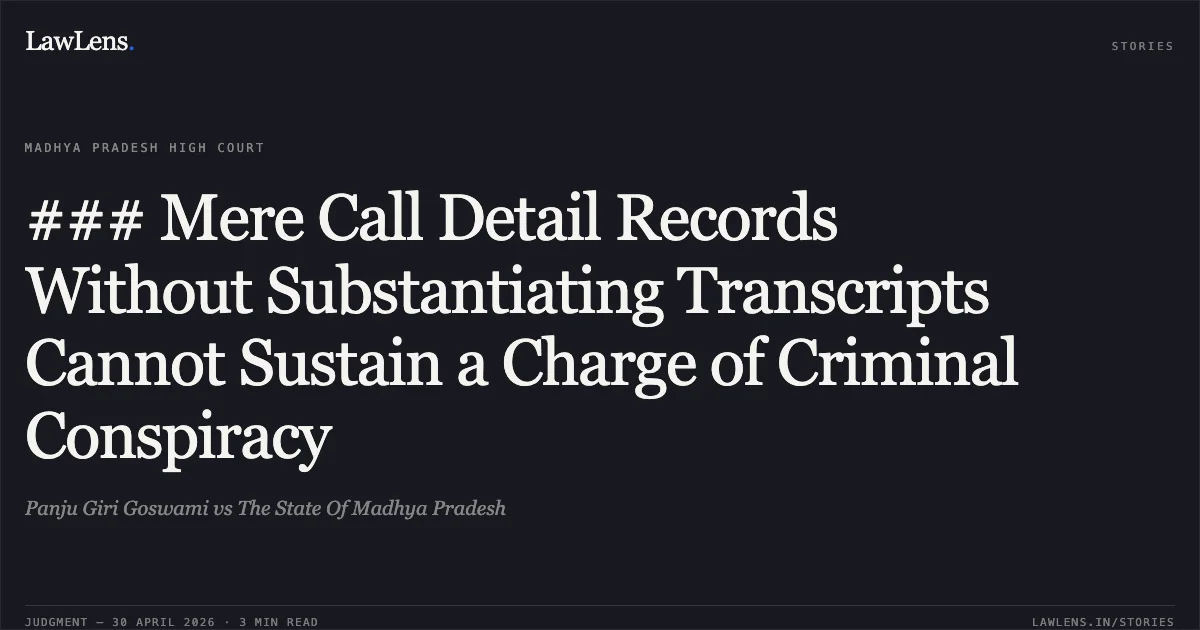
Source reference: para. 1The prosecution's case against the petitioner relied almost exclusively on Call Detail Records (CDR) indicating telephonic contact with the co-accused.
Source reference: para. 4, 12Issues
1. Whether the existence of an alternative statutory remedy of seeking discharge before the Trial Court bars the High Court from exercising its inherent jurisdiction under Section 528 of the BNSS.
Source reference: para. 102. Whether mere telephonic contact evidenced by Call Detail Records (CDR), without evidence of the content of the conversation or meeting of minds, is sufficient to establish a prima facie case of criminal conspiracy.
Source reference: para. 13, 143. Whether the continuation of criminal proceedings against the petitioner based solely on suspicion constitutes an abuse of the process of law.
Source reference: para. 18, 24Law Applied
Section 528 of the Bharatiya Nagarik Suraksha Sanhita (BNSS), 2023 (corresponding to Section 482 of the CrPC) regarding the inherent powers of the High Court to quash proceedings to prevent abuse of process.
Source reference: para. 10Principle from State of Haryana v. Bhajan Lal, establishing that proceedings should be quashed if allegations, even if taken at face value, do not constitute an offence.
Source reference: para. 23Doctrine from Prafulla Kumar Samal v. Union of India, which holds that while a court can sift evidence to see if a prima facie case exists, it must discharge the accused if the material gives rise only to "suspicion" rather than "grave suspicion".
Source reference: para. 18, 19Section 61(2) of the BNS, noting that a "meeting of minds" is a sine qua non for the offence of criminal conspiracy.
Source reference: para. 6, 14Reasoning
The Court observed that the petitioner was not part of the raiding party, was not present at the spot, and no recovery of money was made from him.
Source reference: para. 11, 17The prosecution relied solely on CDRs, which prove the factum of communication but not the substance or "meeting of minds" required for conspiracy under Section 61(2) BNS.
Source reference: para. 13, 20The Court reasoned that acting as an informer by passing information regarding suspicious cash movement is part of a citizen's duty and does not imply dishonest intent.
Source reference: para. 17The Court found no evidence linking the petitioner to the overt acts of kidnapping, dacoity, or wrongful restraint.
Source reference: para. 15Following the Bhajanal Lal and Prafulla Kumar Samal precedents, the Court determined that the evidence created mere suspicion rather than the "grave suspicion" necessary to frame charges, rendering the continuation of trial an exercise in futility and an abuse of process.
Source reference: para. 18-23Holding
The Court held that the existence of an alternative remedy of discharge does not bar Section 528 BNSS jurisdiction when a miscarriage of justice is evident.
CDRs without call transcripts or supporting evidence cannot establish criminal conspiracy.
Source reference: para. 20The petition was allowed, and the FIR (Crime No. 473/2025), charge-sheet, and all consequential proceedings against the petitioner were quashed; the petitioner was discharged from all charges.
Source reference: para. 25Acts & Sections Cited
10 provisions across 3 statutes referred to in this judgment. Each provision opens on LawLens.
Bharatiya Nagarik Suraksha Sanhita, 20231
Bharatiya Nyaya Sanhita, 20235
Code of Criminal Procedure, 19734
Original Court PDF
Panju Giri GoswamivsThe State Of Madhya Pradesh
Click to open original judgment
Original judgment, available to read, download and summarize on LawLens.in