Facts
On 15 June 2008, the appellants allegedly abused and threatened Manohar Harijan, a member of the Damba Scheduled Caste, near his house over a dispute concerning the dumping of garbage and waste on disputed land. The alleged expressions included caste-related abuse and threats to kill him, allegedly in the presence of co-villagers.
Source reference: p.3–4After the police allegedly failed to act on his written report, the complainant instituted a complaint case under Sections 294, 506 and 34 of the IPC read with Section 3(1)(x) of the SC/ST (Prevention of Atrocities) Act.
Source reference: p.3–4The trial court convicted all three appellants and imposed sentences of three months’ simple imprisonment for the IPC offences and six months’ simple imprisonment with fine for the offence under the SC/ST Act.
Source reference: p.3–4The prosecution examined five witnesses, including the complainant and alleged eyewitnesses. The defence pleaded false implication arising from longstanding hostility and multiple civil, revenue and criminal proceedings concerning the disputed land.
Source reference: p.5–8The appeal challenged the conviction and sentence. At the appellate hearing, the appellants’ Amicus Curiae principally contested the SC/ST conviction and, alternatively, sought the benefit of probation, relying on the long pendency of the appeal, the appellants’ advanced age, absence of criminal antecedents and settled lives.
Source reference: p.17–19Issues
Whether the prosecution proved beyond reasonable doubt that the appellants intentionally insulted or intimidated the complainant with intent to humiliate him on account of his Scheduled Caste, in a place within public view, thereby attracting Section 3(1)(x) of the SC/ST (Prevention of Atrocities) Act.
Source reference: p.8–16; para. 8–11Whether the convictions of the appellants under Sections 294 and 506 read with Section 34 of the IPC were sustainable on the evidence.
Source reference: p.16; para. 12Whether, having regard to the nature of the offences, the period already undergone, the appellants’ age, absence of criminal antecedents and the prolonged pendency of the appeal, the appellants should be released on probation under Section 4 of the Probation of Offenders Act, 1958.
Source reference: p.17–21; para. 13–15Law Applied
The Court applied Section 3(1)(x) of the SC/ST (Prevention of Atrocities) Act, which required proof that a person not belonging to a Scheduled Caste or Scheduled Tribe intentionally insulted or intimidated a member of such caste or tribe with intent to humiliate him in a place within public view.
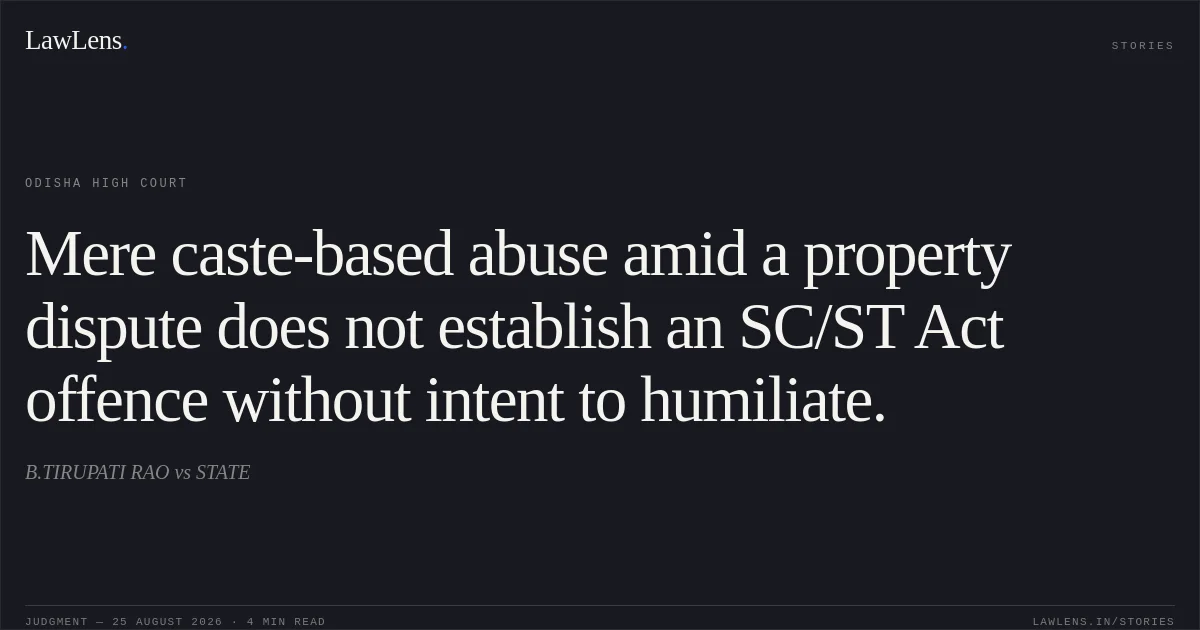
Source reference: p.10–11Relying on Hitesh Verma v. State of Uttarakhand, Criminal Appeal No. 707 of 2020, and the principles in Swaran Singh v. State and Khuman Singh v. State of Madhya Pradesh, the Court held that mere proof of the victim’s Scheduled Caste status and use of caste-related words is insufficient; the prosecution must establish the requisite intention to humiliate on account of caste, rather than a dispute concerning property or possession.
Source reference: p.14–16The Court separately applied Sections 294 and 506 of the IPC to the allegations of obscene abuse and criminal intimidation.
Source reference: no citationFor sentencing, it applied Section 4 of the Probation of Offenders Act, 1958, read with Section 361 of the CrPC, and relied on Chellammal v. State, holding that the sentencing court must consider probation where legally applicable and must give reasons if it declines to grant it.
Source reference: p.19–21The Court also referred to Pathani Parida v. Abhaya Kumar Jagdevmohapatra and Dhani @ Dhaneswar Sahu v. State of Orissa on the appropriateness of probation in comparable circumstances.
Source reference: p.21Reasoning
The Court found that the prosecution witnesses attributed materially different abusive expressions to the appellants: the versions of P.Ws.1, 2, 4 and 5 were inconsistent regarding the precise words allegedly used.
Source reference: p.12–15These discrepancies assumed greater significance because the parties were engaged in persistent and admitted litigation over the disputed land, including civil suits, proceedings under Sections 144/145 CrPC and several complaint cases.
Source reference: p.5–8Applying Hitesh Verma, the Court held that the evidence did not sufficiently establish that the alleged words were uttered with the specific intent to humiliate the complainant because of his caste, as opposed to being part of a land-related altercation.
Source reference: p.14–16The essential ingredients of Section 3(1)(x) were therefore not proved beyond reasonable doubt.
Source reference: p.14–16However, on a conjoint assessment of the evidence, the Court found the findings regarding abusive and threatening conduct sufficient to sustain the convictions under Sections 294 and 506 IPC.
Source reference: p.16On sentence, the Court considered that the occurrence was from 2008, the appeal had remained pending since 2010, the appellants had already undergone approximately thirty-nine days’ incarceration, had no criminal antecedents, and were elderly and settled in life. It accordingly held that probation, rather than further imprisonment, would meet the ends of justice.
Source reference: p.17–21Holding
The appeal was partly allowed.
The appellants’ convictions under Section 3(1)(x) of the SC/ST (Prevention of Atrocities) Act were set aside, and they were acquitted of that charge.
Source reference: p.16; para. 11Their convictions under Sections 294 and 506 read with Section 34 IPC were affirmed.
Source reference: p.16; para. 12Instead of requiring them to undergo the remaining imprisonment, the Court released them under Section 4 of the Probation of Offenders Act for one year, subject to execution of bonds of ₹5,000 each with one surety for the like amount, an undertaking to appear and receive sentence if called upon, maintenance of peace and good behaviour, and supervision by the concerned Probation Officer.
Source reference: p.21–22; para. 15–17The Amicus Curiae was awarded an honorarium of ₹7,500.
Source reference: p.22; para. 18Acts & Sections Cited
12 provisions across 4 statutes referred to in this judgment. Each provision opens on LawLens.
Code of Criminal Procedure, 19736
Indian Penal Code, 18604
Scheduled Castes and the Scheduled Tribes (Prevention of Atrocities) Act, 19891
Probation of Offenders Act, 19581
Original Court PDF
B.TIRUPATI RAOvsSTATE
Click to open original judgment
Original judgment, available to read, download and summarize on LawLens.in
![Courts will not interfere with transfers absent mala fides or violation of statutory rules.. M Ramya vs EMPLOYEES STATE INSURANCE CORPORATION (ESIC). CAT - ['Chennai']. LawLens](/stories/thumbnails/courts-will-not-interfere-with-transfers-absent-mala-fides-or-violation-of-statutory-rules-a6845e9ca6f548fca284c51c8351957f.webp)
![Courts cannot direct one-time recruitment age relaxation absent authority in the governing rules or advertisement.. UT OF PUDUCHERRY vs M ANDAL. CAT - ['Chennai']. LawLens](/stories/thumbnails/courts-cannot-direct-one-time-recruitment-age-relaxation-absent-authority-in-the-governing-895d78fde47143e2a8ed0207c4b6a44f.webp)
![A review cannot correct an allegedly erroneous decision absent an error apparent on the record.. Ajit Kumar Jha vs RAILWAY BOARD. CAT - ['Delhi']. LawLens](/stories/thumbnails/a-review-cannot-correct-an-allegedly-erroneous-decision-absent-an-error-apparent-on-the-re-8ac952fd4eba470c92f7da20af72a220.webp)