Facts
Rajendrakumar Sombhai Thakkar operated a hardware shop at Silver Complex. The prosecution alleged that the accused entered his shop, demanded repayment of money allegedly advanced approximately six years earlier, threw articles from the shop, assaulted and threatened him, following which he jumped from the building and later died from his injuries.
Source reference: paras. 2, 9; pp. 2, 5His wife, Maniramaben Rajendrakumar Thakkar, lodged the complaint. The accused were charged under Sections 306, 323, 452 and 114 of the Indian Penal Code, among other provisions.
Source reference: paras. 1–2; pp. 1–2The trial court acquitted them after recording the prosecution evidence and the accused’s statements under Section 313 of the Code of Criminal Procedure.
Source reference: paras. 3–6; pp. 2–3The State challenged the acquittal under Section 378(1)(3) CrPC.
Source reference: no citationIssues
Whether the trial court’s acquittal was so erroneous, perverse or manifestly illegal as to warrant interference by the High Court in an appeal against acquittal?
Source reference: paras. 14–16, 19–20; pp. 8–12Whether the prosecution proved beyond reasonable doubt that the accused instigated or abetted Rajendrakumar’s suicide, thereby attracting Sections 306 and 107 IPC?
Source reference: paras. 11–13, 18; pp. 7–11Whether the evidence sufficiently established the alleged assault, threats, house-trespass and common liability under Sections 323, 452 and 114 IPC?
Source reference: paras. 9–13, 18–19; pp. 5–12Law Applied
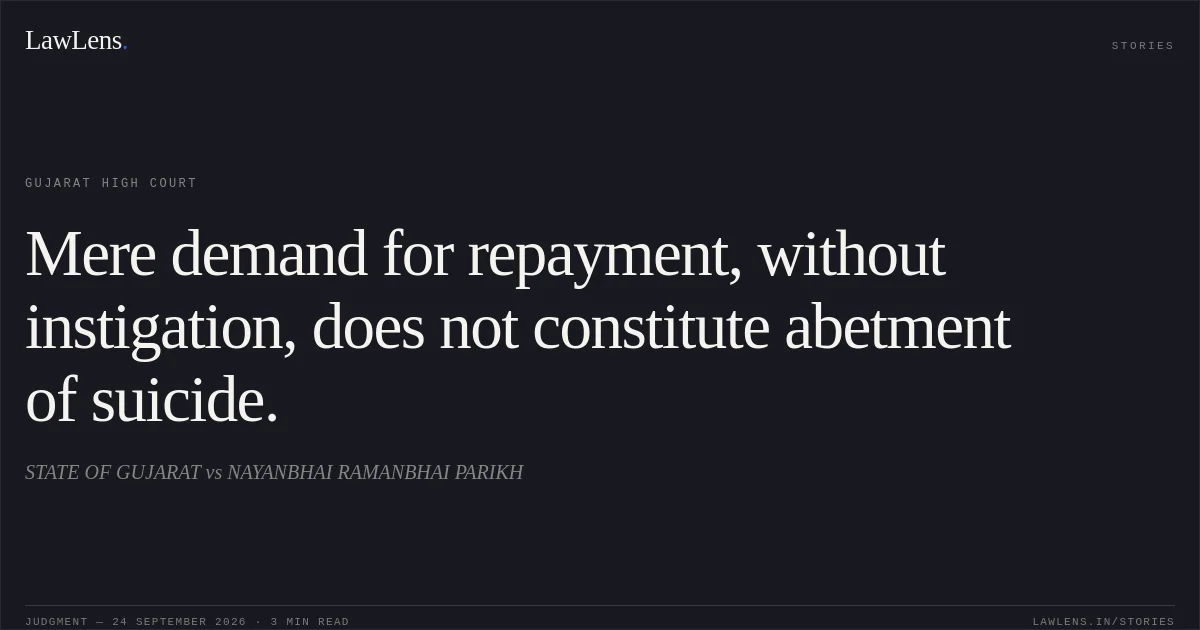
The Court applied Sections 306 and 107 IPC, holding that abetment of suicide requires proof of instigation, intentional aid or active conduct sufficiently connected with the suicide; a mere demand for repayment of money does not, by itself, constitute instigation or abetment.
Source reference: para. 13; p. 7The prosecution was required to establish the charged offences beyond reasonable doubt. In an appeal against acquittal under Section 378 CrPC, the appellate court has power to reappreciate the evidence, but the accused benefit from a double presumption of innocence. Where two reasonable views are possible, the acquittal should not ordinarily be disturbed.
Source reference: paras. 14–16; pp. 8–10These principles were drawn from Chandrappa v. State of Karnataka, (2007) 4 SCC 415; Rajesh Prasad v. State of Bihar, (2022) 3 SCC 471; Babu Sahebagouda Rudragoudar v. State of Karnataka, AIR 2024 SC 2252 / (2024) 8 SCC 149; and Ramesh v. State of Karnataka, (2024) 9 SCC 169.
Source reference: paras. 16–17; pp. 9–11Reasoning
The Court found that the independent witnesses did not support the prosecution and that the case substantially rested on the testimony of the deceased’s wife, whose presence at the shop was considered doubtful and required close scrutiny.
Source reference: para. 10; p. 6The scene panchnama did not corroborate her assertion that goods had been thrown onto the road.
Source reference: para. 10; p. 6The evidence indicated an existing monetary dispute and a demand for repayment, but the Court held that such a demand, without proof of provocation, instigation or intentional aid, could not satisfy Sections 107 and 306 IPC.
Source reference: paras. 11–13; pp. 7–8The alleged documentary material concerning the debt and returned cheque was not properly produced or proved, further weakening the prosecution case.
Source reference: para. 12; p. 7On the totality of the evidence, the prosecution had not established the alleged assault, threats or other charged offences beyond reasonable doubt. Applying the heightened restraint applicable to appeals against acquittal, the Court concluded that the trial court’s view was a reasonable one and not perverse or illegal.
Source reference: paras. 18–19; pp. 11–12Holding
The High Court answered the issues against the State. It held that the prosecution failed to prove that the accused instigated or abetted the deceased’s suicide or committed the other alleged offences beyond reasonable doubt.
Finding no factual or legal error in the trial court’s acquittal, the Court dismissed the State’s appeal and confirmed the judgment and order of acquittal. The accused’s bail bonds were cancelled, and the record and proceedings were ordered to be returned to the trial court.
Source reference: para. 20; p. 12Acts & Sections Cited
7 provisions across 2 statutes referred to in this judgment. Each provision opens on LawLens.
Code of Criminal Procedure, 19732
Indian Penal Code, 18605
Original Court PDF
STATE OF GUJARATvsNAYANBHAI RAMANBHAI PARIKH
Click to open original judgment
Original judgment, available to read, download and summarize on LawLens.in