01Facts
The applicant sought quashing under Section 482 of the Code of Criminal Procedure, 1973, of FIR C.R. No. 11208002200837/2020 registered at Ajidam Police Station, Rajkot, for offences under Sections 306, 387, 506(2) and 114 of the IPC and Sections 5, 40 and 42 of the Gujarat Money-Lenders Act.
p. 1The FIR arose after Prafullbhai Makwana died by suicide by hanging on 20 April 2020.
p. 2A notebook allegedly found at the place of occurrence stated that the deceased had borrowed ₹4,00,000 from the applicant at 5% interest, had repaid ₹7,00,000 including interest, and was nevertheless subjected to continued demands for money.
pp. 3–4The applicant disputed the allegations and relied on a notarised agreement recording that the amount had been advanced without interest and was repayable within six months.
p. 7He also relied on a dishonoured cheque and a pending complaint under Section 138 of the Negotiable Instruments Act against the deceased and his family members.
p. 8The complainant stated that the dispute had been amicably settled and had no objection to quashing, while the State opposed the application on the ground that the allegations involved serious offences.
p. 602Issues
i.Whether the allegations in the FIR and the deceased’s notebook disclosed the ingredients of abetment of suicide under Sections 306 and 107 of the IPC against the applicant?
pp. 5, 7–9ii.Whether the allegations disclosed extortion under Section 387 or criminal intimidation under Section 506(2) of the IPC against the applicant?
p. 9iii.Whether the applicant’s conduct attracted Sections 5, 40 and 42 of the Gujarat Money-Lenders Act?
p. 7, 9iv.Whether continuation of the criminal proceedings against the applicant would amount to an abuse of the process of law warranting exercise of jurisdiction under Section 482 CrPC?
pp. 5, 9–1003Law Applied
The Court applied Section 482 CrPC, which empowers the High Court to quash criminal proceedings to prevent abuse of process and secure the ends of justice.
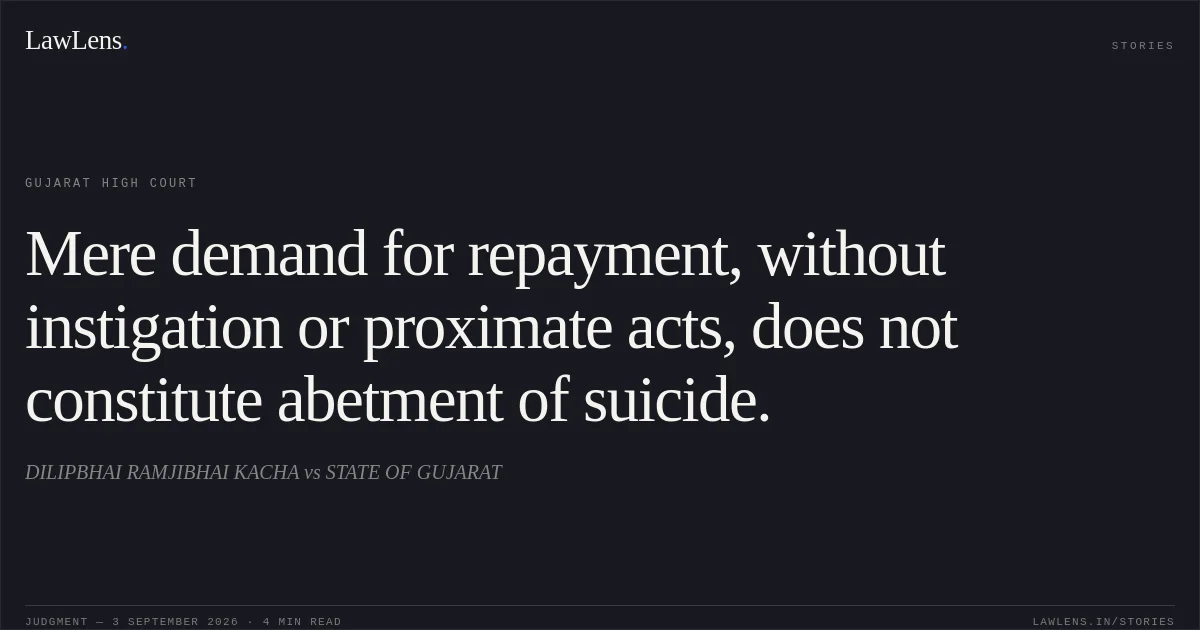
Section 306 IPC, read with Section 107 IPC, requires material indicating instigation, conspiracy or intentional aid constituting abetment of suicide; a mere demand for repayment, without proximate conduct demonstrating abetment, is insufficient.
pp. 5, 8–9Section 387 IPC requires putting a person in fear of death or grievous hurt with the intention of committing extortion, while Section 506(2) IPC requires criminal intimidation involving threats intended to cause alarm.
p. 9The Court relied on Dhirubhai Nanjibhai Patel Notwala v. State of Gujarat & Anr., 2026 LiveLaw (SC) 270, for the principle that repeated demands for repayment, absent evidence of beating or physical assault, do not by themselves constitute abetment of suicide.
p. 8The Court also considered Sections 5, 40 and 42 of the Gujarat Money-Lenders Act, which could not be invoked where the undisputed agreement indicated that the advance was made without interest.
p. 9Provisions in the judgment · 7 · Linked ones open on LawLens
Code of Criminal Procedure, 1973 Section 482
Indian Penal Code, 1860 Section 306Section 387Section 506Section 114Section 107
Negotiable Instruments Act, 1881 Section 138
04Reasoning
The Court found that, insofar as the applicant was concerned, the FIR and notebook contained only a general allegation that he continued demanding repayment after ₹7,00,000 had allegedly been paid; there was no specific allegation of instigation, intentional aid, physical assault or other proximate conduct linking him to the suicide.
p. 7Applying the rule in Dhirubhai Nanjibhai Patel Notwala, the Court held that mere harassment or demands for repayment did not satisfy the requirements of abetment under Sections 306 and 107 IPC.
p. 8The allegations also did not state that the applicant had threatened the deceased with death or grievous hurt, or that he had caused alarm, and therefore Sections 387 and 506(2) IPC were not attracted.
p. 9The notarised agreement, whose existence and execution were not disputed, recorded that ₹4,00,000 had been advanced without interest; this, together with the applicant’s Section 138 NI Act proceedings concerning repayment, undermined the allegation that he was conducting an unlawful money-lending transaction under the Gujarat Money-Lenders Act.
p. 9Consequently, continuation of the prosecution lacked the necessary factual and legal foundation and would amount to an abuse of process.
p. 1005Holding
The Court answered the issues in favour of the applicant.
It held that the FIR did not disclose the essential ingredients of Sections 306, 387 or 506(2) IPC against him, and that the materials did not establish an offence under Sections 5, 40 or 42 of the Gujarat Money-Lenders Act.
p. 9The application under Section 482 CrPC was accordingly allowed; FIR C.R. No. 11208002200837/2020 registered at Ajidam Police Station, Rajkot, and all consequential proceedings were quashed and set aside qua the applicant.
p. 10Rule was made absolute, with direct service permitted.
p. 10Original Court PDF
DILIPBHAI RAMJIBHAI KACHAvsSTATE OF GUJARAT
Click to open original judgment
Original judgment, available to read, download and summarize on LawLens.in