Facts
The petitioner, a registered person under the Central Goods and Services Tax Act, 2017 (“CGST Act”), declared tax liability for December 2018 in its GSTR-1 return. It deposited ₹15,60,826 and ₹23,88,588 through two challans on 5 January 2019, resulting in a total balance of ₹35,82,368 in its Electronic Cash Ledger.
Source reference: paras. 3–4However, the amount was not debited towards the December 2018 liability at that time. The petitioner subsequently discharged the liability while filing its GSTR-3B return for September 2019 on 17 October 2019.
Source reference: paras. 3–4Upon scrutiny of the petitioner’s returns, the Department issued a notice dated 30 August 2023 demanding interest of ₹4,82,295 under Section 50(1) of the CGST Act, calculated for 273 days at 18% per annum.
Source reference: paras. 5–6The petitioner contended that the tax amount had already been deposited in the Electronic Cash Ledger and that the delay resulted from technical difficulties on the GST portal.
Source reference: paras. 5–6The Department thereafter issued a recovery notice in Form GST-DRC-13 to the petitioner’s bank under Section 79(1)(c) of the CGST Act. The petitioner challenged the interest demand and recovery proceedings under Article 226 of the Constitution.
Source reference: para. 7Issues
Whether mere deposit of an amount equivalent to the tax liability in the Electronic Cash Ledger, without its debit towards the relevant tax liability, constitutes discharge of tax liability for the purposes of Section 50(1) of the CGST Act?
Source reference: para. 11Whether the petitioner was liable to pay interest under Section 50(1) of the CGST Act for the period between deposit of the amount in the Electronic Cash Ledger and its subsequent debit upon filing of the GSTR-3B return?
Source reference: paras. 15–18Whether the impugned interest demand and consequential recovery proceedings were liable to be set aside for violation of natural justice or on account of technical difficulties on the GST portal?
Source reference: paras. 18–20Law Applied
The Court applied Sections 39, 49 and 50(1) of the CGST Act and Rule 87 of the CGST Rules, 2017.
Source reference: paras. 12–14Section 49 distinguishes between depositing an amount into the Electronic Cash Ledger and using that amount for payment of tax; the amount becomes effective towards a particular liability only when it is debited or utilised for that purpose.
Source reference: paras. 12–14Section 50(1) requires payment of interest where tax remains unpaid beyond the prescribed period.
Source reference: para. 15The Court relied on M/s. RSB Transmissions (India) Limited v. Union of India, W.P.(T) No. 23 of 2022, Jharkhand High Court, which held that mere deposit in the Electronic Cash Ledger does not discharge tax liability and that interest arises upon delayed filing of GSTR-3B and delayed debit of tax due.
Source reference: para. 15The Court distinguished the contrary approach adopted in M/s. Tamilnadu State Transport Corporation (Villupuram) Limited v. Additional Commissioner of Central Tax, W.P. No. 9793 of 2024, and M/s. Eicher Motors Limited v. Superintendent of GST and Central Excise Range-II, W.P. Nos. 16866 and 22013 of 2023.
Source reference: para. 17The Court also considered Section 79(1)(c), concerning recovery proceedings, and Section 107, concerning the statutory appellate remedy.
Source reference: paras. 7, 20Reasoning
The Court held that the statutory scheme treats the Electronic Cash Ledger as a ledger in which amounts are first credited and are subsequently debited towards a specified tax or other statutory liability.
Source reference: paras. 13–16Therefore, although the petitioner had deposited ₹35,82,368 in January 2019, the amount was not appropriated towards the December 2018 tax liability until the petitioner filed its GSTR-3B return and effected the debit on 17 October 2019.
Source reference: paras. 13–16Applying the principle in RSB Transmissions, the Court concluded that the intervening period constituted delayed discharge of tax and attracted interest under Section 50(1).
Source reference: paras. 15–16The petitioner’s reliance on technical difficulties was rejected because the material on record did not establish that such difficulties prevented statutory compliance; in any event, technical problems alone could not alter the statutory consequence of delayed discharge.
Source reference: para. 18The natural justice challenge also failed because the petitioner had received the demand notice and submitted replies, which were considered before recovery proceedings were initiated.
Source reference: para. 19Although the alternative appellate remedy under Section 107 was not an absolute bar to writ jurisdiction, the Court declined interference after examining the matter on merits.
Source reference: para. 20Holding
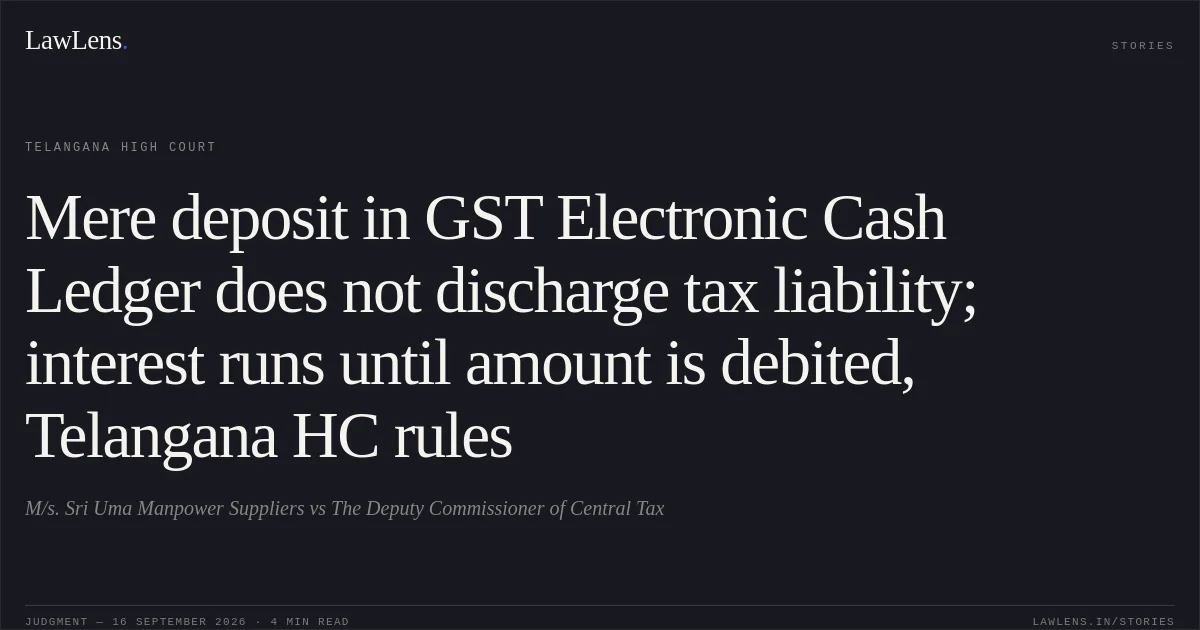
The Court answered the principal issue against the petitioner and held that mere deposit of tax in the Electronic Cash Ledger does not amount to discharge of the corresponding tax liability.
Discharge occurs only when the amount is debited towards the liability upon filing the relevant GSTR-3B return.
Source reference: paras. 21–22Accordingly, the interest demand of ₹4,82,295 and the consequential recovery proceedings were not illegal or arbitrary.
Source reference: paras. 21–22The writ petition was dismissed on merits, with no order as to costs; pending miscellaneous petitions were closed.
Source reference: paras. 21–22Acts & Sections Cited
5 provisions across 1 statute referred to in this judgment. Each provision opens on LawLens.
Central Goods and Services Tax Act, 20175
Original Court PDF
M/s. Sri Uma Manpower SuppliersvsThe Deputy Commissioner of Central Tax
Click to open original judgment
Original judgment, available to read, download and summarize on LawLens.in