Facts
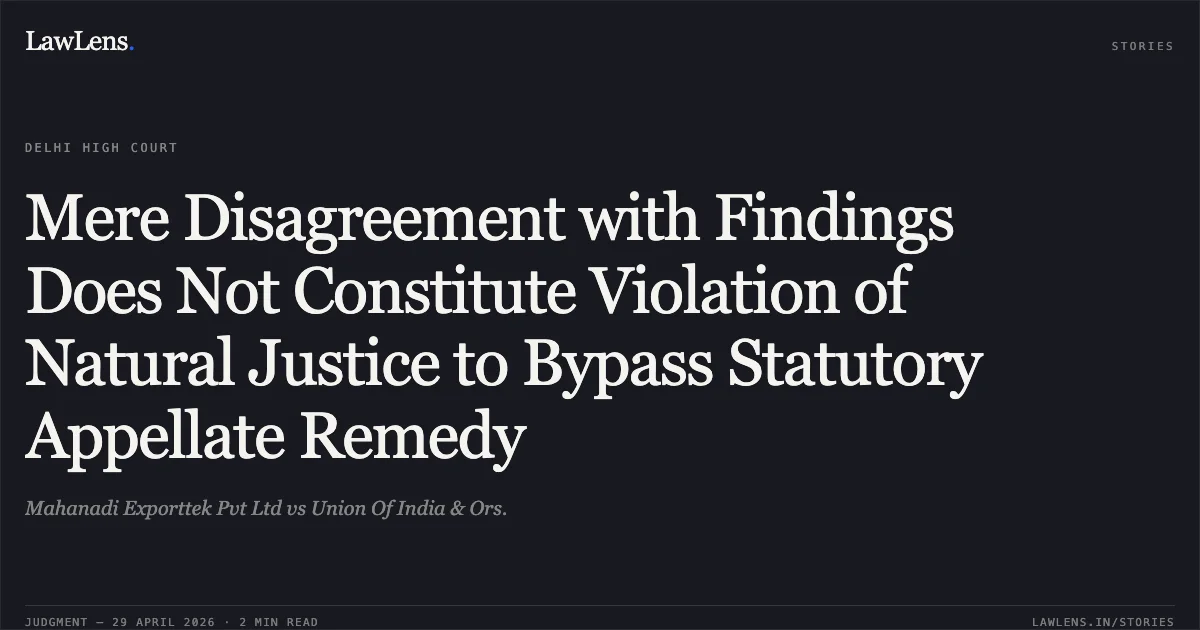
The Petitioner, a company engaged in exporting electronics, filed three applications for GST refunds totaling approximately ₹4.46 Crores under Section 54 of the CGST Act
Source reference: p. 2-3Respondent No. 3 issued Show Cause Notices (SCNs) proposing rejection due to missing documentation
Source reference: p. 3While the Petitioner submitted replies and requested a hearing, Respondent No. 3 rejected the refunds via Orders-in-Original, citing undisclosed "DGARM Alerts" regarding suspicious suppliers
Source reference: p. 3The Petitioner appealed under Section 107; however, Respondent No. 4 (Appellate Authority) dismissed the appeals on 22.08.2025, finding that the Petitioner failed to provide cogent evidence to dispel doubts about transaction veracity
Source reference: p. 4The Petitioner approached the High Court via writ jurisdiction, alleging a violation of natural justice (Audi Alteram Partem) and the non-functionality of the GST Appellate Tribunal (GSTAT)
Source reference: p. 4-5Issues
1. Whether the Orders-in-Original and Order-in-Appeal were vitiated by a violation of the principles of natural justice due to the alleged lack of an effective hearing and reliance on undisclosed material
Source reference: para. 9, 192. Whether the writ petition is maintainable under Article 226 given the availability of an alternative statutory remedy under Section 112 of the CGST Act
Source reference: para. 16, 20Law Applied
The Court applied Section 112 of the CGST Act, which provides for an appeal to the GSTAT
Source reference: para. 16It relied on Nusli Neville Wadia v. Ivory Properties and Asma Lateef v. Shabbir Ahmad to distinguish between a "lack of inherent jurisdiction" and a "jurisdictional error" committed during the exercise of valid jurisdiction.
Source reference: para. 21, 22The Court further noted that under Article 226, interference is restricted to "exceptional circumstances" where a statutory remedy is bypassed only if there is a fundamental lack of jurisdiction or a complete absence of natural justice
Source reference: para. 23Reasoning
The Court reasoned that the authorities did not lack inherent jurisdiction to adjudicate refund claims; rather, the Petitioner challenged the manner in which that jurisdiction was exercised
Source reference: para. 23Regarding natural justice, the Court found that the Petitioner was issued SCNs, filed detailed replies, and was granted personal hearings at both the original and appellate stages
Source reference: para. 24-25The Court distinguished Krishnadatt Awasthy v. State of M.P., noting that this was not a case of "complete absence of opportunity" but rather a disagreement with the authorities' conclusions
Source reference: para. 26Furthermore, the Court rejected the claim that the GSTAT is non-functional, citing evidence from Rajesh Khanna v. Commissioner that the GSTAT has commenced scrutiny of appeals and has functional IT infrastructure
Source reference: para. 27Consequently, any errors in fact-finding or document appreciation were deemed matters for statutory appeal rather than writ intervention
Source reference: para. 28Holding
The Court held that no jurisdictional infirmity or fundamental violation of natural justice existed to warrant bypassing the statutory hierarchy
The Court concluded that the GSTAT is a functional and efficacious remedy. The writ petition was disposed of, relegating the Petitioner to its statutory remedy under Section 112 of the CGST Act, with all rights and contentions on merits left open
Source reference: para. 27, 29-30Acts & Sections Cited
3 provisions across 1 statute referred to in this judgment. Each provision opens on LawLens.
Central Goods and Services Tax Act, 20173
Original Court PDF
Mahanadi Exporttek Pvt LtdvsUnion Of India & Ors.
Click to open original judgment
Original judgment, available to read, download and summarize on LawLens.in