Facts
Sunita, the appellant’s daughter, died by hanging on 9 June 2009 at her matrimonial residence, approximately three and a half months after her marriage.
Source reference: para. 3The post-mortem report attributed her death to asphyxia due to ligature hanging.
Source reference: p. 2, para. 8The Executive Magistrate recorded the statement of her father, Mithai Lal, on 10 June 2009, leading to registration of FIR No. 241/2009 under Sections 304-B, 498-A and 34 IPC.
Source reference: para. 4The husband, father-in-law and brother-in-law were arrested, while the mother-in-law was subsequently arrested after initially being declared a proclaimed offender.
Source reference: paras. 5–7The prosecution relied principally on the testimonies of the deceased’s father, mother, uncle and aunt, who alleged demands for an additional ₹1 lakh and harassment in connection with dowry.
Source reference: paras. 9, 15The Trial Court found material inconsistencies, improvements, hearsay evidence, absence of specific incidents of cruelty, and insufficient proof of dowry-related harassment, and acquitted all four accused under Sections 498-A/304-B/34 IPC.
Source reference: para. 10; pp. 9–14Mithai Lal challenged the acquittal before the High Court.
Source reference: para. 2Issues
Whether the Trial Court’s acquittal of the accused under Sections 498-A, 304-B and 34 IPC was so perverse or unreasonable as to warrant interference in an appeal against acquittal under Section 378 CrPC.
Source reference: paras. 12–14Whether the prosecution proved beyond reasonable doubt that Sunita was subjected to cruelty or harassment by the accused in connection with a dowry demand soon before her death, thereby attracting Sections 304-B and 498-A IPC and the presumption under Section 113-B of the Evidence Act.
Source reference: paras. 26–29Whether the evidence was sufficient to establish abetment of suicide under Section 306 IPC or to invoke the presumption under Section 113-A of the Evidence Act.
Source reference: para. 30Law Applied
The Court applied the principles governing an appeal against acquittal under Section 378 CrPC, as summarised in H.D. Sundara v. State of Karnataka, (2023) 9 SCC 581: an acquittal strengthens the presumption of innocence; the appellate court may reappreciate the evidence but cannot reverse the acquittal merely because another view is possible; interference is justified only where the Trial Court’s view is not a possible view and the evidence permits only a finding of guilt.
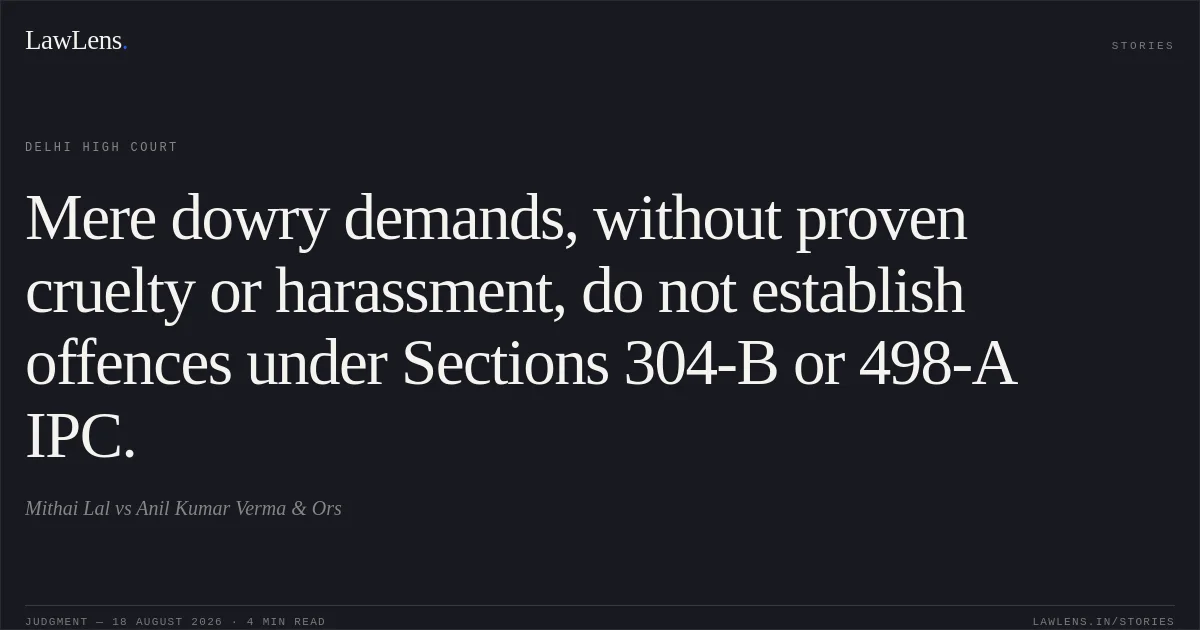
Source reference: paras. 12–13Under Section 304-B IPC, the prosecution must prove that the woman’s death was otherwise than under normal circumstances within seven years of marriage and that, soon before her death, she was subjected to cruelty or harassment by her husband or his relatives in connection with a dowry demand; only after these foundational facts are proved does the presumption under Section 113-B of the Evidence Act arise.
Source reference: para. 26Section 498-A IPC requires proof of cruelty or harassment falling within either limb of its Explanation, including harassment to coerce fulfilment of an unlawful demand for property or valuable security.
Source reference: para. 27The Court also considered Section 306 IPC and Section 113-A of the Evidence Act, observing that the presumption of abetment of suicide by a married woman requires proof of the foundational fact that she was subjected to cruelty.
Source reference: para. 30Reasoning
The High Court held that the Trial Court had adopted a plausible view of the evidence.
Source reference: paras. 31–32The alleged dowry incidents were materially inconsistent: the uncle’s allegation that the father-in-law demanded ₹1 lakh immediately after the deceased’s bidai was absent from his Section 161 CrPC statement and was not corroborated by the deceased’s parents; the alleged demand at the reception was likewise unsupported by the other witnesses.
Source reference: paras. 17–18The allegations that the deceased complained of a demand for ₹1 lakh one and a half months after marriage, fifteen days before death, and three days before death lacked consistent particulars, including the identity of the person making the demand, the precise acts of harassment, and the response of the family.
Source reference: paras. 19–24Parts of the evidence were hearsay, and no specific incident demonstrating cruelty or harassment was established.
Source reference: paras. 19–20, 23, 29The Court further noted the absence of any contemporaneous complaint, panchayat, intervention by marriage mediators, or other steps by the family despite the alleged demands.
Source reference: paras. 23–24, 31Since the prosecution failed to prove the essential element of dowry-related cruelty or harassment soon before death, the statutory presumption under Section 113-B could not arise.
Source reference: paras. 26–30The same evidentiary deficiency also precluded conviction under Section 498-A or invocation of Section 113-A for abetment of suicide.
Source reference: paras. 26–30In the context of the appeal against acquittal, the High Court concluded that the evidence did not make guilt the only possible conclusion.
Source reference: paras. 31–32Holding
The High Court answered the issues against the appellant.
It held that the prosecution failed to prove beyond reasonable doubt that Sunita had been subjected to dowry-related cruelty or harassment soon before her death, and that the Trial Court’s acquittal was a possible view supported by the evidence.
Source reference: paras. 31–32The Court found no perversity or infirmity warranting appellate interference and dismissed the appeal against acquittal under Sections 498-A/304-B/34 IPC.
Source reference: para. 33Acts & Sections Cited
4 provisions across 2 statutes referred to in this judgment. Each provision opens on LawLens.
Indian Penal Code, 18602
Code of Criminal Procedure, 19732
Original Court PDF
Mithai LalvsAnil Kumar Verma & Ors
Click to open original judgment
Original judgment, available to read, download and summarize on LawLens.in