Facts
On 25 October 1990, a mini truck bearing registration No. WB/65/0355 was intercepted at Rathbari, Malda, and 27 bags of boiled rice were allegedly recovered from it.
Source reference: paras. 4, 28–29The prosecution alleged that appellants Bholanath Mondal and Saidul Rahaman claimed ownership of the rice but failed to produce the requisite documents, permit or licence under paragraph 3 of the West Bengal Rice and Paddy (Licensing and Control) Order, 1967.
Source reference: paras. 4, 28–29Appellant Bikash Ghosh was driving the truck. A case was registered under Section 7(1)(a)(ii) of the Essential Commodities Act, 1955, and the Trial Court convicted all the appellants.
Source reference: paras. 4, 28–29During the pendency of the appeal, Bholanath Mondal and Saidul Rahaman died, and the appeal abated against them; it survived only as to Bikash Ghosh.
Source reference: para. 5The defence contended that the rice was produced from agricultural lands belonging to the deceased appellants and that Bikash Ghosh was merely a hired driver.
Source reference: paras. 9–17Issues
Whether the prosecution established beyond reasonable doubt that Bikash Ghosh consciously participated in, or had knowledge of, the alleged unlawful possession or transportation of the 27 bags of boiled rice in violation of the applicable Control Order?
Source reference: paras. 30, 38–45Whether the conviction under Section 7(1)(a)(ii) of the Essential Commodities Act, 1955, could be sustained merely because Bikash Ghosh was driving the vehicle from which the rice was recovered?
Source reference: paras. 39–44Whether the contradictions, omissions and deficiencies in the prosecution evidence, including the manner of search and seizure and the absence of independent witnesses, created a reasonable doubt in favour of the surviving appellant?
Source reference: paras. 31–36, 40, 43–45Law Applied
The Court applied Section 7(1)(a)(ii) of the Essential Commodities Act, 1955, which prescribes punishment for contravention of an order issued under Section 3 of the Act, read with Section 14 concerning presumptions relating to culpable mental state where applicable.
Source reference: paras. 2, 18The alleged substantive violation was of paragraph 3 of the West Bengal Rice and Paddy (Licensing and Control) Order, 1967, governing the licensing and lawful possession or transportation of rice and paddy.
Source reference: paras. 4, 18The Court further applied the fundamental criminal-law principle that the prosecution must prove the accused’s guilt beyond reasonable doubt and that the accused is not required to establish his defence beyond doubt; where the evidence reasonably supports innocence, the benefit of doubt must follow.
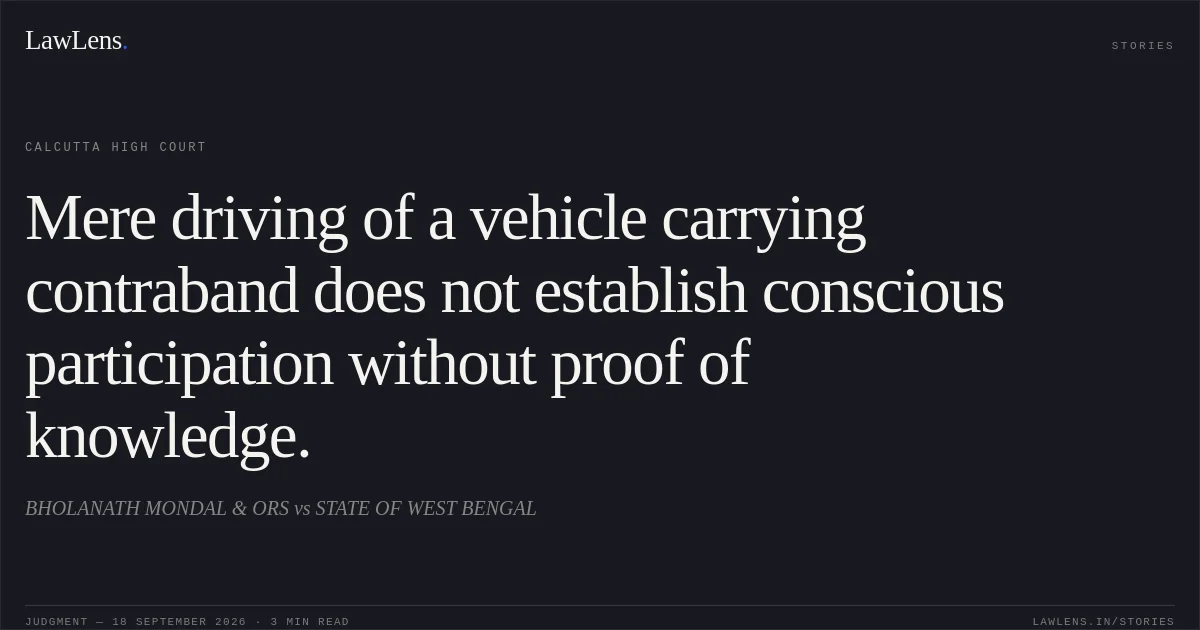
Source reference: para. 45The Court also held that mere physical control of a vehicle or status as its driver does not, without additional incriminating circumstances, establish conscious participation or knowledge of an illegal consignment.
Source reference: paras. 41–42Reasoning
The Court found that PW2’s evidence indicated that the truck was hired at the relevant place for Rs. 200 and that the rice was loaded only thereafter, suggesting that Bikash Ghosh participated as a hired driver rather than as the owner or person responsible for the rice.
Source reference: paras. 31, 38–39No evidence established that he owned the rice, had a proprietary or possessory interest in it, or knew that its transportation violated the Control Order.
Source reference: paras. 38, 41–42The prosecution evidence was further weakened because the complainant allegedly arrived after loading was complete, came alone, no other available independent witness was examined, and the Investigating Officer admitted that material witnesses were examined away from the alleged place of occurrence.
Source reference: paras. 32, 34, 36, 40PW2 also stated that the other appellants sought to produce documents relating to their agricultural lands but were not given an opportunity to do so, lending some support to the defence explanation concerning the source of the rice.
Source reference: paras. 33–35In these circumstances, the Trial Court erred by attributing criminal liability to Bikash Ghosh principally on the basis of his being the driver, without proof of conscious knowledge or participation.
Source reference: paras. 42–45Holding
The Court held that the prosecution failed to prove beyond reasonable doubt that Bikash Ghosh knowingly or consciously participated in the unlawful possession or transportation of the seized rice.
His mere presence as the hired driver of the mini truck was insufficient to sustain the conviction.
Source reference: paras. 41–46The appeal was allowed; the judgment and order of conviction under Section 7(1)(a)(ii) of the Essential Commodities Act were set aside insofar as they related to Bikash Ghosh, and he was acquitted.
Source reference: paras. 47–48His bail bond was directed to stand discharged, subject to compliance with Section 437A of the Code of Criminal Procedure, as applicable.
Source reference: para. 49Acts & Sections Cited
5 provisions across 2 statutes referred to in this judgment. Each provision opens on LawLens.
Essential Commodities Act, 19553
Code of Criminal Procedure, 19732
Original Court PDF
BHOLANATH MONDAL & ORSvsSTATE OF WEST BENGAL
Click to open original judgment
Original judgment, available to read, download and summarize on LawLens.in