Facts
The Plaintiff (Appellant) and Defendants are siblings and the mother of a family headed by the late Manilal Patel, a retired Deputy Collector.
Source reference: para 2.1The Plaintiff filed a suit for partition and for the cancellation of a Will dated 09.02.1988 executed by the deceased father.
Source reference: para 2.2-2.3The Plaintiff contended that the suit properties (Bungalow No. 5, Patidar Society and a plot in Kailashnagar) were Hindu Undivided Family (HUF) properties purchased using income from ancestral agricultural land in Chandkheda.
Source reference: para 2.1The Defendants contested this, asserting the properties were self-acquired and distributed via a valid Will, which granted the Plaintiff only a life interest to reside in the bungalow rather than absolute ownership.
Source reference: para 3-5The Trial Court dismissed the suit on 29.11.2002, leading to this First Appeal.
Source reference: para 1Issues
1. Whether the Plaintiff proved that the suit properties are joint Hindu family properties in which he holds an undivided share.
Source reference: para 10/122. Whether the deceased Manilal Patel executed the Will dated 09.02.1988 in a sound disposing state of mind.
Source reference: para 10/123. Whether the exclusion of a natural heir (Plaintiff) from absolute ownership constitutes a "suspicious circumstance" vitiating the Will.
Source reference: para 10/26Law Applied
Section 96 of the CPC regarding appellate jurisdiction.
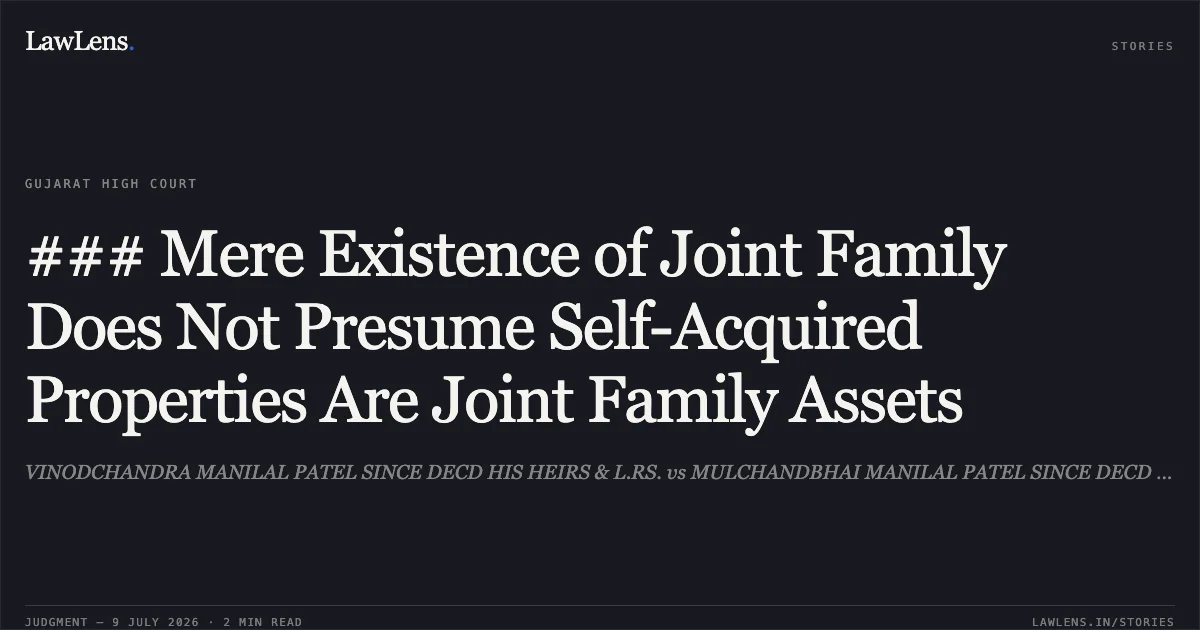
Source reference: para 1There is no legal presumption that a property is joint family property merely because a joint family exists; the burden of proof lies on the party asserting the joint nature to prove a sufficient income-yielding nucleus (D.S. Lakshmaiah v. L. Balasubramanyam and Angadi Chandranna v. Shankar).
Source reference: para 16, 18Section 63 of the Indian Succession Act and Section 68 of the Indian Evidence Act.
Source reference: para 17/29The mere deprivation of a natural heir does not invalidate a Will if the disposition was a voluntary act of a sound mind (H. Venkatachala Iyengar v. B.N. Thimmajjamma and Gurdial Singh v. Jagir Kaur).
Source reference: para 8.1, 17Reasoning
The Court found the Plaintiff failed to discharge the burden of proving a "joint family nucleus." While ancestral land existed, the Plaintiff admitted in cross-examination that he had no documentary evidence of income from said land being used for the bungalow.
Source reference: para 18, 19Crucially, the Plaintiff’s counsel put a suggestion to a defense witness (DW-2) that the father purchased the properties from his "own self-earned income," which the Court treated as an admission damaging the Plaintiff's case.
Source reference: para 22The deceased had independent income as a Deputy Collector, rebutting the theory that the properties were HUF accretions.
Source reference: para 25Regarding the Will, the Court noted that the Plaintiff was not entirely disinherited but given a life interest to reside in the property.
Source reference: para 27The attesting witness (DW-3) proved the Will was signed by the testator in a sound state of mind, satisfying the judicial conscience.
Source reference: para 28-29Holding
The High Court answered Issue 1 in the negative and Issue 2 in the affirmative.
The Court held that the Plaintiff failed to prove the properties were HUF.
Source reference: para 25The Court confirmed that the Will was validly executed and that the partial deprivation of the Plaintiff did not constitute a suspicious circumstance under the facts.
Source reference: para 27, 30The appeal was dismissed, and the Trial Court’s judgment/decree dated 29.11.2002 was confirmed.
Source reference: para 32Acts & Sections Cited
3 provisions across 2 statutes referred to in this judgment. Each provision opens on LawLens.
Code of Civil Procedure, 19081
Indian Succession Act, 19252
Original Court PDF
VINODCHANDRA MANILAL PATEL SINCE DECD HIS HEIRS & L.RS.vsMULCHANDBHAI MANILAL PATEL SINCE DECD THR.HIS HEIRS &L.RS
Click to open original judgment
Original judgment, available to read, download and summarize on LawLens.in