Facts
The respondents/plaintiffs claimed that the disputed lands had been mortgaged with possession in favour of Ganesh Dass, Mula Mal and other mortgagees in Pakistan before Partition, and that possession continued after the mortgagors had been allotted corresponding lands in village Kharian, District Sirsa.
Source reference: paras. 6, 11, 16, 21They asserted that the mortgagors had failed to redeem the alleged usufructuary mortgages within thirty years and that the mortgagees had consequently acquired ownership by prescription.
Source reference: no citationThe plaintiffs also challenged certain subsequent transactions, including a sale deed dated 20.06.1978 and an exchange decree dated 21.04.1981, together with the consequential mutations.
Source reference: paras. 12, 22, 37The trial courts decreed the suits, holding that the plaintiffs had become owners because the mortgagors had not redeemed the properties within thirty years.
Source reference: para. 26The Additional District Judge affirmed those decrees, holding that the mortgagors’ right of redemption had expired and that the mortgagees had acquired ownership.
Source reference: para. 27The mortgagors thereafter filed the four Regular Second Appeals.
Source reference: no citationIssues
Whether the plaintiffs, as usufructuary mortgagees, had acquired ownership of the suit properties by prescription or efflux of thirty years due to the mortgagors’ failure to redeem the mortgages?
Source reference: paras. 28, 30Whether the plaintiffs’ suits challenging the revenue entries and subsequent transactions entered into by the mortgagors were maintainable and within limitation?
Source reference: para. 28Law Applied
The Court applied Section 58(d) of the Transfer of Property Act, 1882, which defines a usufructuary mortgage as one where possession is delivered or agreed to be delivered to the mortgagee, who may retain possession and appropriate the rents and profits until payment of the mortgage money.
Source reference: para. 31It relied on the principle of “once a mortgage, always a mortgage,” under which the right of redemption continues unless extinguished in accordance with law.
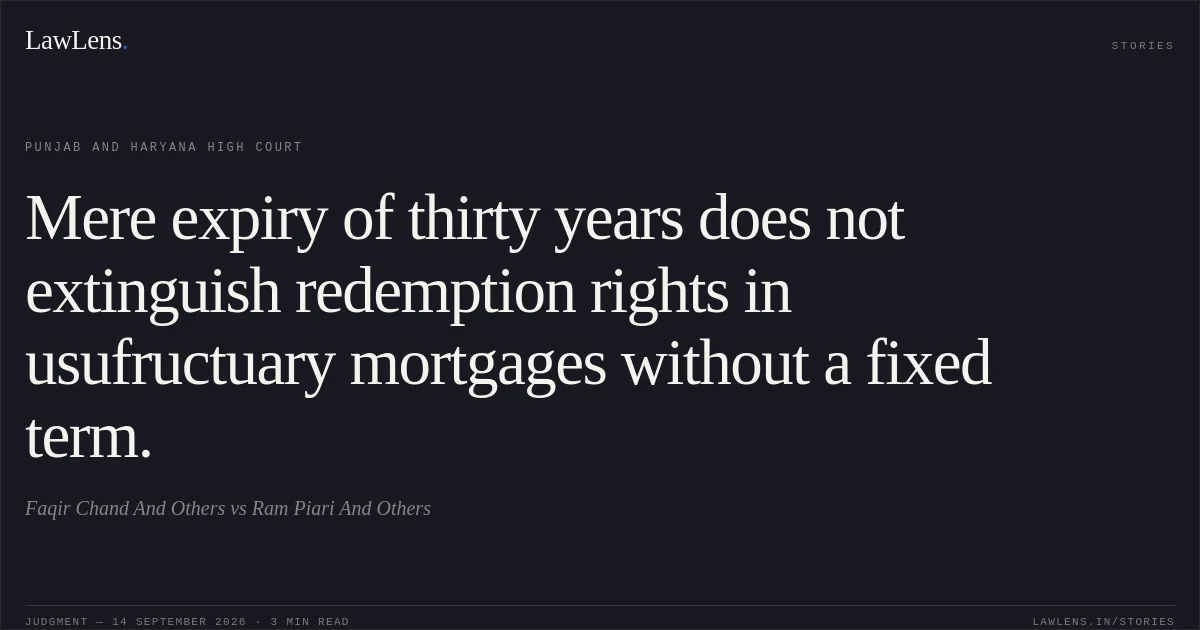
Source reference: no citationFollowing the Full Bench judgment in Ram Kishan v. Sheo Ram, 2008 (1) PLR 1, the Court held that where no period for redemption is fixed in a usufructuary mortgage, the right of redemption does not arise on the date of the mortgage but when the mortgagor tenders or deposits the mortgage money; mere passage of time cannot extinguish that right or convert the mortgagee into an owner.
Source reference: para. 33This principle was approved by the Supreme Court in Singh Ram (D) through LRs v. Sheo Ram, Civil Appeal No. 5198 of 2008, decided on 21.08.2014, and reaffirmed in Dalip Singh (D) through LRs v. Sawan Singh (D) through LRs, 2025 LiveLaw (SC) 1252.
Source reference: para. 34The Court further held that the mortgagors, as holders of the equity of redemption, remained competent to sell or exchange their proprietary interests, subject to the subsisting mortgage.
Source reference: para. 38Reasoning
The plaintiffs’ own pleadings established that possession had been delivered to the mortgagees and that no specific date or period for redemption had been fixed; the transactions were therefore usufructuary mortgages under Section 58(d) of the Transfer of Property Act.
Source reference: para. 32Applying Ram Kishan and Singh Ram, the Court held that the thirty-year period could not be calculated mechanically from the date of the mortgage.
Source reference: paras. 33–35Since no evidence showed that the mortgage debt had been tendered, deposited, or otherwise discharged, the mortgagors’ right of redemption remained subsisting, and the mortgagees’ possession did not become adverse or ripen into ownership merely through lapse of time.
Source reference: paras. 33–35Consequently, the plaintiffs failed to establish title and lacked locus to challenge transactions made by the mortgagors.
Source reference: no citationThe sale deed, exchange decree and mutations remained subject to the pre-existing mortgage, but the mortgagors were legally entitled to alienate or exchange their equity of redemption.
Source reference: paras. 37–38Holding
The High Court answered the substantial questions of law in favour of the appellants/mortgagors.
It held that the plaintiffs had not acquired ownership by prescription and continued to possess the properties only as usufructuary mortgagees.
Source reference: para. 36The plaintiffs therefore had no legal basis to seek cancellation of the sale deed, exchange decree or consequential mutations executed by the mortgagors.
Source reference: para. 38All four Regular Second Appeals were allowed with costs; the judgments and decrees of the courts below were set aside, and the plaintiffs’ suits were dismissed.
Source reference: para. 39Decree-sheets were directed to be drawn accordingly.
Source reference: para. 40Acts & Sections Cited
1 provisions across 1 statute referred to in this judgment. Each provision opens on LawLens.
Transfer of Property Act, 18821
Original Court PDF
Faqir Chand And OthersvsRam Piari And Others
Click to open original judgment
Original judgment, available to read, download and summarize on LawLens.in