Facts
The Petitioner filed a petition under Section 9 of the Arbitration and Conciliation Act, 1996, seeking interim measures to restrain the Respondent from creating third-party interests in the ground floor of property E-96, Saket, New Delhi
Source reference: p. 1-2The parties had originally entered into a Special Power of Attorney (SPA) dated 09.11.2021 regarding the first floor of the property, which contained an arbitration clause (Clause 19)
Source reference: p. 2Following the sale of the first floor, the parties executed a Memorandum of Understanding (MoU) on 05.03.2024 to regulate financial liabilities and rights concerning the ground floor
Source reference: p. 3-4The Petitioner alleged that the MoU was an extension of the SPA and thus governed by its arbitration clause
Source reference: p. 3The Respondent contested maintainability, arguing the MoU was a fresh, independent contract without an arbitration clause
Source reference: p. 4Issues
1. Whether the arbitration agreement contained in the SPA dated 09.11.2021 can be invoked for disputes arising out of the subsequent MoU dated 05.03.2024
Source reference: p. 4, para. 162. Whether the MoU fulfills the requirements of Section 7(5) of the Arbitration and Conciliation Act, 1996, for the incorporation of an arbitration clause by reference
Source reference: p. 6, para. 25Law Applied
Section 7(5) of the Arbitration and Conciliation Act, 1996, which stipulates that a reference in a contract to a document containing an arbitration clause constitutes an arbitration agreement only if the reference is such as to make that clause part of the contract
Source reference: p. 6, para. 24A general reference to another document is insufficient; there must be a "conscious and specific intention" to incorporate the arbitration agreement itself into the subsequent contract, especially when the documents govern different scopes of work or subjects (M.R. Engineers & Contractors Pvt. Ltd. v. Som Datt Builders Ltd.)
Source reference: p. 6-8, para. 26Reasoning
The Court observed that the SPA’s scope was strictly limited to the first floor of the Subject Property and that the arbitration clause (Clause 19) must be construed within that specific context
Source reference: p. 5, para. 18Upon perusal of the MoU, the Court found it to be a "fresh and independent arrangement" governing the ground floor and distinct financial liabilities
Source reference: p. 5, para. 20Applying Section 7(5), the Court noted that the MoU lacked any express or implied incorporation of the SPA’s dispute resolution mechanism
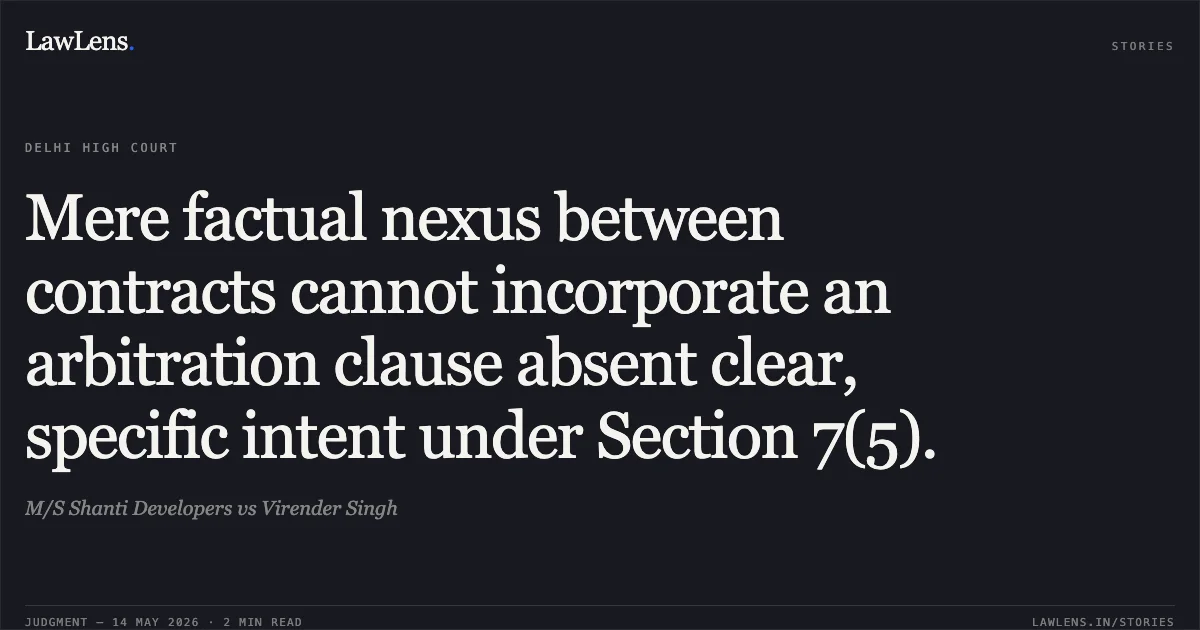
Source reference: p. 5, para. 21The Court rejected the Petitioner's "factual nexus" argument, stating that mere historical dealings or incidental references do not result in a composite transaction for arbitration purposes
Source reference: p. 5-6, para. 23, 25Since the MoU operated in a "distinct contractual field" and lacked a specific reference to the arbitration clause, the Court determined it could not import the clause from the exhausted SPA
Source reference: p. 9, para. 27-28Holding
The Court held that the disputes fell outside the scope of the arbitration clause in the SPA and that the MoU contained no independent or incorporated arbitration agreement
Consequently, the petition under Section 9 of the Act was held not maintainable and was dismissed. The parties were granted liberty to pursue other available legal remedies
Source reference: p. 9-10, para. 31-33Acts & Sections Cited
2 provisions across 1 statute referred to in this judgment. Each provision opens on LawLens.
Original Court PDF
M/S Shanti DevelopersvsVirender Singh
Click to open original judgment
Original judgment, available to read, download and summarize on LawLens.in


