Facts
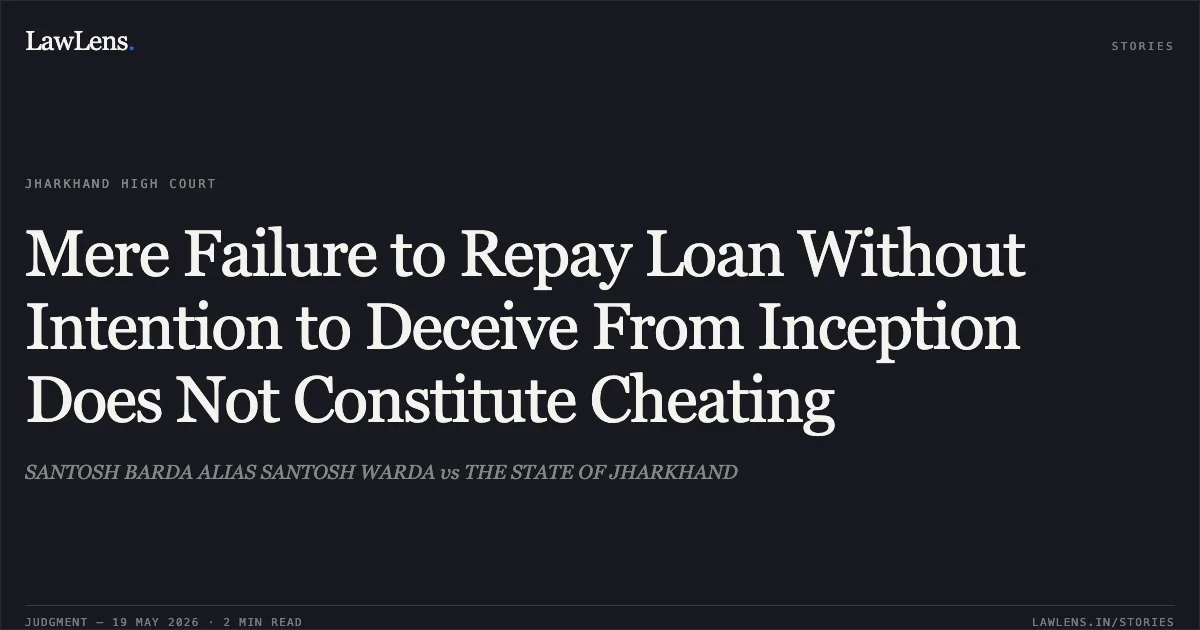
The Petitioner challenged the entire criminal proceeding and the cognizance order dated 23.06.2023 passed by the Judicial Magistrate-1st Class, Jamshedpur, under Sections 406 and 420 of the IPC
Source reference: p. 2The complainant alleged that the Petitioner took a friendly loan of Rs. 1,50,000/- but failed to repay it. Cheques issued by the Petitioner were subsequently dishonored, and a demand notice was returned as the Petitioner was not found at the given address
Source reference: p. 2, para. 4No separate case for dishonor of cheques was filed by the complainant
Source reference: p. 2The Petitioner moved the High Court under Section 482 Cr.P.C. to quash the proceedings on the grounds that the dispute was civil in nature
Source reference: p. 2Issues
1. Whether the failure to repay a friendly loan and the subsequent dishonor of a cheque, without evidence of deception at the inception, is sufficient to constitute the offense of cheating under Section 420 IPC
Source reference: p. 5, para. 92. Whether the payment of a loan qualifies as "entrustment" of property under Section 405 IPC so as to attract criminal breach of trust under Section 406 IPC
Source reference: p. 6, para. 11Law Applied
The court primarily applied Section 406 (Criminal Breach of Trust) and Section 420 (Cheating) of the Indian Penal Code
Source reference: p. 2Sripati Singh v. State of Jharkhand (2022) 18 SCC 614, which held that mere dishonor of a cheque does not imply mens rea for cheating
Source reference: p. 3, para. 5Satishchandra Ratanlal Shah v. State of Gujarat (2019) SC 337, which established that inability to return a loan is not criminal unless fraudulent intention existed at the start of the transaction
Source reference: p. 4, para. 6Uma Shankar Gopalika v. State of Bihar (2005) 10 SCC 336, affirming that a breach of contract only amounts to cheating if deception is played at the very inception
Source reference: p. 5, para. 9Reasoning
The Court observed that for an offense under Section 420 IPC, there must be an allegation of deception from the beginning of the transaction
Source reference: p. 5, para. 9In the present case, the court found no evidence or allegation that the Petitioner intended to cheat at the time the loan was taken
Source reference: p. 5-6, para. 10Regarding Section 406 IPC, the court reasoned that the advancement of a loan does not constitute "entrustment" as defined under Section 405 IPC; rather, it creates a debtor-creditor relationship
Source reference: p. 6, para. 11Since there was no entrustment and no dishonest misappropriation of entrusted property, the essential ingredients of Section 406 IPC were missing
Source reference: p. 6, para. 11Consequently, the court determined that the dispute was a civil breach of contract being converted into a criminal prosecution, which amounts to an abuse of the process of law
Source reference: p. 6, para. 12Holding
The Court answered both issues in the negative. It held that the allegations, even if taken at face value, failed to meet the statutory requirements for Sections 406 and 420 of the IPC
The High Court allowed the Criminal Miscellaneous Petition and quashed the entire criminal proceeding, including the cognizance order dated 23.06.2023 in C/1 Case No. 187 of 2021
Source reference: p. 6-7, paras. 13-14Acts & Sections Cited
5 provisions across 2 statutes referred to in this judgment. Each provision opens on LawLens.
Code of Criminal Procedure, 19731
Indian Penal Code, 18604
Original Court PDF
SANTOSH BARDA ALIAS SANTOSH WARDAvsTHE STATE OF JHARKHAND
Click to open original judgment
Original judgment, available to read, download and summarize on LawLens.in