Facts
On 12 November 2009 at approximately 9:15 a.m., PW5 was riding a bicycle with his mother as pillion rider in C-Block, Naresh Park Extension, Delhi, when tempo no. DL-1LE-2469, allegedly driven by Sanjay at high speed and in a rash and negligent manner, collided with the bicycle.
Source reference: paras. 2, 12–12.1PW5’s mother fell onto the road and was crushed under the tempo’s right front wheel, dying at the spot.
Source reference: paras. 2, 12–12.1On the basis of PW5’s statement, FIR No. 277/2009 was registered at Police Station Nihal Vihar, and the accused was charge-sheeted for offences under Sections 279 and 304A IPC.
Source reference: paras. 3–4The prosecution examined eleven witnesses and relied principally on PW5’s eyewitness testimony, the mechanical inspection report, seizure documents, photographs, and the site plan.
Source reference: paras. 5, 14–15The Metropolitan Magistrate acquitted the accused under Section 255(1) Cr.P.C. on 26 August 2013. The State challenged the acquittal under Section 378 Cr.P.C.
Source reference: para. 8Issues
Whether the evidence established beyond reasonable doubt that the accused drove the tempo in a rash or negligent manner, thereby committing offences under Sections 279 and 304A IPC.
Source reference: paras. 18–19Whether the trial court’s order acquitting the accused disclosed any infirmity warranting interference by the High Court in an appeal against acquittal.
Source reference: paras. 11, 16–17Law Applied
The Court applied Section 279 IPC, which criminalises driving a vehicle on a public way so rashly or negligently as to endanger human life or cause injury, and Section 304A IPC, which requires proof that death was caused by the accused’s rash or negligent act, without culpable homicide.
Source reference: para. 18Relying on Naresh Giri v. State of Madhya Pradesh, (2008) 1 SCC 791, the Court held that rashness or negligence must be established as the direct cause of death and that criminal negligence requires gross or culpable failure to exercise the care expected of a reasonable person.
Source reference: paras. 18.1–18.2Under Sections 378 and 386 Cr.P.C., an appellate court may reappreciate evidence in an appeal against acquittal; however, the accused benefits from a double presumption of innocence, and an acquittal should not be disturbed where two reasonable views are possible or the trial court’s view is reasonable and plausible.
Source reference: paras. 16–17The Court relied on Babu Sahebogouda Rudragoudar v. State of Karnataka, (2024) 8 SCC 149, Rajesh Prasad v. State of Bihar, (2022) 3 SCC 471, Chandrappa v. State of Karnataka, (2007) 4 SCC 415, Ram Kumar v. State of Haryana, 1995 Supp (1) SCC 248, and Bani Singh v. State of U.P., (1996) 4 SCC 720.
Source reference: paras. 10, 16–17Reasoning
The Court accepted that the accused’s identity, his driving of the tempo, and the deceased’s death were not seriously disputed; the decisive question was whether rashness or negligence had been proved.
Source reference: para. 19PW5 merely described the tempo as being driven at “very high speed” and in a “rash and negligent manner,” without explaining the specific manner of driving or giving any objective indication of speed.
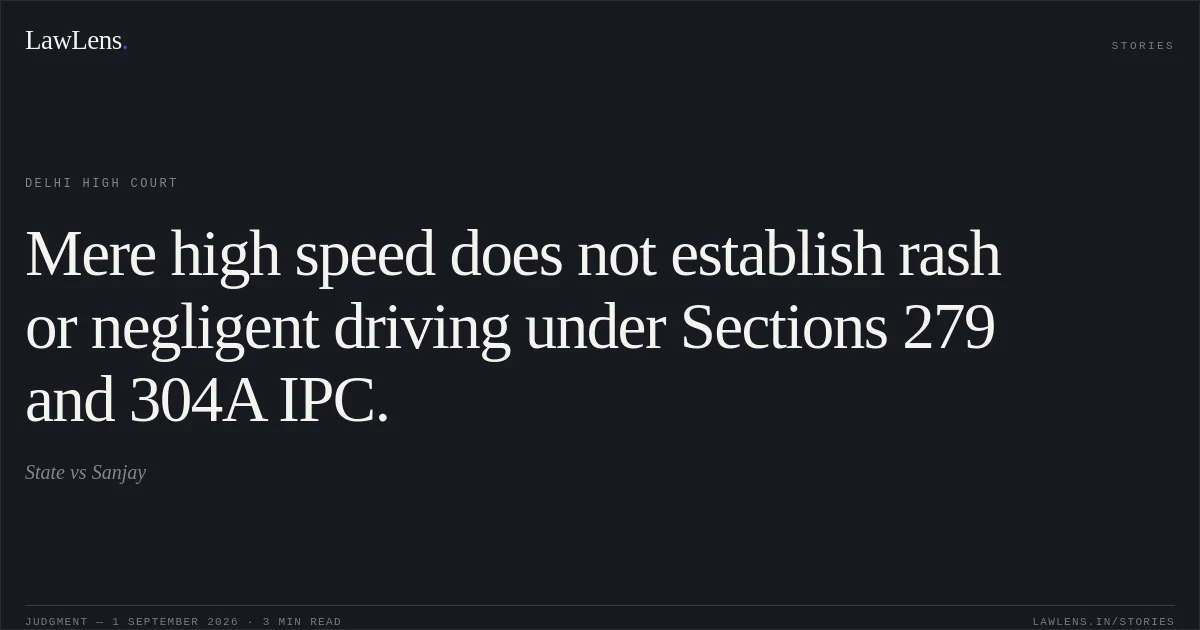
Source reference: para. 19The Court held that high speed is a relative expression and that the mere occurrence of a fatal accident does not establish criminal rashness or negligence; res ipsa loquitur could not substitute for proof in the circumstances.
Source reference: para. 19The mechanical inspection report recorded fresh damage to the left side corner of the tempo, whereas PW5’s account suggested an impact involving the vehicle’s right side, creating a material inconsistency.
Source reference: paras. 15, 20The site plan was merely a rough sketch, did not record the road’s width or establish whether the tempo had entered the wrong side, and had not been prepared in PW5’s presence or properly proved.
Source reference: paras. 21–22Consequently, the prosecution failed to establish the essential ingredient of rash or negligent driving beyond reasonable doubt, and the trial court’s acquittal remained a reasonable view of the evidence.
Source reference: para. 23Holding
The High Court answered the issues against the State, holding that the prosecution had not proved that the accused’s driving was rash or negligent so as to attract Sections 279 or 304A IPC.
Finding no infirmity in the judgment of acquittal dated 26 August 2013, the Court dismissed the State’s appeal as meritless and directed that any pending applications stand closed.
Source reference: paras. 23–25Acts & Sections Cited
11 provisions across 3 statutes referred to in this judgment. Each provision opens on LawLens.
Code of Criminal Procedure, 19737
Indian Penal Code, 18603
Motor Vehicles Act, 19881
Original Court PDF
StatevsSanjay
Click to open original judgment
Original judgment, available to read, download and summarize on LawLens.in