Facts
The petitioners applied for Class-IV posts in the Civil Court, Siwan, under Advertisement Nos. 02/2011 and 01/2013
Source reference: p. 3Following interviews in 2014, they were placed in a waiting list of eleven candidates (at Sl. No. 2 and 10 respectively), which was approved by the Patna High Court
Source reference: p. 3Despite this approval and a request from the District Judge, Siwan, for permission to appoint them, no appointment letters were issued
Source reference: p. 4During this period, the High Court’s Standing Committee resolved to freeze such appointments pending centralized recruitment
Source reference: p. 6-7Subsequently, a Division Bench ruling in 2018 directed that all recruitment under the old 2009 Rules that had not resulted in appointment letters should be cancelled in favor of the new 2017 Rules
Source reference: p. 7-9Issues
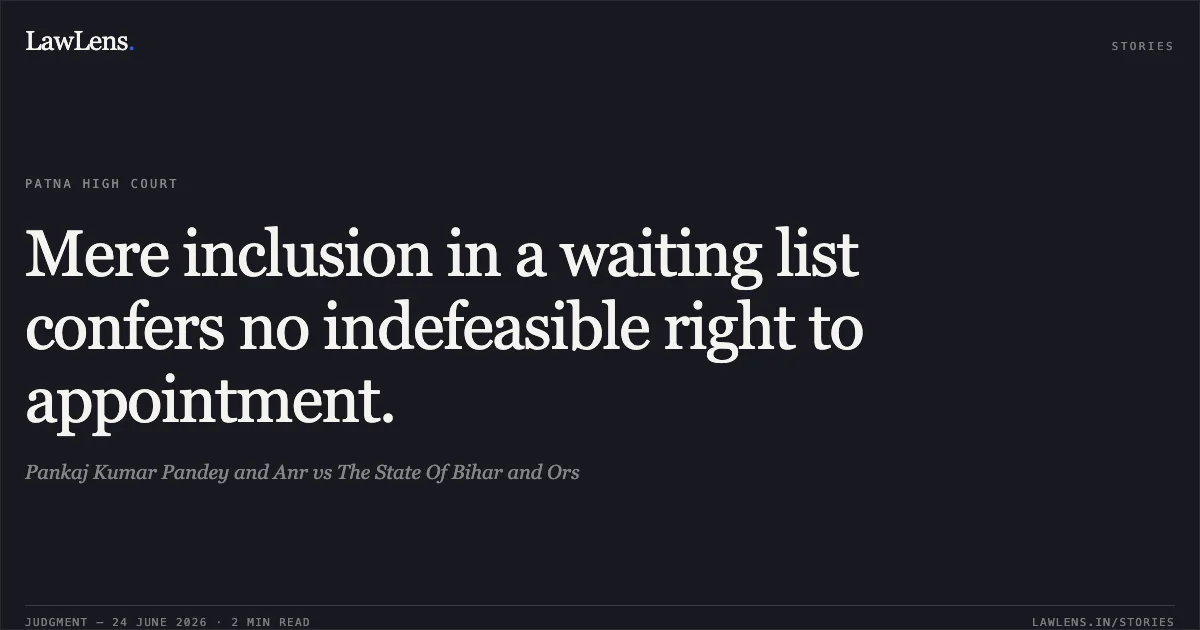
1. Whether candidates included in an approved waiting list possess a vested or indefeasible right to appointment
Source reference: p. 112. Whether the selection process initiated under the 2009 Rules can be enforced after the 2017 Rules came into force and the previous process was directed to be cancelled
Source reference: p. 10Law Applied
The court primarily applied the principle that inclusion in a select list does not confer an indefeasible right to appointment as established in Shankarsan Dash v. Union of India and reaffirmed in State of Karnataka & Ors. vs. Santosh Kumar C. (2026)
Source reference: p. 11-12It further applied the "Rule of 2017," which superseded the Bihar Civil Court Staff (Class-III & Class-IV) Rules, 2009, as interpreted by the Division Bench in Bihar Yuva Adhiwakta Kalyan Samittee vs. Patna High Court, holding that ongoing selection processes not culminating in appointment letters must be cancelled
Source reference: p. 7-9Reasoning
The court reasoned that the petitioners' selection process never culminated in the issuance of appointment letters
Source reference: p. 10Relying on the Division Bench judgment in Bihar Yuva Adhiwakta Kalyan Samittee, the court noted that once the 2017 Rules were implemented, all pending selection processes under the 2009 Rules—where joining had not occurred—were legally mandated to be cancelled
Source reference: p. 10-11Furthermore, the court applied recent Supreme Court jurisprudence from State of Karnataka v. Santosh Kumar C. to clarify that even an approved waiting list does not create a proprietary right to a post
Source reference: p. 11-15Since the District Judge had only sought permission to appoint but had not actually issued the letters before the policy change and judicial intervention, no legal right had accrued to the petitioners
Source reference: p. 11Holding
The court held that the petitioners have no vested right to be appointed based on the 2009 Rules or their status in the waiting list
The court answered the issues in the negative, ruling that the selection process was effectively terminated by the shift to the 2017 Rules and the High Court's administrative and judicial directions. The writ petition was dismissed, and no relief was granted
Source reference: p. 16Original Court PDF
Pankaj Kumar Pandey and AnrvsThe State Of Bihar and Ors
Click to open original judgment
Original judgment, available to read, download and summarize on LawLens.in