01Facts
On 24 January 2014, the police intercepted truck No. CG-04ZC-4326, which was covered with a tarpaulin and allegedly carrying 55 logs of Sakhua wood without supporting documents.
¶ 3, 12Three persons—Dukhharan Bhagat, Illias Kerketta and Etwa Sahu—were apprehended near the truck, while one or more other persons, including the driver and khalasi, allegedly fled.
¶ 3, 12The apprehended petitioners were described as labourers associated with the truck.
¶ 3, 12An FIR was registered under Sections 379 and 414 of the IPC and Sections 33 and 42 of the Indian Forest Act.
¶ 4After investigation, charges were framed under Sections 379 and 414 read with Section 120B of the IPC and Sections 33 and 42 of the Indian Forest Act.
¶ 4The trial court convicted the petitioners and sentenced them to terms of imprisonment ranging from one to two years.
¶ 2, 7–8The appellate court dismissed their appeal on 5 June 2017, affirming the conviction.
¶ 2, 7–8The petitioners challenged both judgments in the present criminal revision.
02Issues
i.Whether the prosecution proved beyond reasonable doubt that the petitioners committed or dishonestly assisted in the theft or transportation of the seized wooden logs under Sections 379 and 414 of the IPC.
¶ 9–13ii.Whether the petitioners’ presence as labourers near the truck established a criminal conspiracy under Section 120B of the IPC.
¶ 9, 12iii.Whether the evidence established the petitioners’ guilt under Sections 33 and 42 of the Indian Forest Act.
¶ 2, 9–13iv.Whether the concurrent findings of conviction recorded by the trial and appellate courts warranted interference in criminal revision.
¶ 11–1303Law Applied
The Court applied Sections 379 and 414 of the Indian Penal Code, which respectively require proof of dishonest taking of movable property and voluntarily assisting in concealing, retaining or disposing of property known or reasonably believed to be stolen.
¶ 9, 12Section 120B IPC requires proof of an agreement constituting a criminal conspiracy; mere presence or association with the alleged offence is insufficient without evidence of the conspiratorial agreement.
¶ 9, 12Sections 33 and 42 of the Indian Forest Act penalise specified unlawful acts relating to forest produce and contravention of applicable forest restrictions.
¶ 2, 4The Court further applied the principle that a conviction must rest on legally sufficient evidence and that concurrent findings may be interfered with in revision where the courts below have committed a serious error of law or recorded a perverse finding.
¶ 11–13Provisions in the judgment · 5 · Linked ones open on LawLens
Indian Penal Code, 1860 Section 379Section 414
Indian Forest Act, 1927 Section 33Section 42
Code of Criminal Procedure, 1973 Section 313
04Reasoning
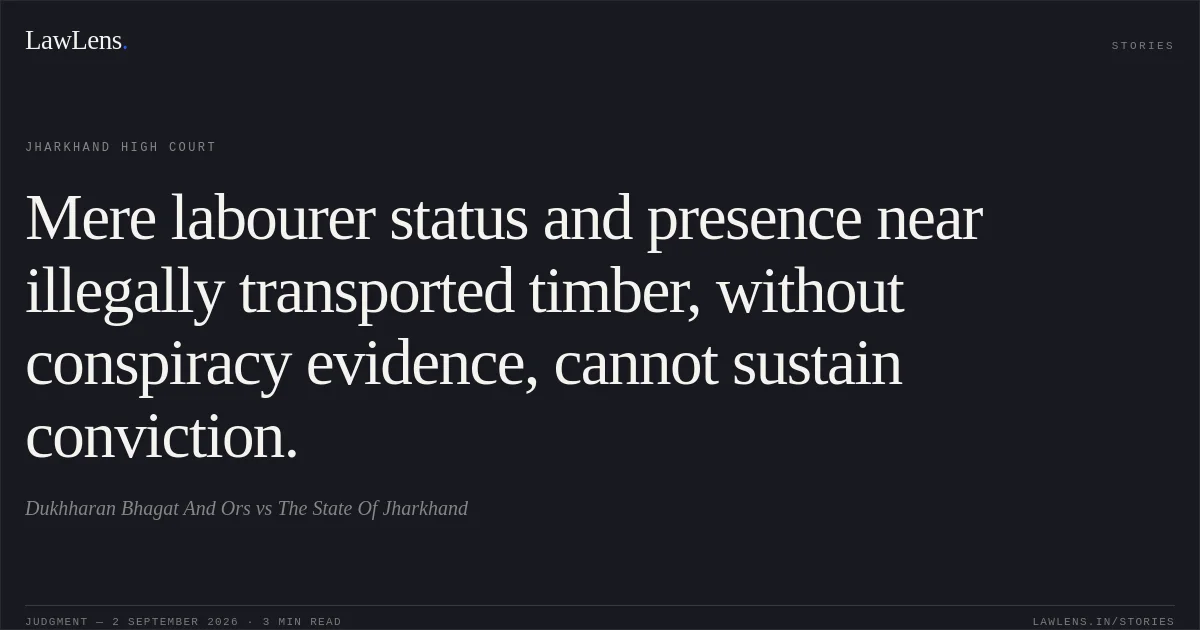
The Court found that the prosecution evidence showed only that the petitioners were labourers apprehended near the truck carrying the wooden logs; it did not establish that they owned, drove or controlled the vehicle or had knowledge of the source or illegal status of the wood.
¶ 12The vehicle owner, driver and khalasi—persons more directly connected with the alleged transportation—were not prosecuted.
¶ 9, 12Crucially, no evidence demonstrated any agreement or meeting of minds between the petitioners and the alleged owner, contractor or other persons involved in the transportation, and therefore the essential element of conspiracy under Section 120B IPC was absent.
¶ 9, 12In the absence of proof connecting the petitioners to the theft, dishonest receipt or disposal of the logs, or to the forest offences, the Court held that the findings of guilt were unsupported and perverse.
¶ 12–13The trial and appellate courts had therefore erred in treating the petitioners’ mere presence and status as labourers as sufficient proof of criminal liability.
¶ 12–1305Holding
The High Court answered the issues in favour of the petitioners.
It held that the prosecution failed to prove the offences under Sections 379, 414 and 120B of the IPC and Sections 33 and 42 of the Indian Forest Act.
¶ 13The judgments of conviction and sentence passed by the trial court and affirmed by the appellate court were set aside, and the criminal revision was allowed.
¶ 13As the petitioners were on bail, they were discharged from their bail bonds and the sureties were also discharged.
¶ 15Pending interlocutory applications, if any, were disposed of, and the trial court record was directed to be returned to the concerned court.
¶ 14, 16Original Court PDF
Dukhharan Bhagat And OrsvsThe State Of Jharkhand
Click to open original judgment
Original judgment, available to read, download and summarize on LawLens.in