Facts
The Petitioner, a joint venture partner, was awarded a contract for the rehabilitation and upgradation of NH-66 in Maharashtra by Respondent No. 5 (Chief Engineer, PWD, Maharashtra)
Source reference: p. 2During execution, a flyover span collapsed at Chiplun, Maharashtra
Source reference: p. 3Following a committee report, the Ministry of Road Transport and Highways (MoRTH) issued a show cause notice through its Ratnagiri office, proposing debarment and a penalty
Source reference: p. 3Subsequently, Respondent No. 2 (DG, MoRTH, New Delhi) approved the action, which was communicated by Respondent No. 3 (Regional Office, Mumbai) and implemented via an impugned circular issued by Respondent No. 4 (Navi Mumbai)
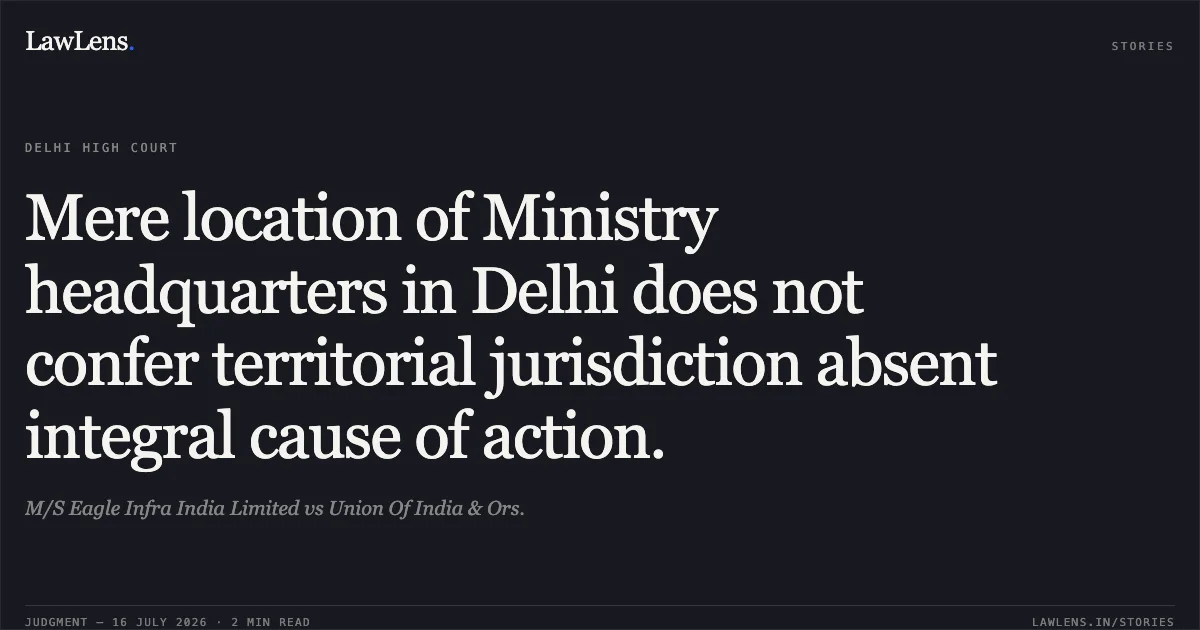
Source reference: p. 3-4The Petitioner challenged the debarment and penalty in the Delhi High Court, arguing that since the MoRTH is headquartered in Delhi and the final decision-making power rested there, the court had jurisdiction
Source reference: p. 4-5Issues
1. Whether the Delhi High Court has the territorial jurisdiction to entertain the writ petition under Article 226 of the Constitution when the project, incident, and implementing authorities are located in Maharashtra
Source reference: p. 4 / para. 42. Whether the fact that the central ministry is headquartered in Delhi and the decision-making process occurred there constitutes a "material" or "integral" part of the cause of action
Source reference: p. 5 / para. 5-6Law Applied
Article 226(2) of the Constitution of India, which mandates that jurisdiction is determined by where the cause of action arises, wholly or in part
Source reference: p. 10-11Kusum Ingots & Alloys Ltd. v. Union of India, which established that the mere seat of the Government does not confer jurisdiction and introduced the doctrine of forum conveniens
Source reference: p. 8-9State of Goa v. Summit Online Trade Solutions (P) Ltd., holding that only material, essential, or integral facts constitute a cause of action
Source reference: p. 9-10Ueta, Inc. & Ors. v. Union of India that corporate headquarters/ministry locations do not automatically vest jurisdiction if all subsequent activities occurred outside that territory
Source reference: p. 11-12Reasoning
The court reasoned that the "bundle of material facts" occurred entirely within Maharashtra: the project site was in Maharashtra, the accident occurred there, the petitioner is based in Thane, and the specific impugned communication and circular were issued by offices in Mumbai and Navi Mumbai
Source reference: p. 7, 13The court rejected the Petitioner's argument that MoRTH’s Delhi headquarters provided jurisdiction, stating that such an interpretation would improperly allow every National Highway dispute in India to be litigated in Delhi
Source reference: p. 12-13Applying the doctrine of forum conveniens, the court found that even if a "slender" part of the administrative approval happened in Delhi, the substance of the matter and the relevant authorities were situated in Maharashtra
Source reference: p. 12-13Holding
The Court held that no integral part of the cause of action arose within its territorial jurisdiction
The writ petition was dismissed for lack of jurisdiction, with liberty granted to the Petitioner to approach the appropriate High Court
Source reference: p. 13-14 / para. 21Under the doctrine of forum conveniens, the Court refused to exercise its discretionary jurisdiction
Source reference: p. 13 / para. 18-20Original Court PDF
M/S Eagle Infra India LimitedvsUnion Of India & Ors.
Click to open original judgment
Original judgment, available to read, download and summarize on LawLens.in