Facts
Kavita married Manoj Kumar on 23 November 2012 and lived with him and his parents.
Source reference: p. 1On 12 June 2013, she died by suicide.
Source reference: p. 1Her mother appealed against the acquittal of Manoj Kumar, Rameshwar Dayal and Usha Devi of offences under Sections 498A and 304B IPC.
Source reference: pp. 1–3The Trial Court found no evidence of cruelty or dowry-related harassment and relied on Kavita’s suicide note, which contained no allegation of either.
Source reference: pp. 1–3In the appeal, the mother argued that the diary entries and other material supported, at least, a charge under Section 306 IPC.
Source reference: p. 4Issues
1. Whether the accused were rightly acquitted of offences under Sections 498A and 304B IPC
Source reference: p. 62. Whether the suicide note and diary entries established abetment of suicide under Section 306 IPC
Source reference: p. 6Law Applied
Sections 498A and 304B IPC require proof of their respective essential ingredients; for Section 304B, the prosecution must establish the statutory conditions before the presumption under Section 113B of the Evidence Act can arise.
Source reference: pp. 2–3The suicide note was treated as a dying declaration relevant under Section 32(1) of the Evidence Act.
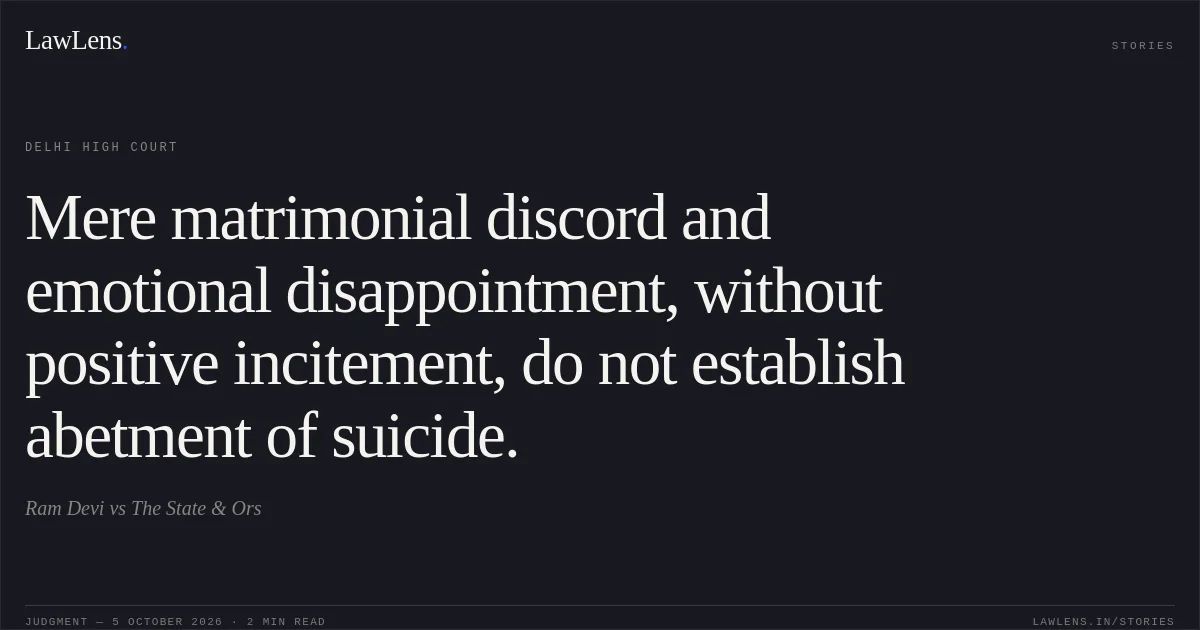
Source reference: p. 3Under Section 306 IPC, abetment requires the requisite mens rea and an act of instigation, intentional aid or other positive conduct that incites or drives the deceased to suicide; mere harassment or ordinary discord, without sufficient evidence of such conduct, is not enough.
Source reference: pp. 6–9The Court applied Gangula Mohan Reddy v. State of A.P., (2010) 1 SCC 750, and Ude Singh v. State of Haryana, (2019) 17 SCC 301.
Source reference: pp. 6–9Reasoning
The Court considered the suicide note and diary entries together.
Source reference: pp. 2–3, 5–6, 9Although they reflected marital difficulties, isolation and disappointment, they also showed Kavita’s affection for her husband and in-laws.
Source reference: pp. 2–3, 5–6, 9The suicide note made no allegation of dowry demand or violence, and the record did not establish cruelty or harassment soon before death so as to satisfy the requirements for Sections 498A or 304B IPC or to raise the Section 113B presumption.
Source reference: pp. 2–3, 5–6, 9The entries described emotional distress and disagreements but did not establish a positive or proximate act of instigation, or other conduct amounting to abetment under Section 306 IPC.
Source reference: pp. 6–10Holding
The Court held that the material did not establish the offences under Sections 498A or 304B IPC or abetment of suicide under Section 306 IPC.
It found no basis to interfere with the acquittal and dismissed the appeal.
Source reference: p. 10Pending applications were disposed of, and the respondents’ personal/bail bonds and sureties were discharged.
Source reference: p. 10Acts & Sections Cited
3 provisions across 2 statutes referred to in this judgment. Each provision opens on LawLens.
Code of Criminal Procedure, 19732
Indian Penal Code, 18601
Original Court PDF
Ram DevivsThe State & Ors
Click to open original judgment
Original judgment, available to read, download and summarize on LawLens.in