Facts
The petitioner, Principal of Marg Darshan College of Nursing, was accused in FIR No. 303/2019 registered for offences under Sections 384, 420 and 34 IPC.
Source reference: para. 3On 16 November 2019, students complained that the college administration had collected examination-related fees, demanded an additional amount of ₹200 per day on the ground of shortage of attendance, and withheld admit cards from students who did not pay, thereby preventing them from appearing in an examination.
Source reference: paras. 3–4The petitioner was arrested on the date of registration of the complaint.
Source reference: paras. 3, 25Following investigation, Final Report/charge-sheet No. 103/2020 dated 30 June 2020 was submitted.
Source reference: para. 2The petitioner invoked the High Court’s inherent jurisdiction under Section 482 CrPC, now corresponding to Section 528 BNSS, seeking quashing of the FIR, final report and consequential proceedings.
Source reference: para. 2He contended that there was no allegation of threat, fear of injury, deception, dishonest inducement, or actual payment of money, and that the investigation had not collected attendance registers, receipts, vouchers or other proof of payment.
Source reference: paras. 4–6The State opposed the petition on the ground that the allegations disclosed a prima facie case and involved disputed questions of fact that ought to be examined at trial.
Source reference: paras. 7–9Issues
Whether the allegations in the FIR and the material collected during investigation disclosed the essential ingredients of extortion under Section 384 IPC against the petitioner?
Source reference: paras. 11, 13–16Whether the allegations and investigation material disclosed the essential ingredients of cheating under Section 420 IPC, read with Section 34 IPC?
Source reference: paras. 11, 17–23, 27Whether the High Court should exercise its inherent jurisdiction under Section 482 CrPC/Section 528 BNSS to quash the criminal proceedings despite the State’s contention that disputed facts should be left to the trial court?
Source reference: paras. 12, 21, 28–29Law Applied
Section 384 IPC applies only where the prosecution prima facie establishes the ingredients of extortion under Section 383 IPC—intentional putting or attempting to put a person in fear of injury, followed by dishonest inducement to deliver property or valuable security.
Source reference: paras. 14–16Section 420 IPC requires deception and dishonest inducement, resulting in delivery of property or the doing or omission of an act causing or likely to cause legally contemplated damage or harm; dishonest intention must be established from the allegations and material on record.
Source reference: paras. 17–20Section 34 IPC creates joint liability for a criminal act done by several persons in furtherance of common intention but is not an independent substantive offence.
Source reference: para. 27Under Section 482 CrPC, now Section 528 BNSS, the High Court may quash proceedings where, even accepting the allegations at face value, the essential ingredients of the alleged offences are absent; however, the Court must not ordinarily conduct a mini-trial or undertake meticulous appreciation of evidence.
Source reference: paras. 12, 21, 29The Court also relied on Lalita Kumari v. Government of Uttar Pradesh, (2014) 2 SCC 1, and Siddharth v. State of Uttar Pradesh, (2022) 1 SCC 676, for the principles that registration of an FIR does not automatically require arrest and that arrest is distinct from the filing of a charge-sheet.
Source reference: paras. 6, 25Reasoning
The Court held that the allegation of demanding ₹200 per day and withholding admit cards for non-payment, even if accepted, did not disclose that the petitioner placed the students in fear of injury or thereby dishonestly induced them to deliver property, as required for extortion under Sections 383–384 IPC.
Source reference: paras. 13–16The prosecution also failed to identify any false representation or deception, specify what representation was made or how it was false, or demonstrate that any complainant actually paid money pursuant to dishonest inducement.
Source reference: paras. 17–20No receipt, voucher or other evidence of payment was collected.
Source reference: paras. 17–20The alleged fraud-related insertion at the bottom of the complaint, without separate signature or date and lacking particulars of deception or inducement, further weakened the prosecution case when considered alongside the absence of payment evidence.
Source reference: paras. 22–23Although the Court noted that the attendance registers had not been seized, it clarified that it was not deciding the legality of the demand; rather, the absence of such material underscored the lack of foundational evidence supporting the prosecution’s factual case.
Source reference: para. 24The Court therefore concluded that this was not a case requiring resolution of disputed facts through trial, because the prosecution allegations themselves did not constitute the offences alleged.
Source reference: paras. 21, 28–30The petitioner’s allegedly hasty arrest was noted, but the proceedings were quashed independently of that issue.
Source reference: paras. 25–26Holding
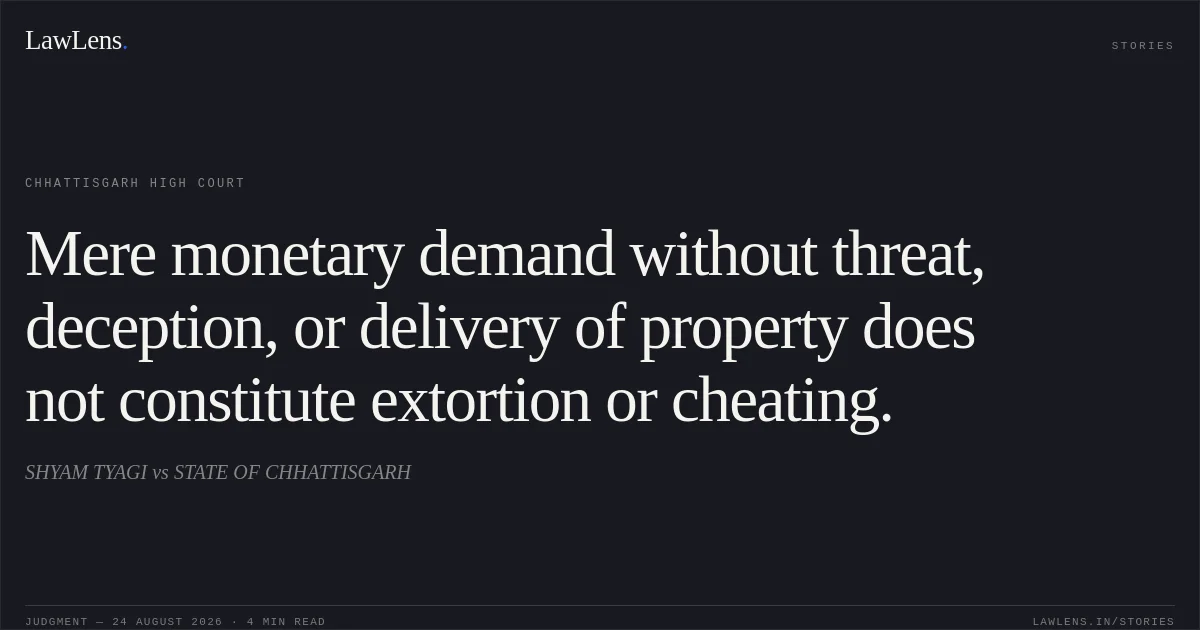
The High Court answered the issues in favour of the petitioner, holding that the FIR and investigation material did not disclose the essential ingredients of extortion under Section 384 IPC or cheating under Section 420 IPC, and that invocation of Section 34 IPC could not independently sustain the prosecution.
The petition was allowed, and FIR No. 303/2019, Final Report/charge-sheet No. 103/2020 dated 30 June 2020, and all consequential criminal proceedings pending before the Judicial Magistrate First Class, Baikunthpur, were quashed insofar as they related to the petitioner.
Source reference: paras. 33–34Acts & Sections Cited
6 provisions across 3 statutes referred to in this judgment. Linked provisions open on LawLens.
Indian Penal Code, 18604
Code of Criminal Procedure, 19731
Bharatiya Nagarik Suraksha Sanhita, 20231
Original Court PDF
SHYAM TYAGIvsSTATE OF CHHATTISGARH
Click to open original judgment
Original judgment, available to read, download and summarize on LawLens.in