Facts
Deepak Tigga, while serving as Assistant Provident Fund Commissioner at SRO, Bhagalpur, conducted proceedings under Section 7C of the Employees’ Provident Funds and Miscellaneous Provisions Act, 1952, concerning Katihar Medical College.
Source reference: pp. 2–8, paras. 2.1–2.11The proceedings related to alleged escaped provident-fund dues after an earlier Section 7C assessment of ₹56,12,483 was quashed by the EPF Appellate Tribunal and remanded for fresh determination.
Source reference: pp. 2–8, paras. 2.1–2.11After examining the materials and relying, inter alia, on the Enforcement Officer’s report, Tigga closed the proceedings on 4 November 2010, holding that there was no reasonable ground for determining any further amount.
Source reference: p. 5, para. 2.11The EPFO subsequently initiated disciplinary proceedings, alleging that Tigga had acted negligently and recklessly by failing to summon and examine relevant records, failing to appreciate the establishment’s case history, and relying on a motivated and inadequate Enforcement Officer’s report.
Source reference: pp. 22–23, para. 35After his retirement, the disciplinary authority imposed a pension cut of 30% for five years under Rule 9 of the CCS (Pension) Rules, 1972; his challenge to the penalty was rejected on 20 April 2022.
Source reference: pp. 8–9, paras. 2.12–2.13The Central Administrative Tribunal quashed both orders, holding that Tigga had acted in a quasi-judicial capacity, that the alleged misconduct was not established, and that there was no evidence of corruption, bribery, or a subsequent contrary determination on the same material.
Source reference: pp. 33–34, para. 53The EPFO challenged the Tribunal’s order under Article 226 of the Constitution.
Source reference: pp. 1–2, para. 1Issues
1. Whether the Tribunal’s order quashing the disciplinary penalty suffered from an error apparent on the face of the record or perversity warranting interference by the High Court under Article 226 of the Constitution.
Source reference: pp. 13–18, paras. 16–272. Whether disciplinary proceedings could validly be initiated against Tigga for alleged negligence and recklessness in passing an order under Section 7C of the EPF Act while exercising quasi-judicial functions.
Source reference: pp. 24–25, paras. 39–423. Whether the charge, absent allegations of extraneous consideration, mala fides, corruption, or undue favour, constituted misconduct rather than a mere error of judgment in a quasi-judicial determination.
Source reference: pp. 31–32, paras. 46–50Law Applied
The Court applied Sections 7A, 7B, 7C and 7-I of the EPF Act, 1952, which confer quasi-judicial powers for determining provident-fund dues and provide statutory review and appellate remedies.
Source reference: pp. 18–22, paras. 29–31It applied the limited scope of judicial review under Article 226/227, as explained in L. Chandra Kumar v. Union of India, under which Tribunal decisions may be scrutinised by the High Court but interference is warranted only for jurisdictional error, an error apparent on the face of the record, or perversity.
Source reference: pp. 13–15, paras. 16–19West Bengal Central School Service Commission v. Abdul Halim and T.C. Basappa v. T. Nagappa establish that an apparent error must be self-evident and not one requiring elaborate reasoning.
Source reference: pp. 15–16, paras. 20–22Arulvelu v. State and Damodar Lal v. Sohan Devi explain that perversity exists where findings disregard material evidence, rely on irrelevant material, or are so irrational that no reasonable decision-maker could reach them.
Source reference: pp. 16–18, paras. 23–25On disciplinary proceedings against quasi-judicial officers, Union of India v. K.K. Dhawan permits action where there is prima facie recklessness, culpable negligence, lack of good faith, undue favour, or violation of essential statutory conditions, but not for a mere technical or legal error.
Source reference: pp. 26–27, para. 44Zunjarrao Bhikaji Nagarkar v. Union of India further holds that negligence in quasi-judicial adjudication must be culpable and that something more than an erroneous order—such as extraneous consideration, mala fides, or dishonest conduct—must ordinarily be shown.
Source reference: pp. 27–31, paras. 45–47Reasoning
The High Court recognised that Tigga’s order was made in exercise of statutory quasi-judicial power under Section 7C and that the EPF Act itself provided appellate review under Section 7-I.
Source reference: pp. 18–22, paras. 28–33Although the EPFO alleged that he failed to verify records and improperly relied on the Enforcement Officer’s report, the charge memorandum did not allege or establish corruption, bribery, mala fides, extraneous influence, monetary benefit, or deliberate favour to the establishment.
Source reference: pp. 22–23, para. 35; pp. 31–32, paras. 48–50The allegation therefore substantially concerned the correctness and diligence of the adjudicatory decision, rather than independent misconduct.
Source reference: pp. 31–32, paras. 48–50Applying K.K. Dhawan and Nagarkar, the Court held that mere negligence, carelessness, omission, or an erroneous conclusion in a quasi-judicial order could not, without more, justify disciplinary action.
Source reference: pp. 24–31, paras. 40–47The Tribunal had also noted that no later decision on the same factual record demonstrated that Tigga’s conclusion was factually untenable.
Source reference: pp. 32–34, paras. 52–58Consequently, the Tribunal’s reasoning was neither irrational nor unsupported by the record and did not meet the threshold of perversity or error apparent on the face of the record.
Source reference: pp. 34–35, paras. 59–60Holding
The High Court answered the issues against the EPFO.
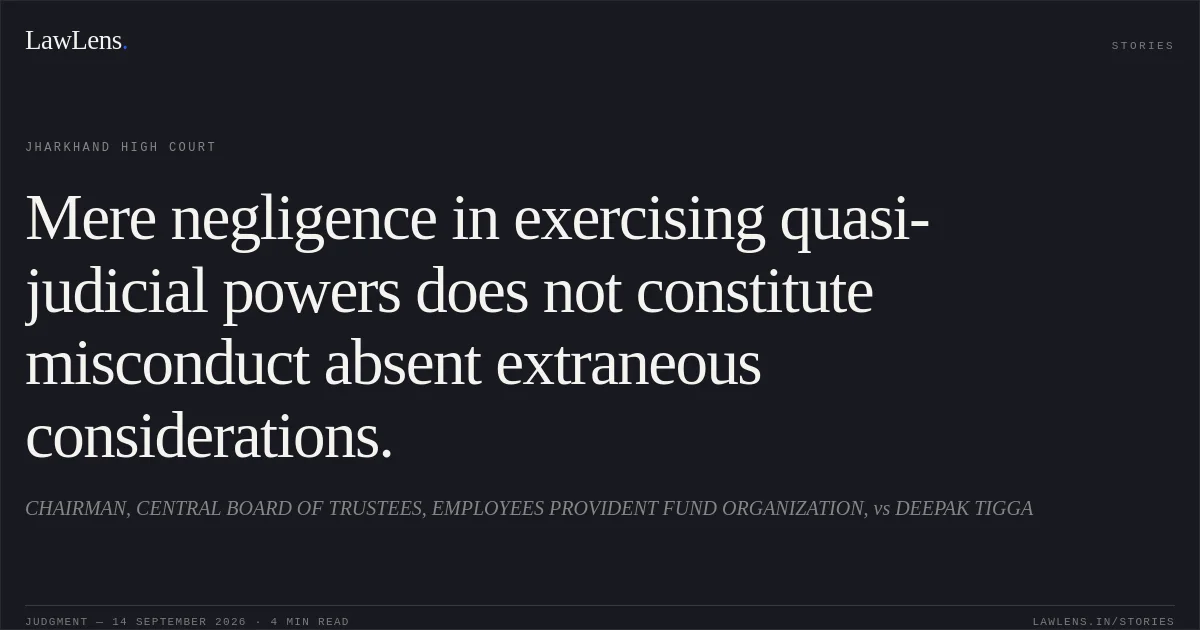
It held that the disciplinary proceedings and pension penalty were based essentially on an alleged error or omission in the exercise of quasi-judicial power, without sufficient material showing culpable misconduct, dishonest motive, extraneous consideration, or undue favour.
Source reference: pp. 31–35, paras. 46–60Finding no perversity or error apparent in the Tribunal’s order, the Court dismissed the writ petition and affirmed the quashing of the penalty orders dated 29 June 2021 and 20 April 2022.
Source reference: p. 36, paras. 61–63The Tribunal’s direction to refund the pension amount deducted as penalty, with statutory interest within three months, consequently remained operative.
Source reference: p. 36, paras. 61–63Acts & Sections Cited
6 provisions across 2 statutes referred to in this judgment. Each provision opens on LawLens.
Indian Penal Code, 18604
Administrative Tribunals Act, 19852
Original Court PDF
CHAIRMAN, CENTRAL BOARD OF TRUSTEES, EMPLOYEES PROVIDENT FUND ORGANIZATION,vsDEEPAK TIGGA
Click to open original judgment
Original judgment, available to read, download and summarize on LawLens.in
![A senior employee’s pay must be stepped up when a junior in the same cadre and post draws higher pay.. Nirmal Dev vs N E Rly.. CAT - ['Allahabad']. LawLens](/stories/thumbnails/a-senior-employees-pay-must-be-stepped-up-when-a-junior-in-the-same-cadre-and-post-draws-h-9f64fdc124814a90ad0adf013f00b440.webp)