Facts
The petitioner, while serving as a Branch Manager at Chhitraulia branch (joining on 26.06.2016), was issued a chargesheet on 02.03.2020 alleging negligence in safe-keeping 108 missing loan documents
Source reference: p. 1-2The Bank relied on a circular dated 27.10.2015, which mandated managers to report discrepancies within 45 days of joining, failing which they would be held responsible for any losses
Source reference: p. 6An enquiry was conducted where the petitioner produced a "clearance certificate" issued to his predecessor noting that numerous documents were already missing at the time of takeover; however, the Enquiry Officer discarded this as "irrelevant"
Source reference: p. 8Based on the enquiry report dated 26.02.2021, the disciplinary authority inflicted a punishment of reduction to the initial stage of pay scale for five years
Source reference: p. 2The petitioner’s appeal was rejected on 29.10.2022
Source reference: p. 2Issues
1. Whether the failure to report missing documents within the timeline prescribed by a Bank circular constitutes "misconduct" under Regulations 18 and 20 of the Uttar Bihar Gramin Bank Service Regulations, 2010
Source reference: p. 92. Whether the findings of the Enquiry Officer were perverse due to the non-consideration of material evidence (clearance certificate) and reliance on assumptions rather than positive evidence
Source reference: p. 10Law Applied
The court applied Regulations 18 and 20 of the Uttar Bihar Gramin Bank (Officers and Employees) Service Regulations, 2010, which mandate obedience to orders and the obligation to promote the Bank's interest
Source reference: p. 9It heavily relied on the Supreme Court precedents of Union of India v. J. Ahmed (1979) and State of Punjab v. Ex-Constable Ram Singh (1992), which established that "misconduct" requires a wrongful intention, wilful character, or gross negligence with irreparable consequences, and specifically excludes mere errors of judgment, innocent mistakes, or simple negligence
Source reference: p. 11-15Reasoning
The court found that the Bank failed to provide any positive evidence, oral or documentary, proving that the loan documents went missing during the petitioner's specific tenure
Source reference: p. 15The disciplinary action was based solely on a "deduction/assumption" derived from the 45-day reporting rule in the 27.10.2015 circular
Source reference: p. 10-11The court observed that the Enquiry Officer committed a grave error by summarily discarding the petitioner’s clearance certificate—which proved the documents were missing prior to his arrival—as "irrelevant"
Source reference: p. 15-16Applying the J. Ahmed standard, the court reasoned that even if the petitioner failed to report the loss within the 45-day window, such an act at best constituted "carelessness or negligence," which does not satisfy the legal threshold of "misconduct" since there was no proof of wrongful intent or a forbidden act
Source reference: p. 16Holding
The Court held that the charges were not proved by evidence and the petitioner’s actions did not amount to misconduct
It quashed the order of punishment dated 20.05.2021 and the appellate order dated 29.10.2022. The writ application was allowed, and the Court directed the Bank to grant the petitioner all consequential benefits
Source reference: p. 16Original Court PDF
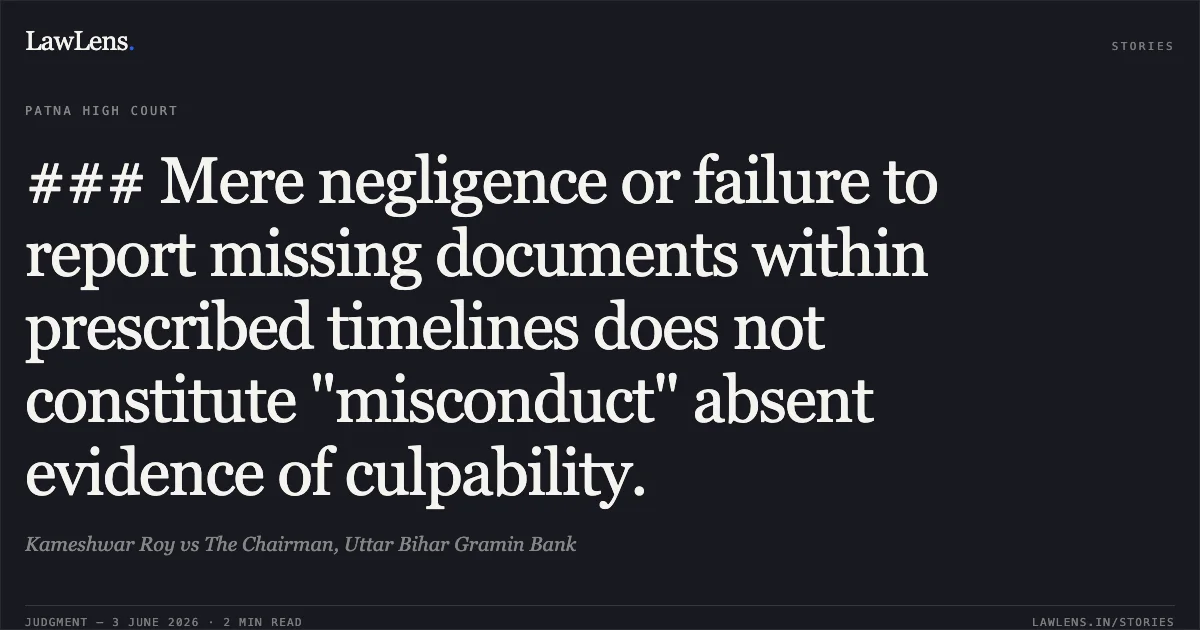
Kameshwar RoyvsThe Chairman, Uttar Bihar Gramin Bank
Click to open original judgment
Original judgment, available to read, download and summarize on LawLens.in


