Facts
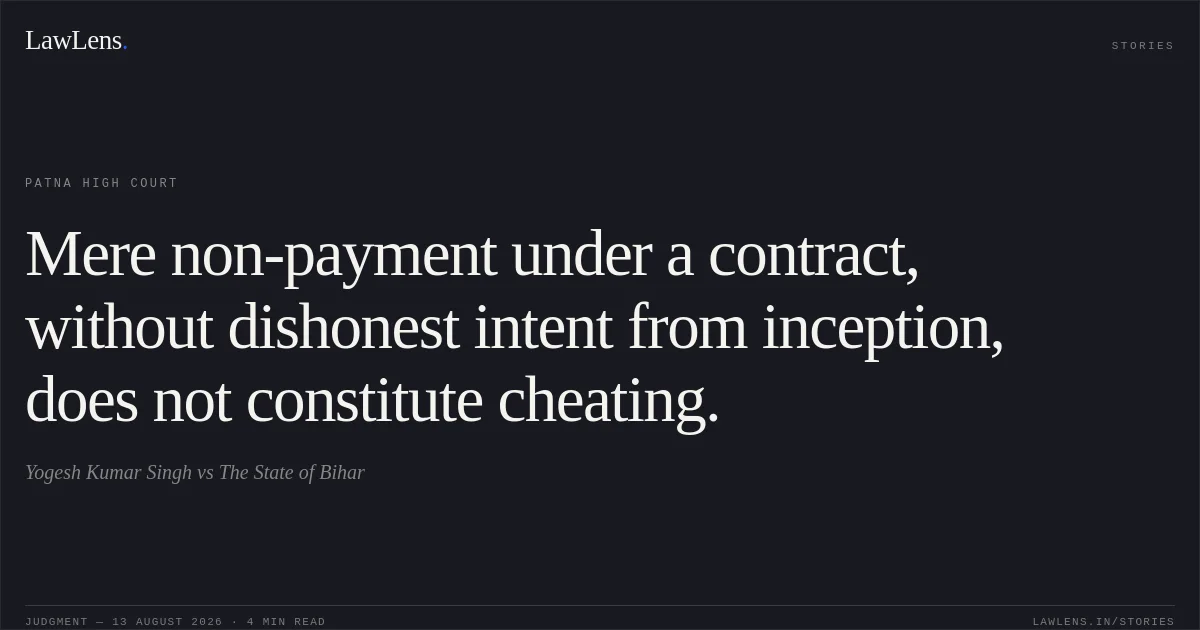
The petitioner-complainant, acting as agent of the landowner, entered into an agreement dated 15 January 2021 with Opposite Party Nos. 2 and 3 for purchase of five kathas of land for ₹2.26 crore, against which ₹20 lakh was paid as advance.
Source reference: para. 3At the accused persons’ request, the landowner subsequently executed a sale deed dated 25 February 2022 for 6 kathas and 6 dhurs in favour of Opposite Party No. 2. The accused allegedly paid ₹1.60 crore into the accounts of the landowner’s wife and son but failed to pay the balance amount of ₹90.20 lakh, comprising the unpaid consideration and the price of the additional land.
Source reference: para. 3The petitioner filed Complaint Case No. 763 of 2022 alleging offences under Sections 120-B, 406, 420, 504, 506 and 34 of the IPC. The Judicial Magistrate dismissed the complaint under Section 203 CrPC on 24 January 2024, finding no prima facie criminal case and holding the dispute to be civil in nature.
Source reference: para. 7The petitioner’s criminal revision was dismissed by the Additional Sessions Judge-XI, Siwan, on 1 October 2024, who affirmed that the dispute concerned enforcement of an agreement and recovery of money. The petitioner thereafter sought quashing of the revisional order before the High Court.
Source reference: paras. 8–9Issues
1. Whether the alleged failure of the accused to pay the balance sale consideration constituted cheating under Section 420 IPC, in the absence of material showing fraudulent or dishonest intention at the inception of the agreement?
Source reference: paras. 11–13, 162. Whether the allegations disclosed criminal breach of trust under Section 406 IPC when there was no specific averment of entrustment, dishonest misappropriation or conversion of property?
Source reference: para. 143. Whether the complaint, essentially concerning non-payment of contractual dues, disclosed any criminal offence warranting interference with the orders dismissing the complaint under Section 203 CrPC and dismissing the criminal revision?
Source reference: paras. 17–21Law Applied
The Court applied Section 203 CrPC, under which a complaint may be dismissed where, after considering the complainant’s statements and the inquiry material, there is no sufficient ground for proceeding. Sections 405–406 IPC require entrustment of property followed by dishonest misappropriation or conversion, while Section 420 IPC requires deception and fraudulent or dishonest inducement, with the dishonest intention ordinarily existing at the time the promise or representation was made.
Source reference: paras. 10–14The Court relied on Vesa Holdings Private Limited v. State of Kerala, (2015) 8 SCC 293, for the principle that every breach of contract does not amount to cheating and that subsequent failure to perform, without dishonest intention at inception, is not an offence under Section 420 IPC.
Source reference: para. 16It also relied on Delhi Race Club (1940) Ltd. v. State of Uttar Pradesh, (2024) 10 SCC 690, distinguishing cheating from criminal breach of trust: cheating involves dishonest inducement at the inception, whereas criminal breach of trust requires lawful entrustment followed by dishonest misappropriation.
Source reference: para. 15The Court further treated the dispute as a civil contractual claim for money and enforcement of the agreement.
Source reference: paras. 8–9Reasoning
The Court found that the complaint’s substance was the alleged non-payment of ₹90.20 lakh after the sale deed had been executed and substantial consideration of ₹1.80 crore had already been paid.
Source reference: paras. 4, 12–13Mere subsequent failure to pay the remaining consideration did not establish that the accused possessed fraudulent or dishonest intention when the agreement was made; consequently, the essential requirement of dishonest inducement under Section 420 IPC was absent.
Source reference: paras. 11–13Section 406 IPC was also not attracted because the petitioner neither established entrustment of property to the accused nor alleged its dishonest misappropriation or conversion.
Source reference: para. 14The Court additionally noted that the complainant and his inquiry witnesses did not support the alleged incident of 22 April 2022 during the inquiry, weakening the factual basis for criminal proceedings.
Source reference: para. 17Since the grievance was essentially recovery of contractual dues, the appropriate remedy lay in civil proceedings, including enforcement of the agreement, rather than prosecution.
Source reference: paras. 9, 17–20Holding
The High Court held that the complaint did not disclose the ingredients of cheating, criminal breach of trust, criminal conspiracy or the other alleged offences. The non-payment of the balance contractual amount constituted, at most, a civil dispute and did not justify criminal prosecution.
Finding no illegality or perversity in the Magistrate’s order dismissing the complaint under Section 203 CrPC or in the revisional court’s order affirming it, the Court dismissed the quashing application. Any pending interlocutory applications were also disposed of.
Source reference: paras. 21–22Acts & Sections Cited
8 provisions across 2 statutes referred to in this judgment. Each provision opens on LawLens.
Code of Criminal Procedure, 19731
Indian Penal Code, 18607
Original Court PDF
Yogesh Kumar SinghvsThe State of Bihar
Click to open original judgment
Original judgment, available to read, download and summarize on LawLens.in