Facts
The deceased, Zaheer Ahmad, was allegedly travelling by Train No. 74021 from Rampur Maniharan to Saharanpur on 20.02.2022 when he fell from the train near Jandhera Samaspur and died.
Source reference: pp.1–2The claimants contended that the journey ticket was lost in the accident.
Source reference: pp.1–2The Railway Claims Tribunal dismissed the claim, holding that the deceased was not proved to be a bona fide passenger because no ticket was recovered during jamatalashi, and that the occurrence was not an “untoward incident” under the Railways Act, 1989.
Source reference: pp.1–2The claimants challenged that decision under Section 23 of the Railway Claims Tribunal Act, 1987.
Source reference: pp.1–2The High Court also condoned a delay of 335 days in filing the appeal, considering the appellants’ economic condition and the beneficial nature of the legislation.
Source reference: pp.1–2The contemporaneous panchnama and police records described the occurrence as a fall from a train, while the Railway relied on the body having been found on the “off side” of the track and on the nature of the injuries.
Source reference: pp.5–6Issues
1. Whether the deceased was a bona fide passenger despite the non-recovery of a journey ticket.
Source reference: pp.3–4; paras 7–112. Whether the deceased’s death resulted from an “untoward incident” under the Railways Act, 1989, or whether the Railway established an exclusion under the proviso to Section 124-A.
Source reference: pp.5–7; paras 12–18Law Applied
The Court applied Section 23 of the Railway Claims Tribunal Act, 1987 concerning appeals to the High Court, and Sections 123(c) and 124-A of the Railways Act, 1989 concerning “untoward incidents” and statutory liability for compensation.
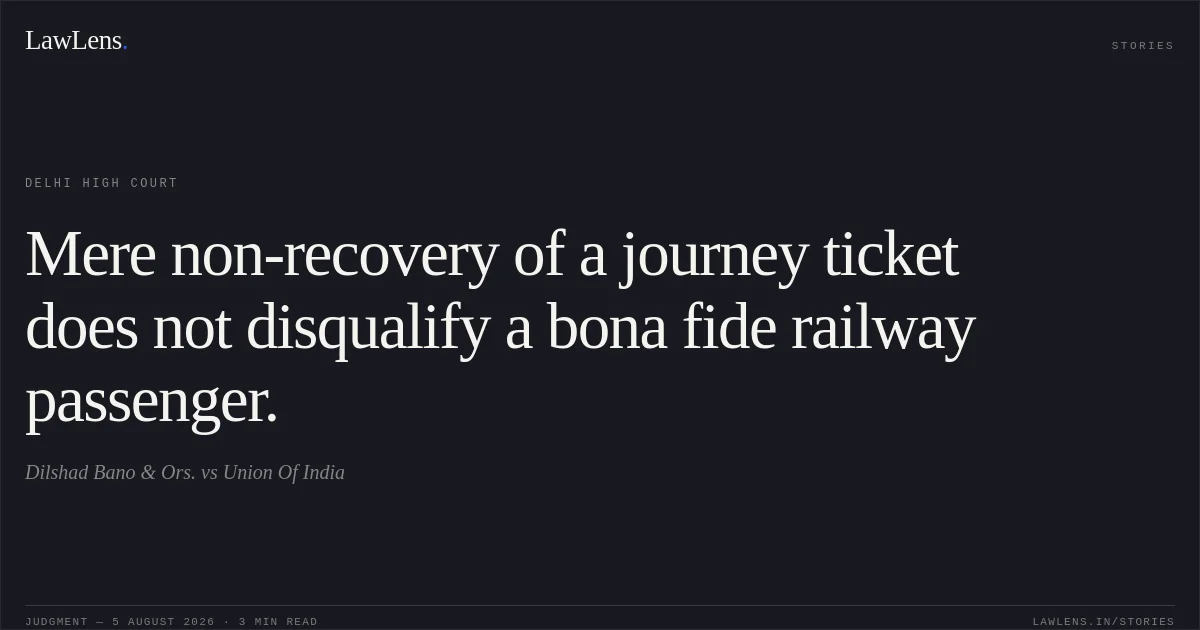
Source reference: no citationIt held that mere non-recovery of a journey ticket does not, by itself, establish that the deceased was not a bona fide passenger; under Union of India v. Rina Devi, (2019) 3 SCC 572, the claimants’ initial burden is not onerous and, once attendant facts and circumstances are shown, the burden shifts to the Railway to rebut the claim by cogent evidence.
Source reference: p.4; para 9The Court also relied on Lata v. Union of India, 2026 SCC OnLine SC 1350, which reiterated this principle.
Source reference: p.4; para 9Further, under Guruvachan Singh v. Union of India, 2026 SCC OnLine Del 2351, the place where a body is recovered cannot, by itself, determine the manner of the incident without cogent supporting evidence.
Source reference: p.7; para 17The Railway must establish that the case falls within one of the exceptions contained in the proviso to Section 124-A.
Source reference: p.7; para 18Reasoning
The Court found that the claimants had consistently pleaded that the deceased was travelling between the stated stations and that the ticket had been lost in the accident.
Source reference: pp.4–5; paras 9–11The Tribunal had incorrectly treated the absence of a recovered ticket as decisive, although the Railway produced no cogent evidence rebutting the claim or proving that the deceased was not a bona fide passenger.
Source reference: pp.4–5; paras 9–11As to the manner of occurrence, the earliest official records—including the Station Master’s memo and panchnama—recorded a fall from a train and did not suggest suicide, trespass, crossing of the railway line, or any other exclusion under Section 124-A.
Source reference: p.5; para 12The statements of the loco pilot and guard merely established that a body was noticed after the incident; neither witness had seen the occurrence or stated that the deceased was attempting to board the train from the off side.
Source reference: p.6; para 14The Tribunal’s conclusions based on the location of the body and the nature of the injuries were speculative, as there was no medical or expert evidence establishing that the injuries could not have resulted from an accidental fall.
Source reference: pp.6–7; paras 15–16Accordingly, the Railway failed to prove any statutory exception.
Source reference: no citationHolding
The High Court held that the deceased was a bona fide passenger and that his death was the result of an untoward incident covered by Section 124-A of the Railways Act, 1989.
The Tribunal’s judgment was set aside.
Source reference: pp.7–8; paras 19–21The matter was remanded to the Tribunal to assess the compensation payable in accordance with law and to direct disbursement by the concerned authorities within two months of receiving the judgment.
Source reference: pp.7–8; paras 19–21The matter was directed to be listed before the Tribunal on 21.08.2026, and the appeal was allowed and disposed of accordingly.
Source reference: pp.7–8; paras 19–21Original Court PDF
Dilshad Bano & Ors.vsUnion Of India
Click to open original judgment
Original judgment, available to read, download and summarize on LawLens.in