Facts
The deceased, Ramesh Dangi, committed suicide by consuming Sulphas poison
Source reference: para. 2, 9The prosecution alleged that the deceased had taken a loan of ₹40,000 from Respondent No. 1, providing two blank cheques as security. Despite repaying the loan, the respondents allegedly refused to return the cheques, took additional cash amounting to ₹1,50,000, and continued to pressurize the deceased for more money
Source reference: para. 2, 10A suicide note (Ex. P/18) named three individuals (Deepak Prajapati, Sattu Patidar, and a "Muslim Patel") as responsible for his death due to harassment over money
Source reference: para. 10The Trial Court (Sessions Judge, Sehore) acquitted the accused of charges under Sections 306/34 of the IPC on 03.08.2023
Source reference: para. 1, 6The State filed this appeal seeking leave to challenge the acquittal
Source reference: para. 1Issues
1. Whether the allegations of financial dispute and non-return of security cheques, as mentioned in the suicide note and oral testimony, constitute "instigation" or "abetment" under Section 107 of the IPC
Source reference: para. 14, 202. Whether the Trial Court’s findings regarding the inconsistencies in the prosecution’s evidence and the handwriting expert's report were perverse or legally implausible
Source reference: para. 13, 24Law Applied
The court applied Section 306 (Abetment of suicide) read with Section 107 (Definition of abetment) of the IPC
Source reference: para. 14The court relied on S.S. Cheena v. Vijay Kumar Mahajan, establishing that abetment requires a "positive act" or "active act" with clear mens rea to push the deceased to suicide
Source reference: para. 16It further cited Prakash and Oris. v. State of Maharashtra, emphasizing that instigation must be in "close proximity" to the suicide and leave the victim with no other option
Source reference: para. 18Regarding the scope of appeals against acquittal, the court followed Mallappa v. State of Karnataka, which mandates that if two views are possible, the view in favor of the accused must prevail
Source reference: para. 23Reasoning
The High Court observed that while the death was suicidal, the prosecution failed to establish the critical element of "instigation"
Source reference: para. 14The court noted significant evidentiary gaps: the handwriting on the initial complaint (Ex. P/5) was not verified by an expert, and PW-1 admitted his signature was obtained posthumously
Source reference: para. 11, 12The suicide note (Ex. P/18) did not specify exact debts or clarify how the alleged harassment directly incited the act of suicide
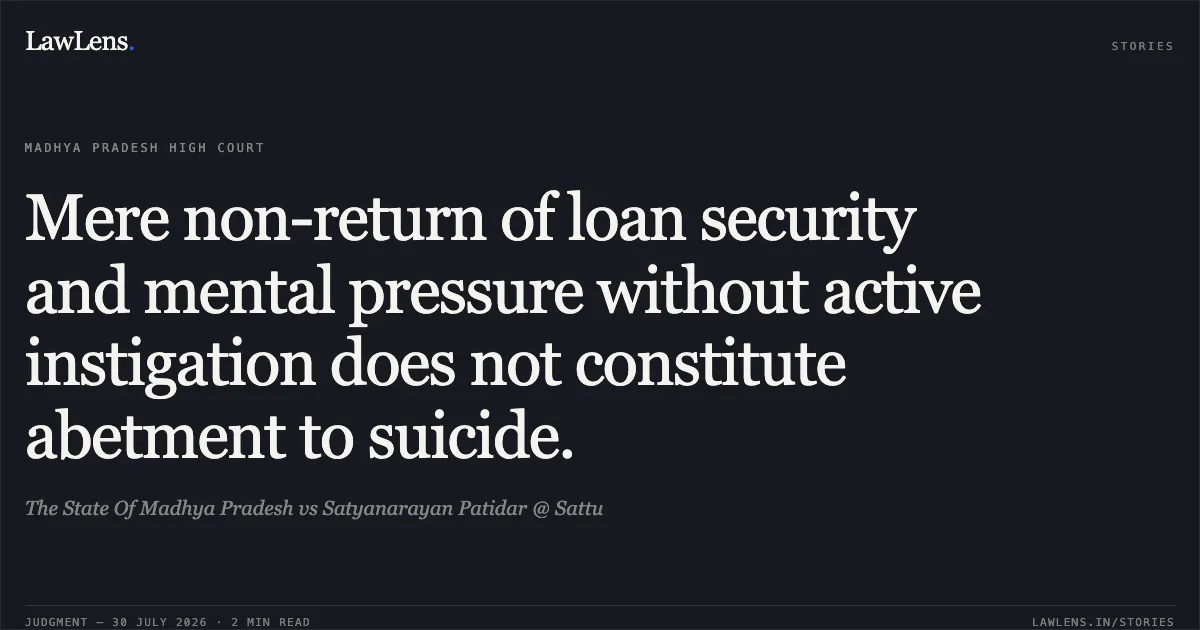
Source reference: para. 13Applying the precedents, the Court reasoned that mere financial disputes, threats, or the non-return of cheques do not amount to the active, intentional provocation required for a conviction under Section 306 IPC
Source reference: para. 14, 19, 20The Court found that the Trial Court's decision was a "legally plausible view" based on the inconsistencies in witness testimonies and the expert report
Source reference: para. 24Holding
The High Court held that the prosecution failed to prove an offense under Section 306/34 IPC beyond reasonable doubt, as the evidence did not satisfy the legal requirements of "abetment" as defined in Section 107 IPC
The Court dismissed the applications seeking leave to appeal (I.A. No. 27718/2023 and I.A. No. 16926/2025) and consequently dismissed the criminal appeal, upholding the Trial Court’s judgment of acquittal
Source reference: para. 25Acts & Sections Cited
5 provisions across 2 statutes referred to in this judgment. Each provision opens on LawLens.
Code of Criminal Procedure, 19732
Indian Penal Code, 18603
Original Court PDF
The State Of Madhya PradeshvsSatyanarayan Patidar @ Sattu
Click to open original judgment
Original judgment, available to read, download and summarize on LawLens.in