01Facts
The second respondent’s complaint led to registration of Crime No. 18/2023 and, after investigation, a charge sheet alleging offences under Sections 323, 324, 354, 354-B, 307, 504 and 506 read with Section 149 of the Indian Penal Code.
pp. 4–6The allegations concerned two incidents on 25 and 26 January 2023, including an alleged assault and trespass; as to accused No. 5, the charge sheet alleged only that she was among those who arrived at the scene, without attributing a specific overt act to her.
pp. 4–6Petitioners Nos. 1–4 and 6–8 withdrew their challenge, which was dismissed as not pressed; the Court considered the petition on merits only for petitioner No. 5.
pp. 4, 7–802Issues
i.Whether the criminal proceedings against accused No. 5 could be quashed where no specific overt act was attributed to her
pp. 5–6ii.Whether the material on record was sufficient to infer that accused No. 5 shared the common object of the other accused under Section 149 IPC
p. 603Law Applied
The Court considered Section 149 IPC, under which a specific overt act by each accused is not invariably required where liability is based on membership of an unlawful assembly sharing a common object.
p. 6However, the record must contain material capable of supporting the inference that the particular accused shared that common object; the Court also considered its jurisdiction under Articles 226 and 227 of the Constitution read with Section 482 of the Code of Criminal Procedure to quash the proceedings.
pp. 3, 6–7Provisions in the judgment · 9 · Linked ones open on LawLens
Code of Criminal Procedure, 1973 Section 482
Indian Penal Code, 1860 Section 323Section 324Section 354Section 307Section 448Section 149Section 504Section 506
04Reasoning
The Court accepted that the absence of a specific overt act would not, by itself, defeat a prosecution invoking Section 149 IPC.
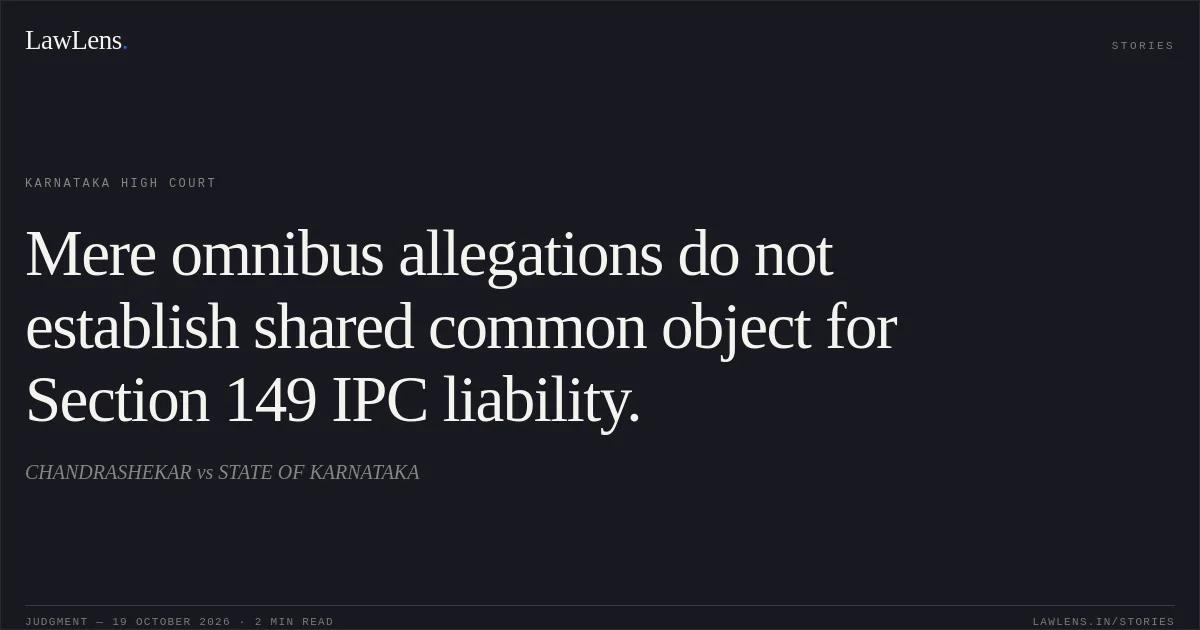
p. 6But the charge-sheet material against accused No. 5 consisted only of an omnibus allegation that she was present, and the Court found no material showing that she shared the other accused’s common object.
pp. 6–7Her name being mentioned in connection with the incident was therefore insufficient to justify continuation of the prosecution against her.
p. 705Holding
The Court allowed the petition as to petitioner No. 5/accused No. 5 and quashed the pending proceedings against her.
p. 8The petition as to petitioners Nos. 1–4 and 6–8 was dismissed as not pressed, with liberty as prayed for.
p. 8Original Court PDF
CHANDRASHEKARvsSTATE OF KARNATAKA
Click to open original judgment
Original judgment, available to read, download and summarize on LawLens.in



