Facts
The petitions arose from disciplinary proceedings against six teachers of Vidya Bharti School concerning protests outside the School during 1–3 August 2013 and subsequent demonstrations.
Source reference: paras. 14–18; pp. 5–7The teachers contended that the protests arose from unresolved service grievances, including implementation of Sixth Central Pay Commission benefits, and that they had been prevented from entering the School.
Source reference: paras. 14–18; pp. 5–7The School alleged mass absenteeism, unlawful protest, obstruction of the School gates, abusive slogans, stone-pelting, damage to property, false complaints and other acts of serious misconduct.
Source reference: paras. 14–18; pp. 5–7The School initiated disciplinary proceedings against a limited number of teachers whom it identified as organisers or active participants, rather than against all approximately fifty teachers allegedly present at the protest.
Source reference: paras. 8–13; pp. 4–5The Inquiry Officers found several charges proved and the teachers were removed from service between 2014 and 2018.
Source reference: paras. 8–13; pp. 4–5On statutory appeals under the Delhi School Education Act, 1973, the Delhi School Tribunal set aside the removal orders and directed reinstatement, while leaving the question of pre-appeal back wages to the Managing Committees under Rule 121 of the Delhi School Education Rules, 1973.
Source reference: paras. 3, 8–13, 130–132; pp. 2–5, 33–34Issues
1. Whether the Delhi School Tribunal, while exercising appellate jurisdiction under Section 11(6) of the Delhi School Education Act, 1973, was entitled to examine the legality, correctness and evidentiary basis of the disciplinary findings and penalty.
Source reference: paras. 24–28; pp. 8–92. Whether statements adopted by witnesses in domestic inquiries, photographs, video recordings and other electronic material could be considered despite the absence of formal examination-in-chief or a certificate under Section 65B of the Evidence Act.
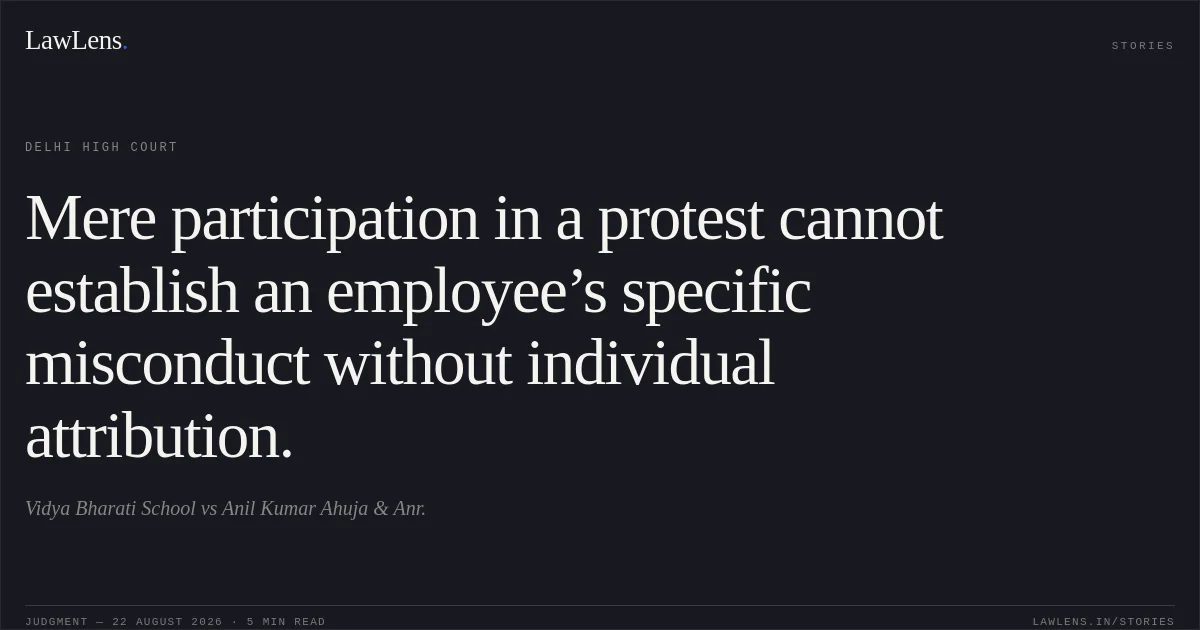
Source reference: paras. 29–34, 46–54; pp. 9–163. Whether the disciplinary findings against each teacher were sustainable where the evidence established participation in a group protest but did not individually attribute the specific acts of stone-pelting, abusive language, obstruction, defacement or property damage alleged in the charges.
Source reference: paras. 37–45, 54–107; pp. 12–294. Whether the earlier stoppage of increments and deduction of salary for alleged absence constituted double punishment barring the subsequent removal proceedings.
Source reference: paras. 108–112; pp. 29–305. Whether the Tribunal’s reinstatement orders should be restored, interfered with, or remanded for fresh consideration or inquiry, and how the consequential monetary benefits were to be determined.
Source reference: paras. 123–141; pp. 32–38Law Applied
Section 8(3) read with Section 11(6) of the Delhi School Education Act, 1973 permits an appeal against dismissal, removal or reduction in rank, and confers upon the Tribunal the powers of a court of appeal; under Sunil Sikri v. Guru Harkrishan Public School, the Tribunal may examine the legality and correctness of the penalty and the merits of the disciplinary findings.
Source reference: paras. 25–28; pp. 8–9Domestic inquiries are not governed by strict rules of evidence: under State of Haryana v. Rattan Singh, logically probative material may be considered subject to fairness, objectivity and nexus with the conclusion, although a finding cannot rest on no evidence.
Source reference: para. 30; p. 9Under State of Mysore v. Shivabasappa Shivappa Makapur, a witness need not repeat an earlier statement word for word where the statement is acknowledged or adopted, disclosed to the charged employee and the witness is made available for cross-examination.
Source reference: paras. 31–32; pp. 9–10A Section 65B certificate is not, by itself, indispensable in a domestic inquiry, though authenticity, reliability and attribution remain relevant to the weight of electronic material.
Source reference: para. 33; p. 10Judicial review under Article 226 is limited and does not ordinarily permit reappreciation of facts, but interference is permissible where the decision rests on no evidence, an error of law or jurisdictional infirmity, consistent with Syed Yakoob v. K.S. Radhakrishnan and B.C. Chaturvedi v. Union of India.
Source reference: para. 35; p. 11The employer nevertheless bears the burden of establishing misconduct on a preponderance of probabilities; collective presence cannot, without an evidentiary link, prove every specific act charged against an individual.
Source reference: no citationRule 121 of the Delhi School Education Rules requires the Managing Committee to determine salary, allowances and treatment of the period of absence upon reinstatement, while Sunil Sikri treats that power as a duty and the subsequent Division Bench decision in The Management of Guru Harkrishan Public School v. Sunil Sikri holds that the period during which reinstatement remains stayed at the employer’s instance falls outside Rule 121.
Source reference: paras. 134–138; pp. 34–36Reasoning
The Court rejected the School’s narrow view of the Tribunal’s jurisdiction, holding that the Tribunal could examine the merits and evidentiary sustainability of the disciplinary findings.
Source reference: paras. 25–28; pp. 8–9It corrected the Tribunal’s overbroad treatment of evidence: earlier statements adopted and tested through cross-examination were not automatically inadmissible, and photographs or recordings could not be excluded merely for want of a Section 65B certificate.
Source reference: paras. 29–34; pp. 9–11However, admissibility did not resolve attribution.
Source reference: no citationThe Court found recurring deficiencies where photographs or recordings showed teachers at a protest but no witness or other material connected particular teachers with stone-pelting, abusive language, obstruction, defacement, property damage or authorship of writings on School walls.
Source reference: paras. 46–54; pp. 14–16Several findings were speculative, based on expressions such as “may have” participated or that involvement “cannot be ruled out,” or improperly placed the burden on the employee to prove innocence.
Source reference: paras. 59–63, 88–94; pp. 16–25The School’s own position—that only teachers with more serious individual roles were proceeded against—made individual attribution essential.
Source reference: paras. 19–23, 118–120; pp. 7–8, 30–32Although some evidence against particular teachers, especially Ms. Rathore and Ms. Chugh, had a legitimate evidentiary basis, the charges were substantially omnibus and the removal penalties were based collectively on findings that were not all individually established.
Source reference: paras. 80–87, 95–107; pp. 21–29The Court also held that the Tribunal’s double-punishment reasoning was unsustainable because the withheld increments had later been restored and the salary deduction was described as “no work no pay,” not necessarily a Rule 117 disciplinary penalty.
Source reference: paras. 108–112; pp. 29–30Nevertheless, the Tribunal’s ultimate result remained justified because the disciplinary orders suffered from evidentiary and attribution defects.
Source reference: no citationGiven the age of the proceedings and the merits-based nature of the Court’s conclusions, neither restoration of removal nor a fresh inquiry was warranted.
Source reference: paras. 123–128; pp. 32–33Holding
The High Court dismissed the School’s challenge to the Tribunal’s orders setting aside the removal of all six teachers and affirmed their reinstatement.
Teachers who had not reached superannuation were directed to be reinstated within four weeks and paid salary and allowances attached to their posts from actual reinstatement.
Source reference: para. 141(c); p. 37For the period preceding the Tribunal’s orders, salary, allowances and treatment of the period as duty were to be determined separately by the Managing Committee under Rule 121, after hearing each teacher and passing a reasoned order.
Source reference: para. 141(e), (g), (h), (l); pp. 37–38For the period from the Tribunal’s orders until actual reinstatement or superannuation, the teachers were held entitled to the full wages and consequential benefits granted by the Tribunal; that period was outside Rule 121 and was not to be reopened.
Source reference: para. 141(f), (i), (j); pp. 37–39No fresh inquiry was permitted on the charges forming the subject matter of the removal orders.
Source reference: para. 141(m); p. 39Acts & Sections Cited
2 provisions across 1 statute referred to in this judgment. Each provision opens on LawLens.
Delhi School Education Act, 19732
Original Court PDF
Vidya Bharati SchoolvsAnil Kumar Ahuja & Anr.
Click to open original judgment
Original judgment, available to read, download and summarize on LawLens.in