Facts
The Petitioner (Defendant No. 1) challenged an order dated 06.04.2026 passed by the 9th District Judge, Raipur, which rejected an application under Section 151 of the CPC to stay execution proceedings.
Source reference: para 1In 2014, a decree for declaration of title and removal of encroachment was passed in favor of Respondent No. 1.
Source reference: para 2The Petitioner’s First Appeal (No. 52/2014) against said decree was dismissed for want of prosecution on 10.07.2017.
Source reference: para 2The Petitioner claimed they only became aware of the dismissal upon receiving an execution notice on 02.04.2025, attributing the lapse to the retirement of the Officer-in-charge in 2014.
Source reference: para 2-3The Petitioner filed a restoration application under Order 41 Rule 19 of the CPC along with a Section 5 Limitation Act application on 02.01.2026.
Source reference: para 2Pending this restoration, the Petitioner sought a stay on the execution of the 2014 decree, which the lower court refused.
Source reference: para 2Issues
Whether the learned appellate Court committed a jurisdictional error or illegality in refusing to stay execution proceedings during the pendency of a restoration application for a dismissed appeal.
Source reference: para 6-7Law Applied
Section 151 of the Code of Civil Procedure (CPC), 1908, regarding the inherent powers of the court to meet the ends of justice.
Source reference: para 1Order 41 Rule 19 of the CPC concerning the restoration of appeals dismissed for default.
Source reference: para 2Section 5 of the Limitation Act, 1963, regarding the condonation of delay.
Source reference: para 2The court exercised its supervisory jurisdiction under Article 227 of the Constitution of India, which limits interference to cases of patent illegality or perversity.
Source reference: para 7Reasoning
The Court observed that the Petitioner demonstrated gross negligence and a lack of diligence in prosecuting the litigation.
Source reference: para 5Although the Petitioner’s principal retired in April 2014, the appeal was not dismissed until July 2017—a three-year window during which the Petitioner failed to track the case.
Source reference: para 5A significant gap existed between the dismissal (2017) and the filing of the restoration application (2026), and even after admittedly receiving notice of the execution in April 2025, the Petitioner waited another eight months to file the restoration application.
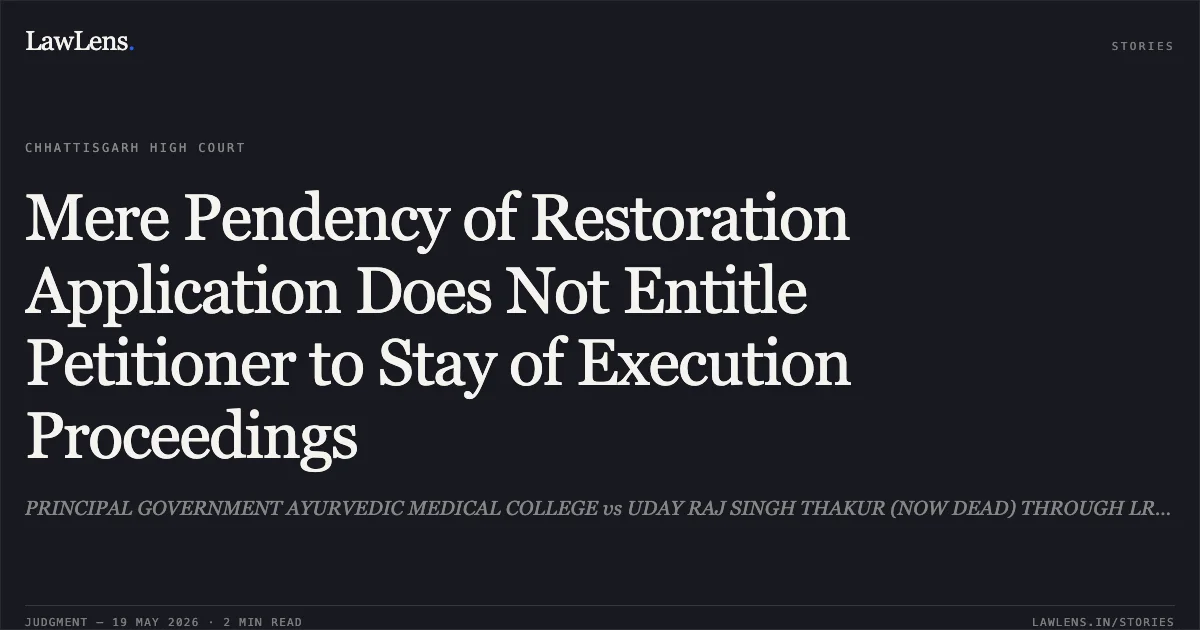
Source reference: para 5The Court reasoned that the mere pendency of a restoration application, especially one hampered by significant delay and an undecided limitation application, does not automatically entitle a party to stay a decree that has attained finality.
Source reference: para 7The Court found that the appellate court’s refusal to grant discretionary relief was justified given the "prolonged pendency" of execution since 2017 and the Petitioner’s conduct.
Source reference: para 6-7Holding
The High Court held that the appellate court committed no illegality, perversity, or jurisdictional error in rejecting the Section 151 CPC application.
The Court answered the issue in the negative, affirming that the Petitioner's negligence disentitled them to discretionary relief.
Source reference: para 7The writ petition was dismissed as devoid of merit, and no order as to costs was made.
Source reference: para 8Acts & Sections Cited
3 provisions across 2 statutes referred to in this judgment. Each provision opens on LawLens.
Code of Civil Procedure, 19082
Limitation Act, 19631
Original Court PDF
PRINCIPAL GOVERNMENT AYURVEDIC MEDICAL COLLEGEvsUDAY RAJ SINGH THAKUR (NOW DEAD) THROUGH LRS RAGHVENDRA SINGH
Click to open original judgment
Original judgment, available to read, download and summarize on LawLens.in