Facts
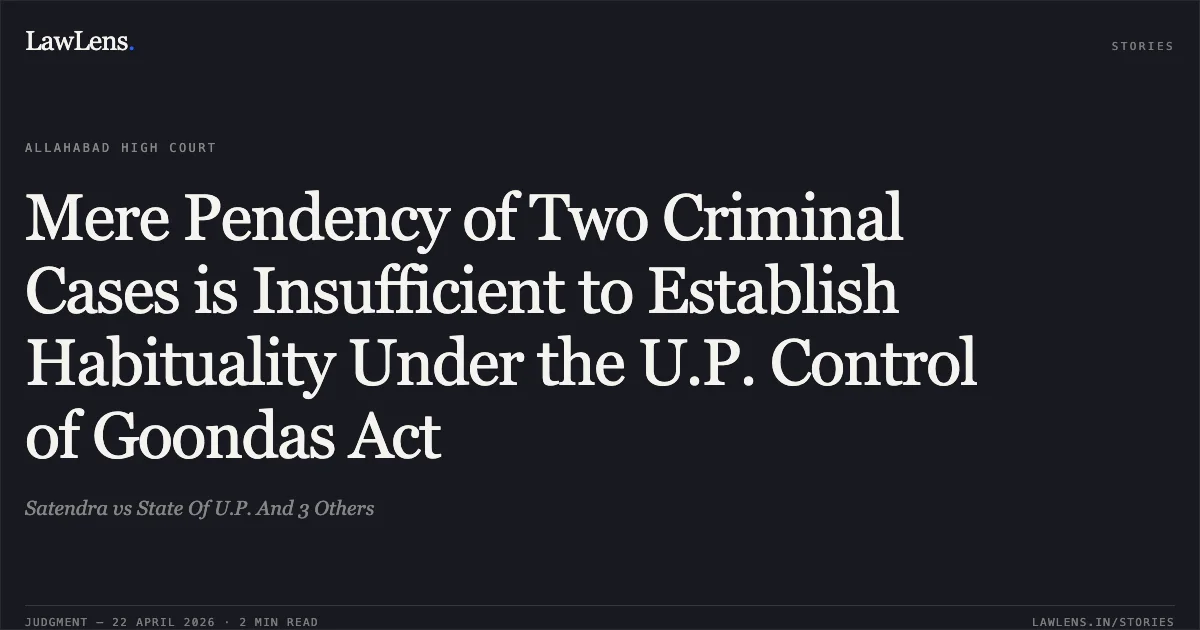
The petitioner challenged two orders: an externment order dated 12.02.2025 issued by the Additional District Magistrate, Bulandshahr, and an appellate order dated 02.06.2025 passed by the Commissioner, Meerut Division.
Source reference: para. 1The externment was based on the petitioner’s involvement in two pending criminal cases: Case Crime No. 3 of 2022 (IPC and SC/ST Act) and Case Crime No. 445 of 2023 (IPC and SC/ST Act).
Source reference: para. 2The lower authorities concluded that the petitioner was a "Goonda" due to his habitual involvement in crime and the fear he instilled in the public.
Source reference: para. 4The petitioner contended that the cases were false and that two isolated incidents do not suffice to prove habituality.
Source reference: para. 3, 5Issues
1. Whether the pendency of only two criminal cases is sufficient to categorize an individual as a "Goonda" and justify an externment order under the U.P. Control of Goondas Act, 1970.
Source reference: para. 5, 17Law Applied
The court applied Section 2(b) of the U.P. Control of Goondas Act, 1970, which defines a "Goonda" as a person who "habitually" commits or abets specific IPC offences or meets other criteria involving reputation or specific convictions.
Source reference: para. 9, 14The court relied on the Supreme Court precedent Vijay Narain Singh v. State of Bihar (1984), which held that "habituality" implies a thread of continuity and frequent commission, rather than isolated or individual acts.
Source reference: para. 10, 16It further cited Allahabad High Court precedents Lalani Pandey v. State of U.P. (2011), Shankar Ji Shukla v. Ayukt (2005), and Govardhan v. State of U.P. (2023), which established that one or two criminal cases are generally insufficient to brand a person a "Goonda".
Source reference: para. 10, 11, 12, 13Reasoning
The court reasoned that the statutory term "habitually" in Section 2(b)(i) requires a persistent tendency to repeat crimes, necessitating a thread of continuity between acts.
Source reference: para. 10, 16While Section 2(b) does not mandate prior conviction for IPC offenses to initiate proceedings, it does require a finding of habituality.
Source reference: para. 15, 16The court observed that the petitioner was branded a "Goonda" solely based on two pending cases from 2022 and 2023.
Source reference: para. 2, 18Following consistent judicial trends, the court found that insignificant or trivial counts (specifically two cases) do not meet the legal threshold of being a "habitual offender".
Source reference: para. 12, 17The court emphasized that labeling a person a "Goonda" is a deterrent executive action that causes irreparable damage to reputation, and thus must be exercised with caution.
Source reference: para. 12, 17Holding
The court answered the issue in the negative, holding that the petitioner could not be branded a "Goonda" based on only two criminal cases.
The writ petition was allowed, and the externment order dated 12.02.2025 and the appellate order dated 02.06.2025 were quashed.
Source reference: para. 19Acts & Sections Cited
2 provisions across 2 statutes referred to in this judgment. Each provision opens on LawLens.
Scheduled Castes and the Scheduled Tribes (Prevention of Atrocities) Act, 19891
Information Technology Act, 20001
Original Court PDF
SatendravsState Of U.P. And 3 Others
Click to open original judgment
Original judgment, available to read, download and summarize on LawLens.in