Facts
The claimants, being the wife, children and mother of the deceased Velu, claimed compensation under the Motor Vehicles Act, 1988, alleging that on 17 March 2015 the deceased was riding his motorcycle when a Toyota car bearing Registration No. TN 09 BT 1984, driven rashly and negligently from behind, collided with the motorcycle. Velu sustained grievous injuries and subsequently died during treatment.
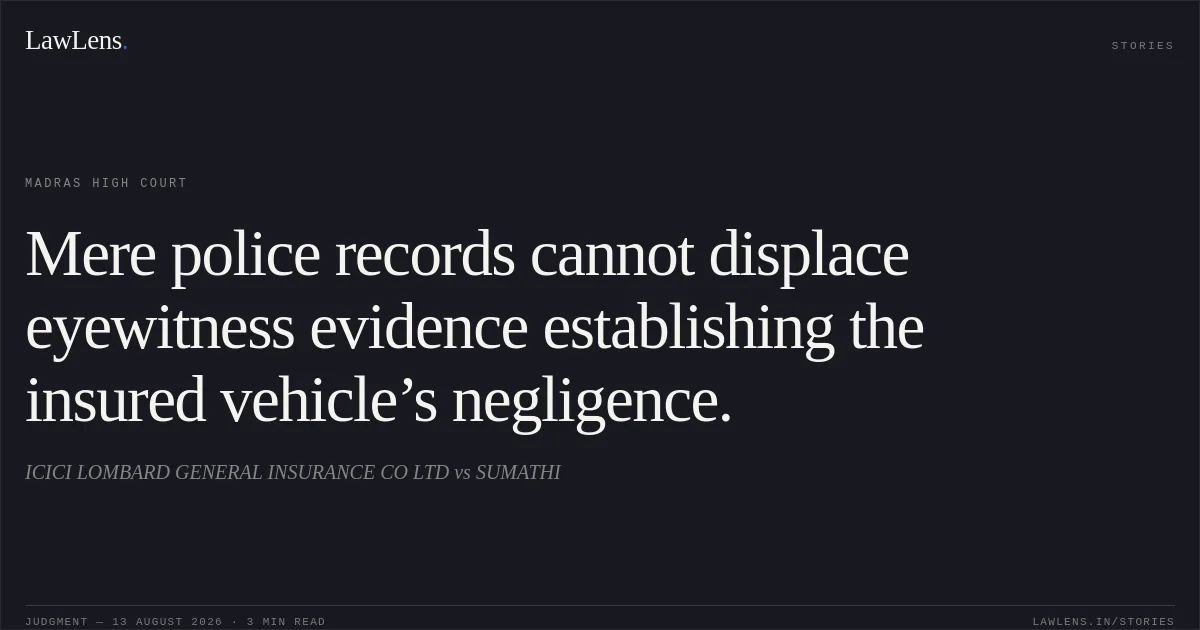
Source reference: p.3, para. 2The insurer denied negligence and relied on the police Final Report, Rough Sketch, Observation Mahazar and Motor Vehicle Inspection Reports to contend that the deceased had himself dashed against a stationary car.
Source reference: p.4, para. 3; p.8, para. 12The Motor Accident Claims Tribunal, II Additional District Judge, Tindivanam, accepted the evidence of the claimants’ eyewitness, PW2, and held the car driver negligent. It assessed the deceased’s notional monthly income at Rs.12,000, added 25% towards future prospects, applied a multiplier of 15, and awarded total compensation of Rs.18,91,000 under various heads.
Source reference: p.5, para. 5; p.6The insurer challenged the award under Section 173 of the Motor Vehicles Act, principally disputing the finding on negligence; it did not challenge the deceased’s age, income assessment or the quantum under the other heads.
Source reference: p.2; p.10, paras. 16–17Issues
Whether the Tribunal was correct in holding that the driver of the insured car was rash and negligent, notwithstanding the police Final Report stating that the deceased had collided with a stationary vehicle?
Source reference: pp. 7–10, paras. 11–15Whether the compensation awarded by the Tribunal required interference on the grounds raised in the appeal?
Source reference: p.10, paras. 16–18Law Applied
The appeal was governed by Section 173 of the Motor Vehicles Act, 1988, which permits an aggrieved party to challenge an award of the Motor Accident Claims Tribunal.
Source reference: p.2In a motor accident claim, the claimants bear the initial burden of establishing negligence, but the issue is determined on the basis of the overall evidence and the preponderance of probabilities.
Source reference: pp. 7–9, paras. 11–15The Court relied on the eyewitness account and the FIR as relevant evidence of the manner of the accident.
Source reference: pp. 7–9, paras. 11–15It held that the insurer could not establish contributory or sole negligence merely by marking the Final Report, Rough Sketch, Observation Mahazar and Motor Vehicle Inspection Reports without examining the car driver or the Investigating Officer.
Source reference: p.9, paras. 13–15For computation of compensation, the Court applied the principles in Sarla Verma v. Delhi Transport Corporation, concerning the multiplier and deduction for personal expenses, and National Insurance Co. Ltd. v. Pranay Sethi, concerning future prospects.
Source reference: pp. 5–6, para. 5; p.10, para. 17Reasoning
The Court found that PW2 gave a clear eyewitness account that the car, being driven rashly, came from behind and hit the deceased’s motorcycle, and that this account was corroborated by the FIR, which was lodged on the same day and specifically identified the offending vehicle.
Source reference: pp. 7–8, paras. 11–12Although the insurer relied on the Final Report stating that the deceased had hit a stationary car, the Court noted that the insurer did not examine either the car driver or the Investigating Officer who prepared the report. Consequently, the Final Report, Rough Sketch and Observation Mahazar, by themselves, were insufficient to displace the claimants’ evidence.
Source reference: p.9, para. 13The absence of damage to the car was also not decisive, since a larger vehicle could have merely touched the moving motorcycle and caused the rider to lose control and fall.
Source reference: p.9, para. 14The claimants therefore discharged the initial burden of proving negligence, while the insurer failed to rebut it.
Source reference: p.9, para. 15As the insurer did not challenge the assessment of age, income, multiplier or other heads of compensation, the Court found no reason to interfere with the award on quantum.
Source reference: p.10, paras. 16–17Holding
The Court answered the principal issue against the insurer and upheld the finding that the insured car’s driver was negligent.
It held that the police Final Report and the absence of damage to the car did not, without supporting oral evidence, establish negligence on the part of the deceased.
Source reference: pp. 9–10, paras. 13–15Finding the compensation of Rs.18,91,000 to be just and reasonable, the Madras High Court dismissed CMA No. 3259 of 2025, confirmed the Tribunal’s award dated 28 April 2025 in MCOP No.153 of 2016, imposed no costs, and consequently dismissed CMP No.27131 of 2025.
Source reference: p.10, paras. 17–18Acts & Sections Cited
1 provisions across 1 statute referred to in this judgment. Each provision opens on LawLens.
Motor Vehicles Act, 19881
Original Court PDF
ICICI LOMBARD GENERAL INSURANCE CO LTDvsSUMATHI
Click to open original judgment
Original judgment, available to read, download and summarize on LawLens.in