Facts
The dispute concerned agricultural land measuring 1 acre 33 guntas in Sy. No. 92, Dasarahalli Village. Muddamma claimed that she had cultivated the land as a tenant. In 1958, the original owners sold the land to Kempaiah; the sale deed recorded Muddamma’s possession and directed Kempaiah to obtain possession from her.
Source reference: p. 5Following earlier tenancy and possession proceedings, Muddamma applied for occupancy rights under Form No. 7 in 1974. After a remand, the Land Tribunal granted her occupancy rights in 2002.
Source reference: pp. 6–7A Single Judge quashed that order, finding that Muddamma had denied Kempaiah’s title and that she had not identified the portion claimed as tenanted separately from 16 guntas she had purchased in the same survey number. Her legal representatives appealed.
Source reference: pp. 7–10Issues
1. Whether the Single Judge’s order quashing the Tribunal’s grant of occupancy rights warranted interference in the writ appeal.
Source reference: p. 162. Whether Muddamma established the legal requirements for occupancy rights, including lawful tenancy and sufficiently precise identification of the land claimed.
Source reference: pp. 16–19Law Applied
Under Sections 4 and 45 of the Karnataka Land Reforms Act, 1961, a claim to occupancy rights requires more than physical possession: the claimant must establish the legal basis for treating the land as tenanted and must have personally cultivated it; Section 4 does not require formal induction by the owner where deemed tenancy is otherwise established.
Source reference: pp. 17–18Honnamma v. Nanjundaiah supports the proposition that absence of direct authority from the owner alone does not defeat a deemed-tenancy claim.
Source reference: p. 17Bhimappa Channappa Kapali v. Bhimappa Satyappa Kamagouda holds that lawful cultivation under Section 4 must have a legal foundation and cannot be established by possession or cultivation alone.
Source reference: p. 18Where a claim concerns only part of a survey number, the extent claimed must be identifiable and distinguishable from other portions; M.S. Narayanagouda v. Girijamma recognises this requirement.
Source reference: p. 19Reasoning
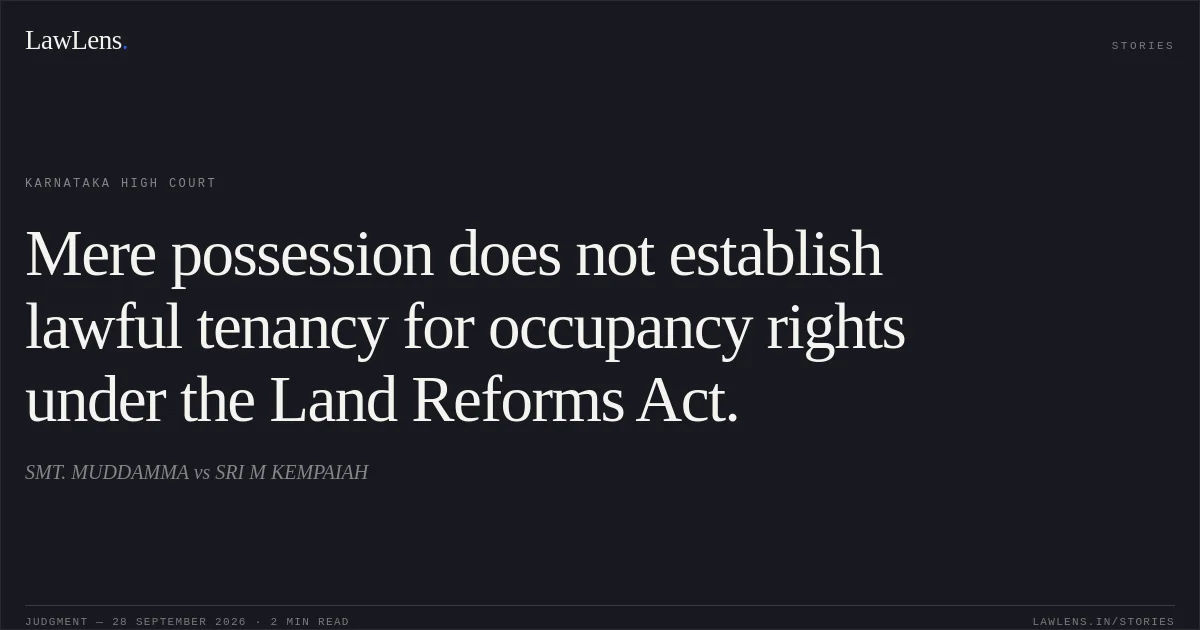
The Court found that the 1958 sale deed recorded Muddamma’s possession but did not establish that Kempaiah had inducted or accepted her as his tenant. Her denial of his title, the absence of evidence that he accepted her as a tenant, and the circumstances of her continued possession did not provide the legal foundation required for tenancy; possession alone was insufficient.
Source reference: pp. 16–18Further, because Muddamma had purchased 16 guntas in the same survey number, her Form No. 7 needed to identify the alleged tenanted portion separately. It did not provide sufficient particulars or boundaries to do so, and the Tribunal therefore could not grant occupancy rights over the larger extent without determining the precise area claimed.
Source reference: pp. 18–19Holding
The Court held that the Single Judge’s decision disclosed no error warranting appellate interference.
It dismissed the writ appeal, leaving in place the order quashing the Tribunal’s grant of occupancy rights and rejecting Muddamma’s Form No. 7 claim.
Source reference: p. 20Acts & Sections Cited
5 provisions across 3 statutes referred to in this judgment. Each provision opens on LawLens.
KARNATAKA HIGH COURT ACT, 19611
KARNATAKA LAND REFORMS ACT, 19613
Transfer of Property Act, 18821
Original Court PDF
SMT. MUDDAMMAvsSRI M KEMPAIAH
Click to open original judgment
Original judgment, available to read, download and summarize on LawLens.in