Facts
The petitioners, an advocate (A7) and a journalist (A6), sought to quash FIR No. 194/2026 registered under Section 108 r/w 3(5) of the Bharatiya Nyaya Sanhita (BNS).
Source reference: no citationThe complainant’s daughter (the deceased) committed suicide following a series of events where Accused No. 1 (A1), who was HIV positive, allegedly injected her with his blood using a syringe after she refused to marry him.
Source reference: p. 4, 5Subsequently, A6 (representing Vedhan Media TV) conducted an interview with A1's family in the presence of A7 (A1's legal counsel), during which they allegedly assassinated the character of the deceased.
Source reference: p. 5, 8This interview was uploaded to YouTube and social media, leading to severe mental distress for the deceased.
Source reference: p. 5, 8A five-page suicide note and a selfie video were recovered, specifically naming the accused as responsible for her death.
Source reference: p. 6, 11Issues
1. Whether the allegations in the FIR and the suicide note prima facie disclose the essential ingredients of "abetment of suicide" under Section 108 of the BNS against the petitioners
Source reference: p. 7, 112. Whether the High Court should exercise its inherent power under Section 528 of the BNSS to quash the investigation at a nascent stage when specific roles are attributed to the petitioners
Source reference: p. 10, 14Law Applied
The Court primarily applied Section 108 (Abetment of suicide) and Section 3(5) (Common intention) of the Bharatiya Nyaya Sanhita (BNS), and Section 528 of the Bharatiya Nagarik Suraksha Sanhita (BNSS) regarding inherent powers of the High Court.
Source reference: p. 3It relied on Laxmi Das v. State of West Bengal, which defines "instigation" as a positive act with a live link to the suicide.
Source reference: p. 12Furthermore, it applied the restrictive guidelines for quashing FIRs established in State of Haryana v. Bhajan Lal, which mandates quashing only if allegations disclose no offence.
Source reference: p. 13Neeharika Infrastructure Pvt. Ltd. v. State of Maharashtra, which cautions against scuttling investigations into cognizable offences at the threshold.
Source reference: p. 14Reasoning
The Court rejected the petitioners' contention that their actions (legal representation and journalism) were merely professional duties without mens rea.
Source reference: no citationIt noted that the FIR and the seized suicide note contained specific allegations that the petitioners participated in a conspiracy to assassinate the character of the deceased via a public interview, which directly prompted the suicide.
Source reference: p. 11, 13The Court distinguished the present facts from the Laxmi Das precedent, finding that here, the character assassination on social media constituted a prima facie "proximate and intentional act".
Source reference: p. 13Since the investigation was ongoing and statements from other accused (A2, A3, and A5) implicated the petitioners, the Court held that truthfulness of the allegations is a matter of trial and cannot be adjudicated in a quashing petition.
Source reference: p. 12, 14Holding
The Court held that the allegations prima facie attract the ingredients of Section 108 r/w 3(5) of the BNS.
Following the Bhajan Lal and Neeharika Infrastructure doctrines, the Court refused to quash the proceedings as the investigation is in progress and the FIR is not expected to be an encyclopedia of all facts.
Source reference: p. 14, 15The Court answered the issues in the negative and dismissed both criminal petitions. The prayer to quash FIR No. 194/2026 was denied.
Source reference: p. 14, 16Acts & Sections Cited
6 provisions across 3 statutes referred to in this judgment. Each provision opens on LawLens.
Bharatiya Nagarik Suraksha Sanhita, 20231
Bharatiya Nyaya Sanhita, 20234
Code of Criminal Procedure, 19731
Original Court PDF
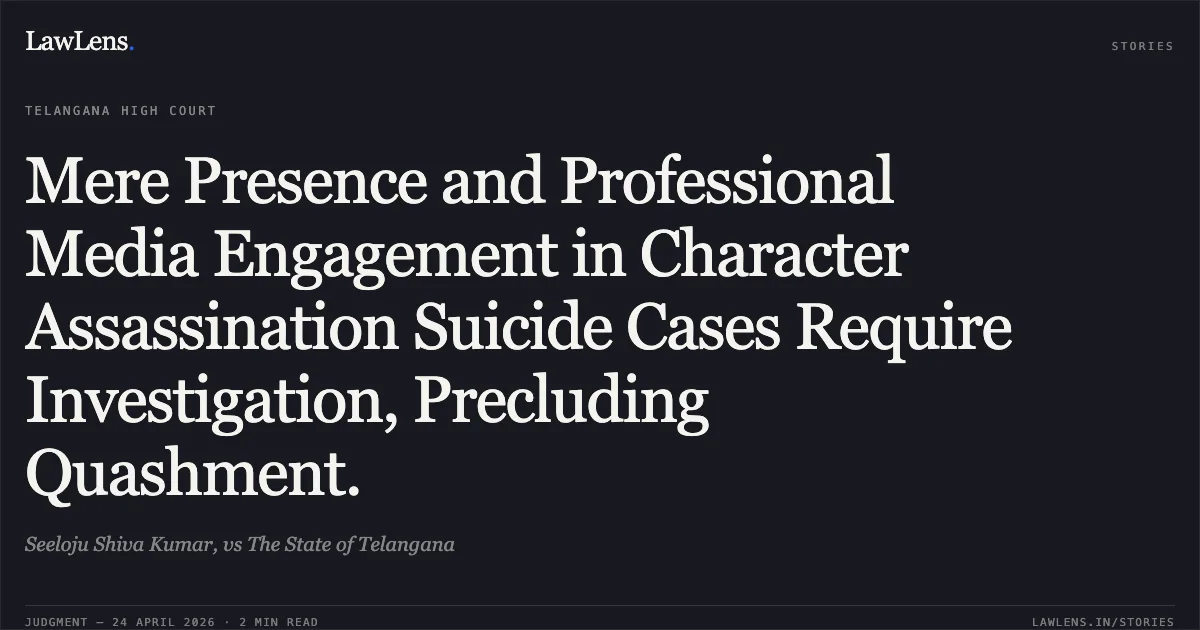
Seeloju Shiva Kumar,vsThe State of Telangana
Click to open original judgment
Original judgment, available to read, download and summarize on LawLens.in