01Facts
The applicant was arrayed as accused No. 8 in FIR No. 11214042252200 of 2025, registered at Olpad Police Station, Surat Rural, for offences under Sections 143(2), 143(3) and 61(2)(A) of the Bharatiya Nyaya Sanhita, 2023, and Sections 3, 4 and 5 of the Immoral Traffic (Prevention) Act, 1956 (“ITPA”).
¶ 2 · p. 1The prosecution alleged that the applicant was a customer who had been apprehended at the place of occurrence and had paid ₹1,500 for the alleged activity; the victims’ statements recorded on 20 December 2025 allegedly supported this version.
¶ 4 · p. 2After investigation, charge-sheet/final report No. 075 of 2026 was filed, resulting in Criminal Case No. 758 of 2026 before the Principal Senior Civil Judge and Additional Chief Judicial Magistrate, Olpad.
¶ 2 · p. 1The applicant sought quashing of the FIR, charge-sheet and consequential proceedings, contending that the ITPA provisions were not attracted merely because he was a customer.
¶ 4–5 · pp. 2–302Issues
i.Whether a person alleged merely to be a customer at a brothel can be prosecuted under Sections 3, 4 and 5 of the Immoral Traffic (Prevention) Act, 1956, in the absence of allegations showing that he kept or managed the brothel, lived on the earnings of prostitution, or procured/induced a person for prostitution
¶ 7–8 · pp. 4–10ii.Whether the FIR, charge-sheet and consequential criminal proceedings against the applicant disclosed the commission of offences under the BNS and the ITPA so as to warrant continuation of the prosecution
¶ 5, 7–8 · pp. 3–1003Law Applied
The Court applied Sections 3, 4 and 5 of the ITPA: Section 3 concerns keeping or managing a brothel or knowingly allowing premises to be used as a brothel; Section 4 penalises knowingly living wholly or partly on the earnings of prostitution; and Section 5 concerns procuring, inducing, taking or causing a person to engage in prostitution.
¶ 7 · pp. 4–9Relying on Jojo Thomas Kannappilly v. State of Gujarat, Bhaliya Sureshbhai Laljibhai v. State of Gujarat, and the principles in Vinod @ Vijay Bhagubhai Patel v. State of Gujarat, as well as Umedsinh P. Champavat v. State of Gujarat and State of Gujarat v. Bai Radha w/o Natwarlal Ramshankar, the Court held that a customer is not, merely by being present at a brothel or engaging in sexual activity for payment, a person who keeps a brothel, lives on prostitution earnings, or “procures” a woman for prostitution.
¶ 7–8 · pp. 4–10The Court also applied the settled principle governing quashing jurisdiction under Section 482 of the Code of Criminal Procedure, corresponding to the Court’s inherent jurisdiction, that proceedings may be quashed where the uncontroverted allegations, taken at their face value, do not constitute any offence.
¶ 7 · pp. 8–10The prosecution provisions under the BNS, including the provisions treated as corresponding to Section 370 IPC, could not survive where the factual allegations did not disclose the necessary criminal role.
¶ 5, 8 · p. 3, 10Provisions in the judgment · 11 · Linked ones open on LawLens
Bharatiya Nyaya Sanhita, 2023 Section 143Section 61Section 528
Immoral Traffic (Prevention) Act, 1956 Section 3Section 4Section 5Section 7Section 8Section 9
Indian Penal Code, 1860 Section 370
Code of Criminal Procedure, 1973 Section 482
04Reasoning
The Court found that the prosecution’s own case attributed to the applicant only the role of a customer who was present at the alleged place of offence and had made payment.
¶ 4 · p. 2There was no allegation or material showing that he owned, kept, managed or permitted the premises to be used as a brothel, as required for Section 3; nor was there material showing that he knowingly lived on the earnings of another person’s prostitution, as required for Section 4.
¶ 7 · pp. 4–8Likewise, the allegation that the applicant paid for services did not establish that he procured, induced, transported or caused any person to engage in prostitution under Section 5.
¶ 7 · pp. 6–10The Court distinguished the role of a customer from that of a procurer, agent or pimp and held that the ITPA prosecution was legally unsustainable.
¶ 7 · pp. 6–10Since the essential ingredients of the charged offences were absent from the FIR and charge-sheet, the applicant’s presence at the premises and the existence of antecedents did not justify continuation of the proceedings.
¶ 6, 8 · p. 3, 1005Holding
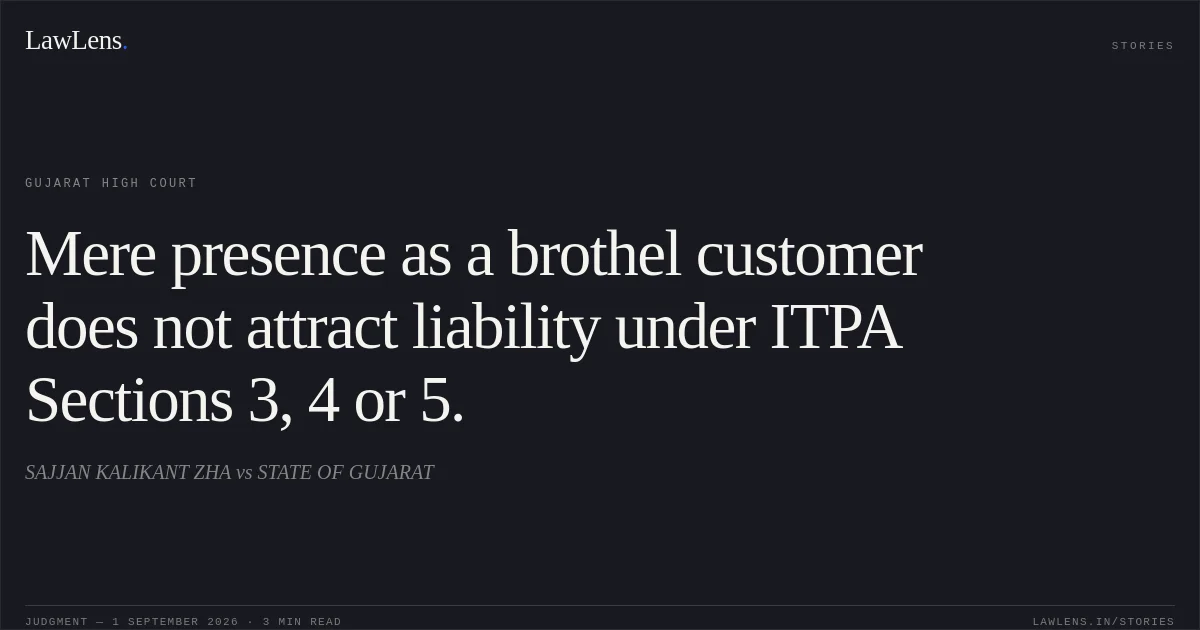
The Court answered the issues in favour of the applicant and held that prosecution of the applicant, merely as a customer, under Sections 3, 4 and 5 of the ITPA was not maintainable.
¶ 8 · p. 10It allowed the application and quashed FIR No. 11214042252200 of 2025 dated 20 December 2025, charge-sheet/final report No. 075 of 2026 dated 28 February 2026, Criminal Case No. 758 of 2026, and all consequential proceedings qua the applicant.
¶ 8 · pp. 10–11Rule was made absolute.
¶ 8 · p. 11Original Court PDF
SAJJAN KALIKANT ZHAvsSTATE OF GUJARAT
Click to open original judgment
Original judgment, available to read, download and summarize on LawLens.in