Facts
On 30 September 2015 at approximately 1:00 p.m., Arun Chaudhary was sitting in an orchard belonging to Kedar Nath Sah when his mother, Sharda Devi—the informant—went to call him for lunch.
Source reference: paras. 4–7; pp. 2–4The prosecution alleged that Mahendra Chaudhary, his wife Sharda Devi, and their sons arrived together; Sundesh Chaudhary was carrying an axe, Mahendra exhorted him to kill Arun, and Sundesh repeatedly assaulted Arun on the head, neck, chest, and abdomen, causing his death at the spot.
Source reference: paras. 4–7; pp. 2–4The post-mortem disclosed multiple sharp-cut injuries, including a deep abdominal wound with protrusion of the intestine, and the doctor opined that death resulted from hypovolemic shock due to excessive haemorrhage.
Source reference: paras. 19–20; pp. 10–11The Trial Court convicted all three appellants under Section 302 read with Section 34 IPC and sentenced each to life imprisonment with a fine of ₹10,000, while acquitting them under Section 120-B read with Section 34 IPC.
Source reference: paras. 1–2; p. 1In appeal, the defence challenged the reliability of the eyewitnesses, the alleged motive, the non-examination of the Investigating Officer, the non-production of the axe, the absence of forensic evidence, the proof of the place of occurrence, and the rejection of the alibi.
Source reference: paras. 10–12, 21–33; pp. 4–19Issues
Whether the prosecution established beyond reasonable doubt that Sundesh Chaudhary inflicted the fatal sharp-edged weapon injuries upon Arun Chaudhary?
Source reference: paras. 34–36; pp. 19–20Whether Mahendra Chaudhary’s alleged exhortation and participation established the common intention required to impose vicarious liability under Section 34 IPC?
Source reference: paras. 37–43; pp. 20–26Whether the evidence proved that Sharda Devi shared the common intention and participated in the criminal act, notwithstanding the absence of any specific weapon or exhortation attributed to her?
Source reference: paras. 44–50; pp. 26–28Whether the non-examination of the Investigating Officer, non-production of the alleged axe, and absence of forensic examination created a reasonable doubt requiring acquittal?
Source reference: paras. 21–28, 54–58; pp. 11–18, 29–30Whether the prosecution established the charge of criminal conspiracy under Section 120-B read with Section 34 IPC?
Source reference: paras. 51–53; pp. 28–29Law Applied
The Court applied Sections 302 and 34 IPC: Section 302 punishes murder, while Section 34 imposes joint liability where a criminal act is done by several persons in furtherance of their common intention; a separate overt act by every accused is not indispensable, but both common intention and participation must be proved, and common intention may develop at the scene.
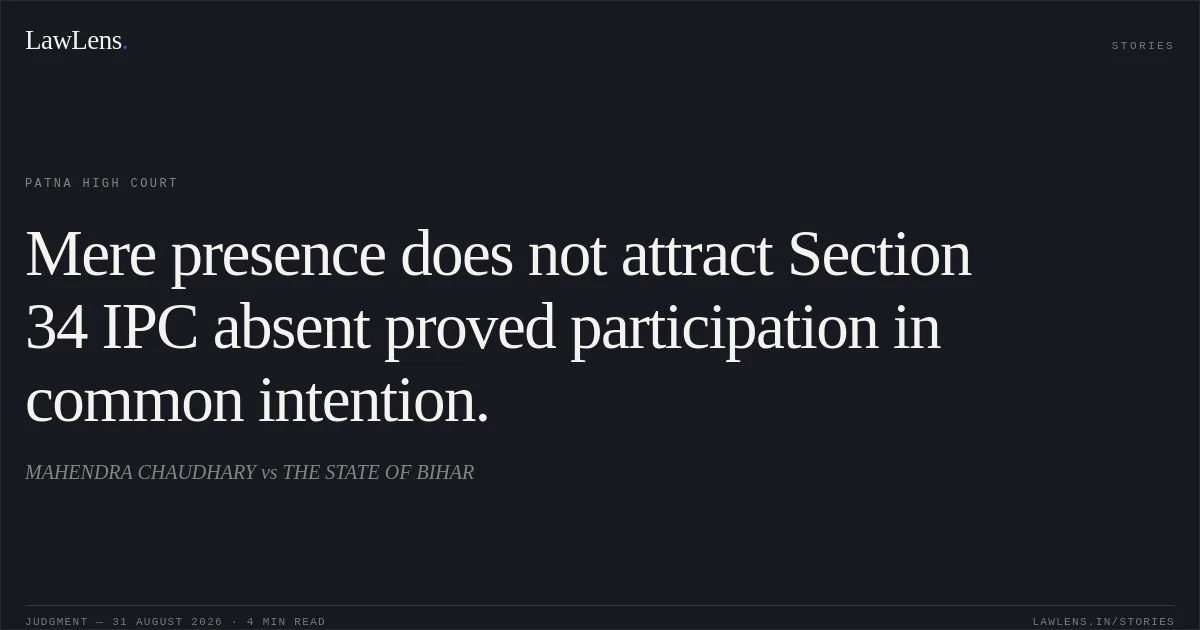
Source reference: paras. 37–39; pp. 20–25Relying on Suresh v. State of U.P., (2001) 3 SCC 673, the Court held that common intention is inferred from the facts, conduct, and surrounding circumstances, and that mere presence is insufficient.
Source reference: paras. 38–39; pp. 20–25Under Dalip Singh v. State of Punjab, AIR 1953 SC 364, relationship with the deceased does not by itself disqualify a witness; the evidence must be assessed on its intrinsic reliability.
Source reference: para. 13; pp. 6–8Following Behari Prasad v. State of Bihar, (1996) 2 SCC 317, non-examination of the Investigating Officer is not automatically fatal and prejudice must be established on the facts of the case.
Source reference: paras. 21–24; pp. 11–14The Court further applied the principle, reiterated in Ghanshyam Mandal v. State of Bihar (Now Jharkhand), 2026 SCC OnLine SC 307, that recovery or production of the weapon is not a sine qua non for conviction where credible ocular and medical evidence otherwise proves the offence.
Source reference: paras. 25–28; pp. 14–18Criminal conspiracy requires proof of an agreement to commit the offence and cannot be inferred merely from joint presence or participation in the occurrence.
Source reference: paras. 51–53; pp. 28–29Reasoning
The Court treated PW-10’s presence as natural because she had gone to the orchard to call her son for lunch, and accepted her specific account that Mahendra exhorted Sundesh and that Sundesh immediately assaulted Arun.
Source reference: paras. 14–15, 34–36; pp. 9, 19–20Although PWs.1–9 broadly supported the prosecution, their admissions showed that several had arrived only after the assault and therefore their evidence was principally relevant to the aftermath, not necessarily to the actual assault.
Source reference: paras. 10–12; pp. 4–6The medical evidence substantially corroborated PW-10’s account of repeated sharp-edged weapon injuries.
Source reference: paras. 19–20, 34–35; pp. 10–11, 19–20The alleged illicit-liquor motive was treated as a material improvement absent from the earliest version and was excluded, but the Court held that absence of motive did not defeat an otherwise proved murder.
Source reference: paras. 16–18; pp. 9–10The Investigating Officer’s death, non-production of the axe, and absence of forensic examination were investigative deficiencies but did not cause sufficient demonstrated prejudice or undermine the consistent ocular and medical evidence.
Source reference: paras. 21–28, 54–58; pp. 11–18, 29–30Mahendra’s alleged exhortation was considered a specific and proximate act directly connected with the assault, supporting common intention under Section 34 IPC.
Source reference: paras. 40–43; pp. 25–26By contrast, the evidence against Sharda consisted substantially of presence with the group and uncorroborated general allegations of participation; no weapon, exhortation, or sufficiently reliable conduct was attributed to her. Mere presence could not establish common intention beyond reasonable doubt.
Source reference: paras. 44–50; pp. 26–28Finally, the prosecution proved no agreement, its timing, or its manner of formation sufficient to sustain the conspiracy charge.
Source reference: paras. 51–53; pp. 28–29Holding
Sundesh Chaudhary’s conviction and life sentence for murder were affirmed, as the Court found that he inflicted the fatal assault.
Mahendra Chaudhary’s conviction and sentence under Section 302 read with Section 34 IPC were also affirmed because his exhortation and participation established common intention.
Source reference: paras. 63–64; p. 31Sharda Devi’s conviction and sentence were set aside, and she was acquitted by extending the benefit of reasonable doubt; if not required in any other case, she was directed to be released forthwith.
Source reference: para. 65; p. 31The acquittal of all accused under Section 120-B read with Section 34 IPC was maintained.
Source reference: para. 66; p. 32The period of custody already undergone by Sundesh and Mahendra was directed to be set off in accordance with law, and the fine and default sentence remained subject to the stated modification.
Source reference: paras. 67–68; p. 32Acts & Sections Cited
5 provisions across 2 statutes referred to in this judgment. Each provision opens on LawLens.
Indian Penal Code, 18604
Code of Criminal Procedure, 19731
Original Court PDF
MAHENDRA CHAUDHARYvsTHE STATE OF BIHAR
Click to open original judgment
Original judgment, available to read, download and summarize on LawLens.in