Facts
The appellant, Vikram, aged 12 years and studying in Class VI, sustained injuries in a motor-vehicle accident on 6 March 2000 caused by the rash and negligent driving of respondent No. 1, involving vehicle No. HR-47-783.
Source reference: paras. 1–3The vehicle was owned by respondent No. 2 and insured with respondent No. 3. The Tribunal had found the respondents jointly and severally liable and awarded ₹65,000 with interest at 9% per annum under Section 166 of the Motor Vehicles Act, 1988.
Source reference: paras. 1–3The High Court noted that the Tribunal and appellate records had been destroyed in a fire and therefore decided the appeal on the basis of the impugned award and available documents.
Source reference: paras. 1–3The appellant had suffered a head injury and an avulsion injury to the right leg, required hospitalisation and skin-grafting surgery, remained under treatment for several months, and subsequently suffered 20% permanent disability due to contracture of the right knee and leg with restricted right-ankle movement.
Source reference: paras. 11–12, 16Issues
Whether the compensation of ₹65,000 awarded by the Motor Accident Claims Tribunal was inadequate and required enhancement in light of the appellant’s medical treatment, permanent disability, pain and suffering, and consequential losses.
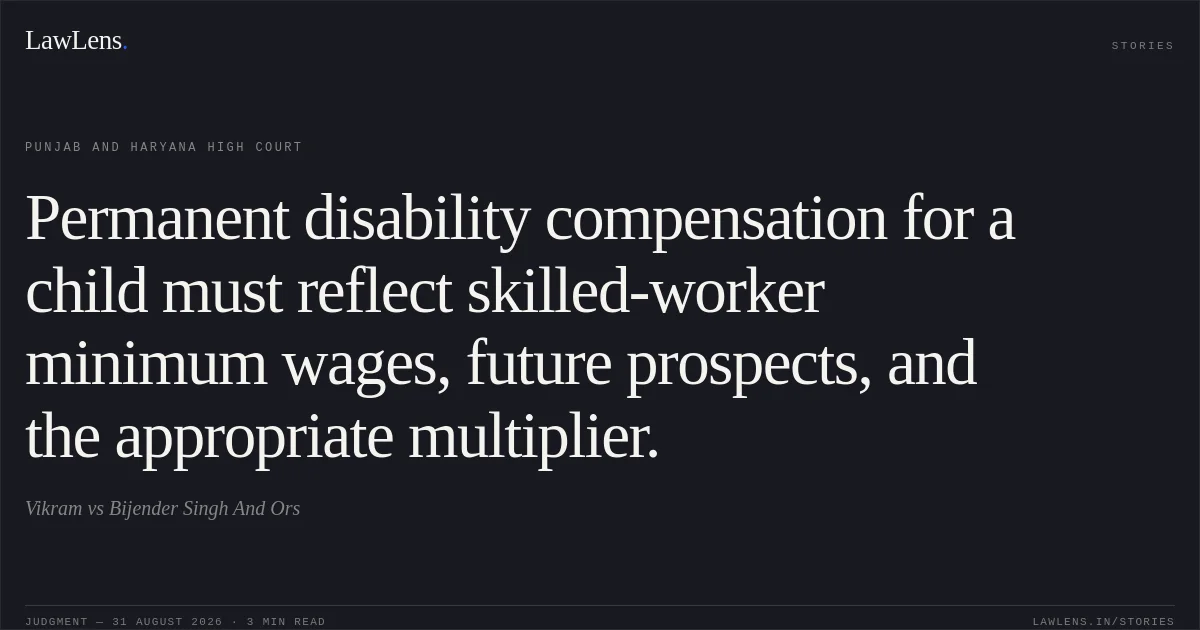
Source reference: paras. 8–10, 13–14Whether compensation for loss of future earning capacity could be assessed in respect of a minor by applying minimum wages, future prospects, the extent of permanent disability, and an appropriate multiplier.
Source reference: paras. 18–22Whether the enhanced compensation was payable by respondents No. 1 to 3 jointly and severally, with interest from the date of filing of the claim petition.
Source reference: para. 26Law Applied
The Court applied Section 166 of the Motor Vehicles Act, 1988, governing claims for compensation arising from motor-vehicle accidents.
Source reference: no citationIt relied on G. Ravindranath @ R. Chowdary v. E. Srinivas, 2013 (3) RCR (Civil) 934, which requires personal-injury compensation to be assessed under pecuniary heads—medical and related expenses, loss of earnings, and future medical expenses—and non-pecuniary heads—pain and suffering, loss of amenities, and loss of expectation of life.
Source reference: para. 15The Court further relied on Sanjay Verma v. Haryana Roadways, 2014 (1) RCR (Civil) 914, National Insurance Co. Ltd. v. Pranay Sethi, (2017) 16 SCC 680, and Karuna Parmar v. Prakash Sinha, 2025 ACJ 1624, for applying future prospects in the assessment of loss of earning capacity.
Source reference: paras. 18–22Relying also on Baby Sakshi Greola v. Manzoor Ahmad Simon, 2024 SCC OnLine SC 3692, the Court treated the minimum wages payable to a skilled worker as a reasonable basis for assessing the notional income of a child and applied a multiplier of 18 for a 12-year-old claimant.
Source reference: paras. 18–22Compensation must be “just,” fair, reasonable, and equitable, and neither a windfall nor a pittance.
Source reference: para. 14Reasoning
The Court affirmed the finding that the accident resulted from respondent No. 1’s rash and negligent driving, noting that respondents No. 1 and 2 had neither appealed nor filed cross-objections against that finding.
Source reference: para. 8On quantum, it found that the Tribunal had inadequately assessed the appellant’s serious avulsion injury, prolonged hospitalisation, skin-grafting surgery, continuing treatment, and permanent disability.
Source reference: no citationPain and suffering were increased from ₹20,000 to ₹40,000.
Source reference: para. 16The Court accepted the evidence regarding dressing charges and medical treatment, adding an amount for physiotherapy and assessing treatment expenses at ₹25,000.
Source reference: para. 16It awarded ₹17,500 towards nutritious diet, transportation, and attendant charges, ₹25,000 for loss of amenities, and ₹5,000 for loss of studies arising from the prolonged treatment.
Source reference: paras. 17, 23–24For permanent disability, the Court assessed the appellant’s notional monthly income at ₹2,700, added 40% for future prospects to arrive at ₹3,780 per month, applied 20% functional loss, and calculated annual loss of income at ₹9,072.
Source reference: paras. 19–22Applying multiplier 18, it awarded ₹1,63,296 for loss of future earning capacity.
Source reference: paras. 19–22The total compensation was consequently rounded to ₹2,76,000.
Source reference: para. 25Holding
The appeal was partly allowed.
The Court enhanced the total compensation from ₹65,000 to ₹2,76,000, granting an enhancement of ₹2,11,000 over and above the Tribunal’s award.
Source reference: para. 26The enhanced amount was made payable by respondents No. 1 to 3 jointly and severally, with interest at 9% per annum from 31 July 2000, the date of filing of the claim petition, until realisation.
Source reference: para. 26The Registry was directed to email the authenticated award to the insurer, which was required to comply with the directions in Bajaj Allianz General Insurance Co. Ltd. v. Union of India, W.P. (Civil) No. 534 of 2020, decided on 16 March 2021.
Source reference: para. 27Acts & Sections Cited
1 provisions across 1 statute referred to in this judgment. Each provision opens on LawLens.
Motor Vehicles Act, 19881
Original Court PDF
VikramvsBijender Singh And Ors
Click to open original judgment
Original judgment, available to read, download and summarize on LawLens.in