Facts
The appellant-husband and respondent no. 1-wife were married on 02 July 2006 and had a male child born in 2010.
Source reference: para. 3The husband alleged that, after the child’s birth, the wife subjected him to cruelty and maintained an illicit relationship with the husband of her elder sister. He claimed to have seen them in a compromising position. He further alleged that, on 30 March 2013, the wife’s father and others forcibly took her away with her belongings, after which she deserted him.
Source reference: para. 4On these grounds, he sought dissolution of marriage under Sections 13(1)(i) and 13(1)(ia) of the Hindu Marriage Act, 1955.
Source reference: para. 4The wife denied the allegations, contending that the accusation of an illicit relationship was fabricated and itself amounted to cruelty. She also alleged that the husband had attempted to kill her by poisoning and stated that a local settlement had not been honoured by him.
Source reference: para. 5The Principal Judge, Family Court, Madhubani dismissed M.M. Case No. 86 of 2013, later renumbered as M.M. Case No. 49 of 2017, by judgment and decree dated 04 April 2024. The husband preferred the present appeal.
Source reference: para. 1Issues
Whether the respondent-wife treated the appellant-husband with cruelty after solemnization of the marriage, within the meaning of Section 13(1)(ia) of the Hindu Marriage Act, 1955?
Source reference: para. 5Whether the appellant proved that the respondent-wife had sexual intercourse with a person other than her spouse, thereby attracting Section 13(1)(i) of the Hindu Marriage Act, 1955?
Source reference: paras. 4, 6–9Whether the appellant was entitled to a decree of divorce on the pleaded grounds?
Source reference: para. 5Law Applied
The Court applied Sections 13(1)(i) and 13(1)(ia) of the Hindu Marriage Act, 1955: Section 13(1)(i) permits divorce where, after solemnization of marriage, a spouse has sexual intercourse with a person other than the spouse, while Section 13(1)(ia) concerns cruelty.
Source reference: para. 4Relying on Hargovind Soni v. Ramdulari, 1985 SCC OnLine MP 109, the Court stated that adultery is ordinarily established through circumstantial evidence, non-access, birth of a child, venereal disease, confession or admission, and requires clear proof excluding reasonable alternative inferences; a mere probability or the husband’s uncorroborated bald statement is insufficient.
Source reference: para. 7The Court further observed that, although matrimonial issues are generally decided on a preponderance of probabilities, adultery, in its view, required proof beyond reasonable doubt.
Source reference: para. 8Allegations of cruelty must also be specific and proved, rather than vague, omnibus allegations.
Source reference: para. 10Reasoning
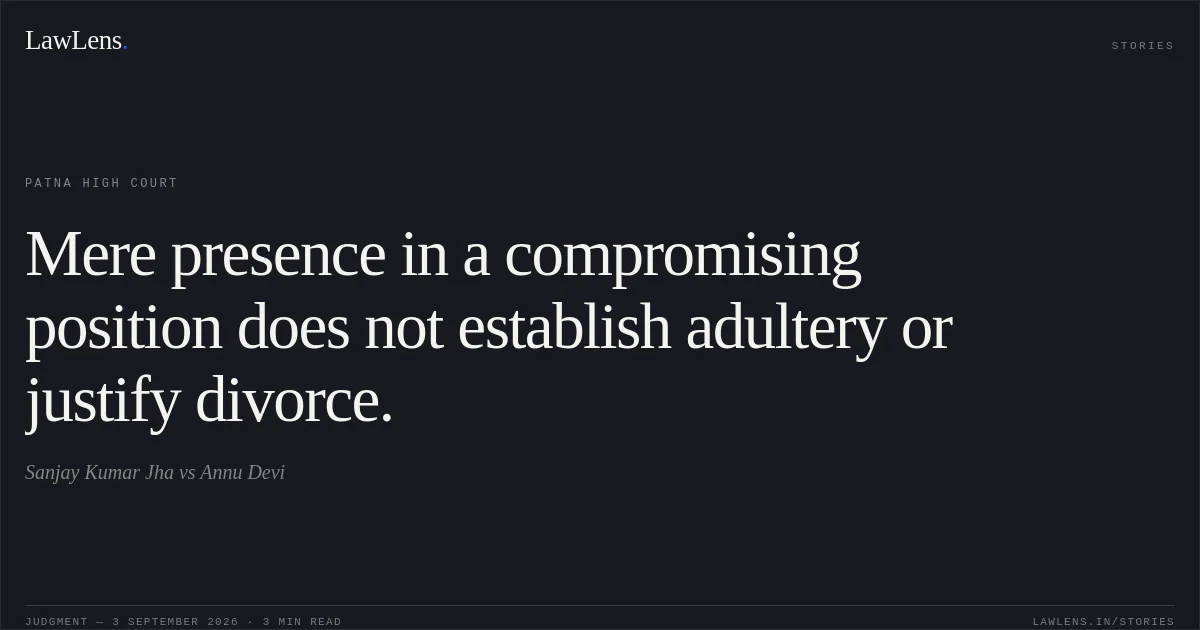
The Court found that the husband’s allegation that he saw the wife and her brother-in-law in a “compromising position” did not establish the distinct statutory requirement of sexual intercourse under Section 13(1)(i).
Source reference: para. 6The husband neither lodged a police complaint or sanha nor made any contemporaneous complaint to matrimonial relatives after the alleged incident. His parents and other relatives also did not support the allegation.
Source reference: para. 6Applying the evidentiary principles stated in Hargovind Soni, the Court held that the accusation of adultery was unsupported by clear or corroborative evidence.
Source reference: paras. 7–9Since the cruelty allegation substantially rested on the same unproved accusation of an illicit relationship, it was regarded as vague, omnibus and incapable of sustaining a finding of cruelty.
Source reference: paras. 9–10The Court therefore found no error in the Family Court’s dismissal of the matrimonial case.
Source reference: para. 10Holding
The Court answered the issues against the appellant. It held that the husband failed to prove either adultery or cruelty under Sections 13(1)(i) and 13(1)(ia) of the Hindu Marriage Act, 1955.
The appeal was dismissed, and the judgment and decree dated 04 April 2024 of the Principal Judge, Family Court, Madhubani, dismissing the matrimonial case, were affirmed.
Source reference: para. 11Acts & Sections Cited
1 provisions across 1 statute referred to in this judgment. Each provision opens on LawLens.
Hindu Marriage Act, 19551
Original Court PDF
Sanjay Kumar JhavsAnnu Devi
Click to open original judgment
Original judgment, available to read, download and summarize on LawLens.in