Facts
On April 16, 2017, the appellant was injured when his vehicle (AS-18-E-0418) collided with an offending vehicle (AS-18/D-7799) driven and owned by the respondents.
Source reference: p.3The appellant sustained a left clavicle fracture and lacerations on his thigh and finger.
Source reference: p.7He filed a claim under Section 166 of the Motor Vehicles Act, 1988.
Source reference: p.3The Motor Accident Claims Tribunal (MACT), Goalpara, awarded Rs. 1,30,360/- with 9% interest, but concluded the appellant suffered no permanent disability.
Source reference: p.4The appellant challenged this find, seeking enhancement of compensation based on a 40% disability certificate issued by a medical board member (PW-3).
Source reference: p.4-5Issues
1. Whether the Motor Accident Claims Tribunal was correct in concluding that the appellant suffered no permanent disability and consequently awarding a compensation of Rs. 1,30,360/-.
Source reference: p.6, para 13Law Applied
The court applied Section 173 of the Motor Vehicles Act, 1988 regarding appeals against awards.
Source reference: p.2It relied on the evidentiary principles established in Raj Kumar v. Ajay Kumar Anr. (2011) 1 SCC 343, which mandates that a Tribunal must satisfy itself that an accident resulted in a real loss of earning capacity and physical disability, rather than blindly accepting a disability certificate.
Source reference: p.5, 7Reasoning
The High Court scrutinized the medical evidence, noting that the initial injury report (Exhibt-3) and discharge certificate (Exhibit-6) showed only a left clavicle fracture and soft tissue "degloving" injuries to the thigh, with no evidence of bone fractures in the limbs.
Source reference: p.7The Court observed that clavicle fractures typically heal and there was no evidence of complications.
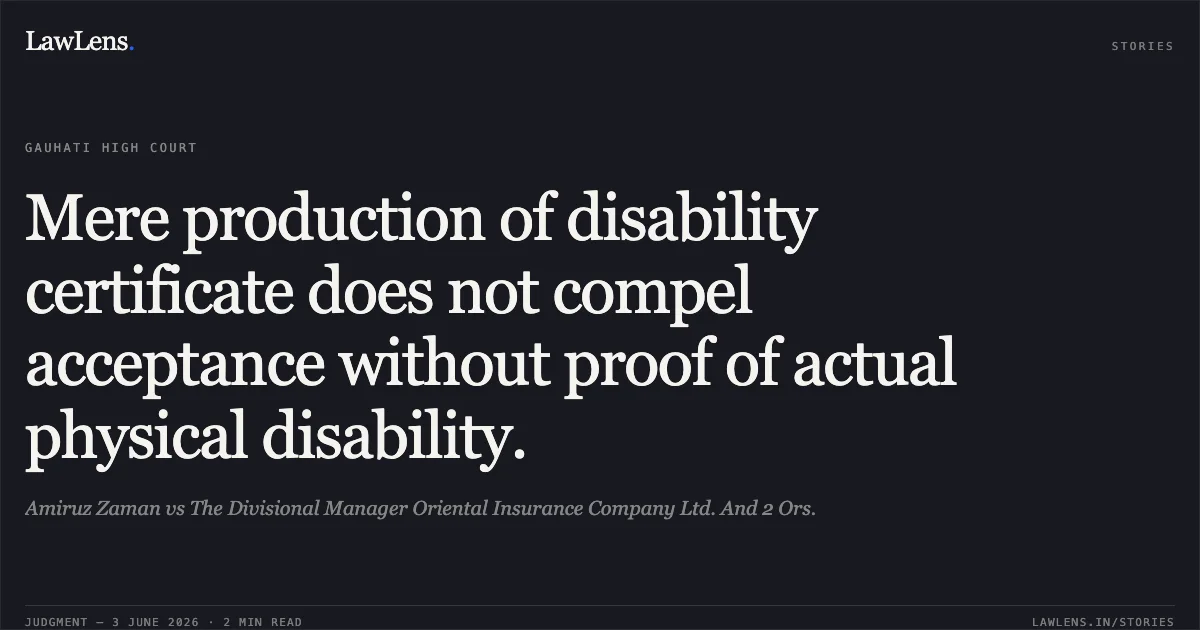
Source reference: p.7The Court rejected the 40% disability certificate (Exhibit-4) because it was issued by a doctor (PW-3) who did not treat the appellant and based the assessment on previous documents without detailing the functional or structural nature of the disability.
Source reference: p.5-7Consequently, the Court found the Tribunal was justified in ignoring the certificate as it failed to prove any actual sensory, locomotor, or functional impairment.
Source reference: p.7-8Holding
The Court answered the issue in the affirmative, holding that the appellant failed to prove permanent disability.
The appeal was dismissed for lack of merit, and the compensation awarded by the Tribunal was deemed "just". The Registry was directed to return the records to the MACT, Goalpara.
Source reference: p.8Acts & Sections Cited
5 provisions across 2 statutes referred to in this judgment. Each provision opens on LawLens.
Motor Vehicles Act, 19882
Indian Penal Code, 18603
Original Court PDF
Amiruz ZamanvsThe Divisional Manager Oriental Insurance Company Ltd. And 2 Ors.
Click to open original judgment
Original judgment, available to read, download and summarize on LawLens.in