01Facts
On 24 January 2018, at approximately 6:45 p.m., the deceased, Julkekar Ahmed Khan, sustained injuries at Panchsheel Kirana Store, Golbazar, Khairagarh, allegedly in an assault involving an iron rod. He subsequently died.
pp. 2–3 · ¶ 2–3The prosecution registered the merg and FIR, conducted inquest and investigation, and obtained a post-mortem report opining that the death was homicidal and caused by coma and haemorrhage.
pp. 2–3 · ¶ 2–3The appellant was arrested, and an iron rod was seized pursuant to his memorandum statement; the FSL report recorded the presence of bloodstains on the rod.
p. 3 · ¶ 3The prosecution examined 17 witnesses and relied on documentary and FSL evidence.
p. 3 · ¶ 4The Additional Sessions Judge, Khairagarh, convicted the appellant under Section 302 of the Indian Penal Code and sentenced him to life imprisonment with a fine of ₹500, with six months’ rigorous imprisonment in default.
p. 3 · ¶ 5In appeal under Section 374(2) of the Code of Criminal Procedure, the appellant contended that the principal witnesses were hearsay witnesses and that the recovery of the bloodstained iron rod did not establish his involvement in the offence.
p. 4 · ¶ 602Issues
i.Whether the deceased’s death was homicidal in nature?
p. 5 · ¶ 9ii.Whether the appellant was proved beyond reasonable doubt to be the author of the assault causing the deceased’s death?
p. 5 · ¶ 10iii.Whether the evidence of Juber Ahmad Khan (PW-1), Dileep Futani (PW-4), and Sanjay Walecha (PW-7), together with the recovery of the iron rod and FSL report, was sufficient to sustain conviction under Section 302 IPC?
pp. 5–9 · ¶ 10–1503Law Applied
The Court applied Section 302 of the Indian Penal Code, which prescribes punishment for murder, and the prosecution’s general burden to establish guilt beyond reasonable doubt.
The Court considered the evidentiary requirements governing circumstantial evidence and held that a witness who arrives after the occurrence or merely sees the accused holding an alleged weapon cannot be treated as an eye-witness to the assault.
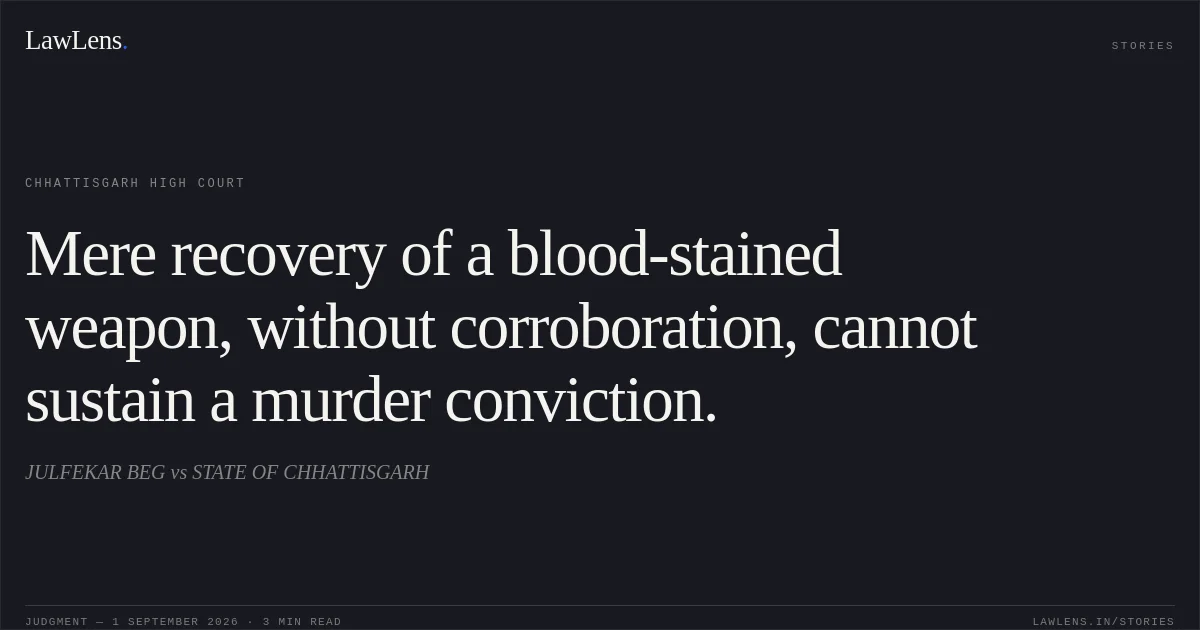
pp. 6–8 · ¶ 12–14The Court further held that the evidentiary value of a recovery pursuant to a memorandum statement depends on its connection with the crime and that the mere recovery of a bloodstained article, without corroborating incriminating circumstances, is insufficient by itself to sustain conviction.
p. 9 · ¶ 15It relied on Mustkeem alias Sirajudeen v. State of Rajasthan, (2011) 11 SCC 724, and Raja Nayka v. State of Chhattisgarh, 2024 SCC OnLine SC 67.
p. 9 · ¶ 15The Court also examined whether the witnesses’ statements fell within the principle of res gestae under Section 6 of the Indian Evidence Act, 1872, and found that they did not.
p. 8 · ¶ 14Provisions in the judgment · 4 · Linked ones open on LawLens
Code of Criminal Procedure, 1973 Section 374Section 175Section 437
Indian Penal Code, 1860 Section 302
04Reasoning
The Court affirmed the finding that the death was homicidal, relying on the post-mortem report and the testimony of the doctor who conducted the examination.
p. 5 · ¶ 9However, it found that none of the three material witnesses had seen the appellant assaulting the deceased.
pp. 6–8 · ¶ 12–14PW-1 came out of the bathroom only after the incident; PW-4 was informed of the injuries and thereafter saw the deceased and the appellant holding an iron rod; and PW-7 expressly stated that he had not seen the appellant causing the injuries.
pp. 6–8 · ¶ 12–14Their evidence therefore did not establish the act of assault and could not be treated as direct evidence or res gestae evidence.
pp. 6–8 · ¶ 12–14The recovery of the iron rod also did not cure this evidentiary deficiency.
p. 9 · ¶ 15Although the rod was seized pursuant to the appellant’s memorandum statement and bore bloodstains, the prosecution failed to establish that the recovered rod was the weapon used in the assault.
p. 9 · ¶ 15Applying Mustkeem and Raja Nayka, the Court held that recovery of a bloodstained article, standing alone and unsupported by other reliable incriminating circumstances, could not prove the appellant’s guilt beyond reasonable doubt.
p. 9 · ¶ 15The prosecution consequently failed to establish the appellant’s authorship of the crime, despite proving the homicidal nature of the death.
p. 9 · ¶ 1605Holding
The Court held that the prosecution failed to prove beyond reasonable doubt that the appellant committed the assault resulting in the deceased’s death.
p. 10 · ¶ 17The conviction under Section 302 IPC and the sentence imposed by the trial Court were set aside, and the appellant was acquitted on the benefit of doubt.
p. 10 · ¶ 17As the appellant was already on bail, he was not required to surrender; however, his bail bond was directed to remain in force for six months under Section 437-A Cr.P.C.
p. 10 · ¶ 17The criminal appeal was accordingly allowed.
p. 10 · ¶ 18Original Court PDF
JULFEKAR BEGvsSTATE OF CHHATTISGARH
Click to open original judgment
Original judgment, available to read, download and summarize on LawLens.in