Facts
On 9 June 2022, airport security recovered a single live cartridge from baggage checked in for a flight from Delhi to Hyderabad.
Source reference: para. 2–6A co-passenger initially identified the bag as his, but stated that it belonged to the petitioner, who was travelling with him.
Source reference: para. 2–6The petitioner had no licence or other valid document for the cartridge.
Source reference: para. 2–6The cartridge was confirmed by the FSL to be ammunition under the Arms Act, and, after obtaining sanction under Section 39 of the Act, police filed a charge sheet against the petitioner under Section 25.
Source reference: para. 2–6The petitioner sought quashing of the charge sheet and ensuing proceedings, contending that he did not know the cartridge was in his luggage and was not in conscious possession of it.
Source reference: para. 7–8The State opposed the petition, relying on the petitioner’s alleged disclosure that he had found the cartridge on a village farm, put it in his bag out of curiosity, and later forgot to remove it.
Source reference: para. 9–10Issues
Whether the petitioner was in conscious possession of the live cartridge recovered from his baggage, such that an offence under Section 25 of the Arms Act was made out
Source reference: para. 13Whether, in the circumstances, the charge sheet and criminal proceedings should be quashed
Source reference: para. 17–20Law Applied
Section 25 of the Arms Act requires “possession” to include the requisite mental element of conscious possession; mere custody without awareness of the nature of the possession is insufficient, as explained in Sanjay Dutt v. State through CBI, Bombay (II) [(1994) 5 SCC 402].
Source reference: para. 14Under Gunwantlal v. State of Madhya Pradesh [(1972) 2 SCC 194], possession under the Arms Act requires consciousness or knowledge and may be constructive where the accused has power or control over the weapon.
Source reference: para. 16A live cartridge falls within the statutory definition of ammunition under Section 2(b) of the Arms Act.
Source reference: para. 12The Court also relied on prior Delhi High Court decisions applying the conscious-possession requirement to ammunition recovered from baggage and holding that prosecution under Section 25 is unwarranted where the evidence does not establish such possession.
Source reference: para. 15–17Reasoning
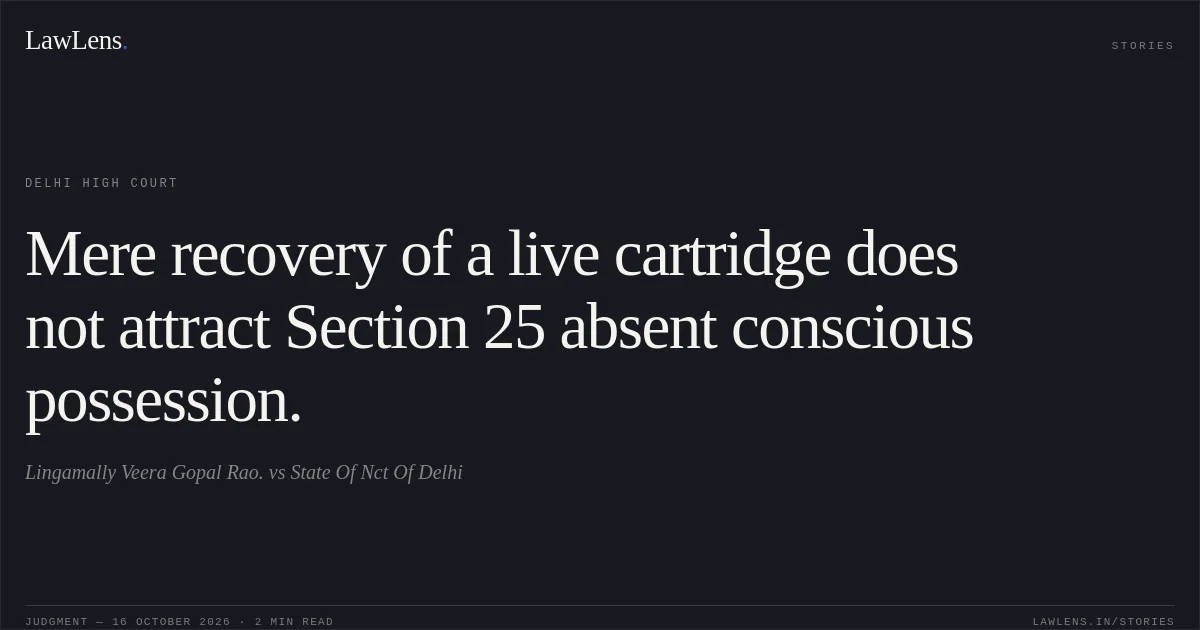
The Court accepted that the recovered live cartridge was ammunition, but treated conscious possession—not recovery alone—as determinative.
Source reference: para. 12–14It found that only one cartridge had been recovered from the petitioner’s baggage, no corresponding firearm was recovered, and the FIR disclosed no suspicious circumstances indicating that the petitioner knowingly possessed the cartridge.
Source reference: para. 18Applying the conscious-possession principle and the cited decisions, the Court concluded that the material did not establish the mental element necessary for an offence under Section 25.
Source reference: para. 17–19Holding
The Court held that the petitioner was not shown to be in conscious possession of the cartridge and was therefore not liable to prosecution under Section 25 of the Arms Act.
It quashed the charge sheet in FIR No. 0226/2022 and the proceedings in CR Case No. 8406/2022 pending before the ACMM-01, Patiala House Courts, and disposed of the petition and pending applications.
Source reference: para. 20–22Acts & Sections Cited
3 provisions across 1 statute referred to in this judgment. Each provision opens on LawLens.
Arms Act, 19593
Original Court PDF
Lingamally Veera Gopal Rao.vsState Of Nct Of Delhi
Click to open original judgment
Original judgment, available to read, download and summarize on LawLens.in