Facts
The appellant, an Assistant Development Officer at Janpad Panchayat, Antagarh, was prosecuted under Sections 7 and 13(1)(d) read with Section 13(2) of the Prevention of Corruption Act, 1988.
Source reference: paras. 2–3, 14–17The complainant alleged that the appellant demanded ₹15,000 as illegal gratification for issuing withdrawal slips and releasing instalments under the Indira Awas Scheme in favour of the complainant’s mother and sister-in-law.
Source reference: paras. 2–3, 14–17A trap was conducted on 15 April 2015. The complainant allegedly handed over ₹10,000 in phenolphthalein-treated currency notes to the appellant, which were subsequently recovered from his trouser pocket.
Source reference: paras. 2–3, 15The trial court convicted the appellant under Sections 7 and 13(1)(d) read with Section 13(2) of the Prevention of Corruption Act and sentenced him to rigorous imprisonment of four and five years respectively, with fines; the sentences were to run concurrently.
Source reference: para. 1Issues
Whether the prosecution proved beyond reasonable doubt the demand and acceptance of illegal gratification, in addition to recovery of the tainted currency, so as to sustain conviction under Sections 7 and 13(1)(d) of the Prevention of Corruption Act, 1988?
Source reference: paras. 10–12, 29–34Whether the audio recording and transcript could reliably establish the alleged demand when the recording remained in the complainant’s possession, was not subjected to voice or forensic examination, and was not verified by the panch witnesses?
Source reference: paras. 22–28, 34Whether mere recovery of tainted money and positive hand-wash results were sufficient to invoke the statutory presumption under Section 20 of the Prevention of Corruption Act in the absence of foundational proof of demand and acceptance?
Source reference: paras. 11–12, 31–33Law Applied
The court applied Sections 7 and 13(1)(d) read with Section 13(2) of the Prevention of Corruption Act, 1988, holding that proof of demand and acceptance or obtainment of illegal gratification is indispensable, and that mere recovery of currency is insufficient.
Source reference: paras. 10–12, 29, 31–33Under Section 20, the presumption regarding the gratification being a motive or reward arises only after the foundational facts of demand and acceptance have been proved; the provision does not dispense with proof of those facts.
Source reference: paras. 11–12, 33Relying on Neeraj Dutta v. State (NCT of Delhi), (2023) 4 SCC 731, the court held that demand and acceptance may be proved by direct, documentary or circumstantial evidence, but must first be established as facts in issue.
Source reference: para. 12It further relied on Mukhtiar Singh v. State of Punjab, (2017) 8 SCC 136, B. Jayaraj v. State of A.P., (2014) 13 SCC 55, and V. Sejappa v. State, (2016) 12 SCC 150, for the principle that mere possession or recovery of tainted money does not establish the offence without proof of demand.
Source reference: paras. 11, 32–33On electronic evidence, the court applied Ram Singh v. Col. Ram Singh, 1985 Supp SCC 611, and Rajesh Gupta v. State through CBI, (2022) 20 SCC 793, requiring identification of the speaker’s voice, proof of accuracy, exclusion of tampering, and clear audibility.
Source reference: paras. 23, 28It also referred to Sanjaysinh Ramrao Chavan v. Dattratray Gulabrao Phalke, (2015) 3 SCC 123, concerning source and authenticity of electronic recordings.
Source reference: para. 25Reasoning
The court found that the prosecution failed to establish the essential foundational fact of demand.
Source reference: paras. 17, 22The audio recording allegedly made on 4 April 2015 remained with the complainant until 14 April 2015, and the investigating officer admitted that it was neither examined for tampering nor subjected to scientific or voice analysis.
Source reference: paras. 17, 22No voice sample of either the appellant or the complainant was taken, and the prosecution did not independently establish that the recorded voice belonged to the appellant.
Source reference: paras. 22–24The panch witnesses had neither heard the recording nor verified the transcript, while the laptop used to prepare the CD was not seized or produced.
Source reference: paras. 18, 20, 27The complainant’s testimony also contained material inconsistencies regarding the dates of issuance of withdrawal slips, the place and circumstances of the complaint, and the alleged demand.
Source reference: paras. 16, 30The person allegedly present when the demand was made, Dasari Bai, was not examined.
Source reference: paras. 16, 30Although recovery of ₹10,000 and the pink hand-wash result could support acceptance or possession, those circumstances could not substitute proof of a prior demand.
Source reference: paras. 29–34Consequently, the statutory presumption under Section 20 could not arise because the prosecution had not proved the foundational facts beyond reasonable doubt.
Source reference: paras. 29–34Holding
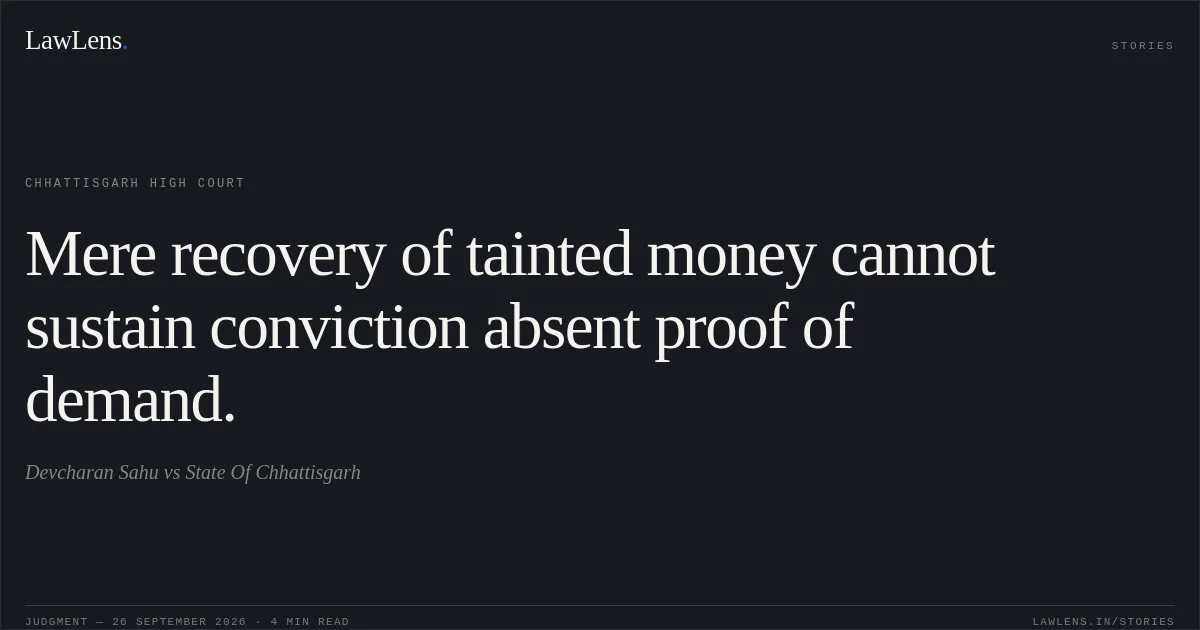
The High Court held that the prosecution failed to prove demand and acceptance of illegal gratification beyond reasonable doubt.
Mere recovery of the tainted currency and the positive hand-wash result were insufficient to sustain conviction under Sections 7 and 13(1)(d) read with Section 13(2) of the Prevention of Corruption Act.
Source reference: paras. 31–34The appeal was allowed; the trial court’s judgment of conviction and order of sentence dated 14 September 2017 were set aside, and the appellant was acquitted.
Source reference: para. 35As the appellant was on bail, his bail bond was directed to remain operative for six months under Section 481 of the Bharatiya Nagarik Suraksha Sanhita, 2023.
Source reference: para. 35Acts & Sections Cited
7 provisions across 3 statutes referred to in this judgment. Each provision opens on LawLens.
Code of Criminal Procedure, 19732
Prevention of Corruption Act, 19884
Bharatiya Nagarik Suraksha Sanhita, 20231
Original Court PDF
Devcharan SahuvsState Of Chhattisgarh
Click to open original judgment
Original judgment, available to read, download and summarize on LawLens.in