01Facts
The plaintiff sued for declaration of title and perpetual injunction over Sy. No. 375/4 (135 ft × 30 ft), Nuggehalli Village, Channarayapatna Taluk.
¶ 3(i) · pp. 2–3He claimed the land was ancestral, that he was in possession as owner, and that the defendant had created false documents dated 30.10.1984 and attempted to encroach and erect a fence.
¶ 3(i) · pp. 2–3The defendant pleaded that the plaintiff's father sold 3½ guntas to her under a sale deed dated 26.10.1984, registered on 30.10.1984, after which she obtained mutation (MR No. 5/1984-85), a non-agricultural licence (01.12.1984), constructed an RCC house, and paid tax and electricity charges.
¶ 3(ii)–(iii) · pp. 4–5The defendant further pleaded that the plaintiff and his brother later sold additional land to her (2002) and that the plaintiff retained only 24½ guntas.
¶ 3(iii) · pp. 5–6The plaintiff contended that his father died on 01.04.1978 when he was a minor, so the 1984 deed was concocted.
¶ 8 · pp. 7–8The trial court dismissed the suit, and the First Appellate Court dismissed the appeal (R.A. No. 36/2023) on 11.02.2025.
¶ 6–7 · pp. 6–7The plaintiff then filed this second appeal.
¶ 7 · p. 702Issues
i.1. Whether the trial court's failure to frame a separate issue on the plaintiff's title (in a suit for declaration of title) vitiates the decision and warrants remand for fresh adjudication.
¶ 8 · pp. 7–8 · ¶ 10 · p. 8ii.2. Whether the plaintiff, having himself and his father alienated the suit property under the sale deed Ex.P.29/Ex.D.4, can maintain a suit for declaration of title and injunction decades later, and whether such a suit is barred by limitation.
¶ 10 · pp. 8–10iii.3. Whether any substantial question of law arises for consideration under Section 100 CPC.
¶ 10 · p. 1003Law Applied
The Court applied Section 100 CPC, under which a second appeal lies only on a substantial question of law.
p. 1 · ¶ 10 · p. 10Parties who proceed to trial with knowledge of their respective cases cannot later complain that a specific issue was not framed, since the omission does not prejudice them where the evidence on title was led.
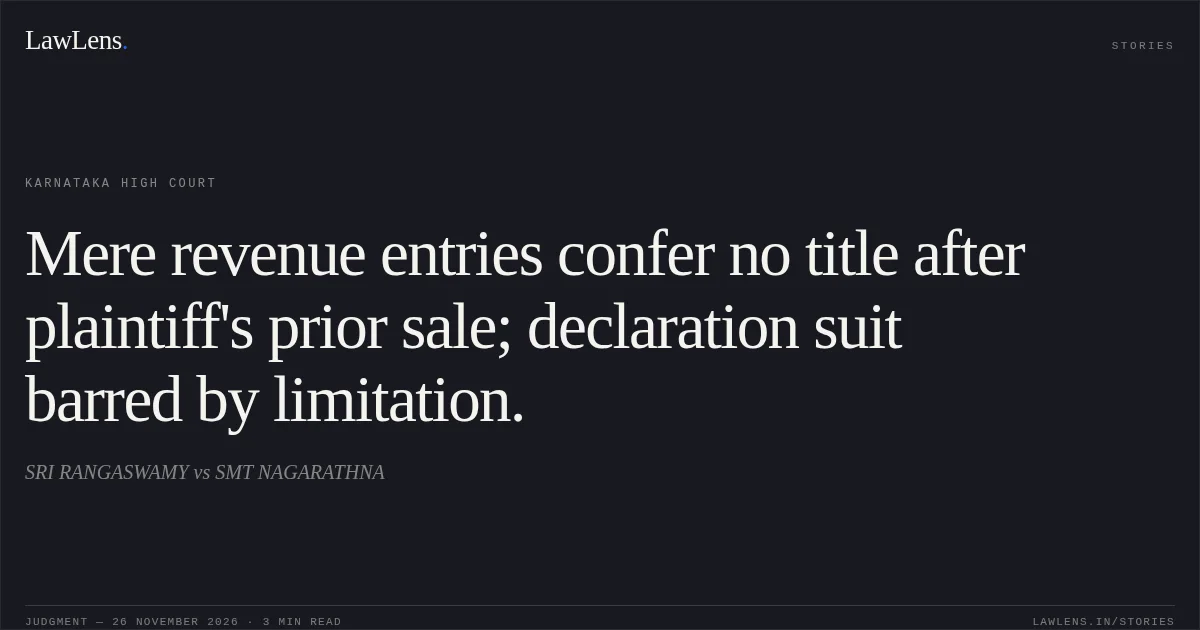
¶ 10 · p. 8A person who has alienated property cannot subsequently assert title to it, so a revenue entry in his name confers no right, title or interest once a valid prior sale is established.
¶ 10 · pp. 9–10The law of limitation bars a declaratory suit filed after an unreasonable lapse of time following execution of the sale deed.
¶ 10 · p. 10Provisions in the judgment · 1 · Linked ones open on LawLens
Code of Civil Procedure, 1908 Section 100
04Reasoning
The Court first held that the plaintiff could not complain about the absence of a title issue, because both parties led evidence on title and the trial court examined the documentary title of both sides.
¶ 10 · pp. 8–9It then examined Ex.P.29/Ex.D.4 and found that the plaintiff did not establish that the deed was unauthorised, illegal, or not executed by him and his father. The plaintiff's own admissions regarding mutation, construction of the house, and its amenities supported the defendant's possession.
¶ 10 · pp. 8–9The First Appellate Court's finding that the plaintiff retained only 24½ guntas, and that the RTC extract (Ex.P.1) reflecting 3.08 guntas in his name conferred no title after alienation, was accepted.
¶ 10 · pp. 9–10Because the sale was executed about 32 years before the suit, the Court treated the claim as time-barred and held that the plaintiff lacked any subsisting right, title or interest.
¶ 10 · p. 10The concurrent findings of fact by both lower courts on possession and title were treated as final for second appeal purposes.
¶ 10 · p. 1005Holding
The non-framing of a title issue did not vitiate the trial, as both parties went to trial knowing their cases and led evidence on title.
¶ 10 · p. 8The plaintiff's suit was barred by limitation, and having alienated the property under Ex.P.29/Ex.D.4, he had no subsisting title or interest. No substantial question of law arose under Section 100 CPC.
¶ 10 · p. 10The Regular Second Appeal is dismissed, affirming the judgment and decree of the First Appellate Court dated 11.02.2025 and of the trial court dated 23.09.2023 in O.S. No. 577/2016.
¶ 10 · p. 10Original Court PDF
SRI RANGASWAMYvsSMT NAGARATHNA
Click to open original judgment
Original judgment, available to read, download and summarize on LawLens.in