Facts
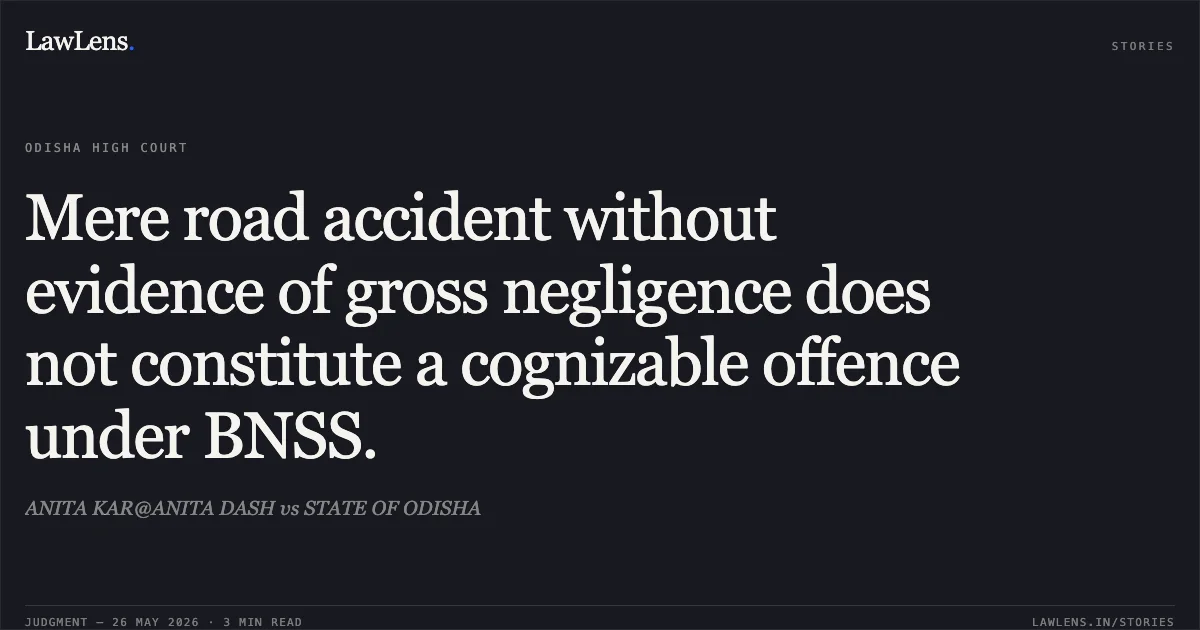
The Petitioner, a practicing advocate, was driving her car with the Informant (Opposite Party No. 2) on April 5, 2025. Near Deokaranpur School, the vehicle veered off a sharp blind curve into a field, causing injuries to both occupants.
Source reference: p. 2Nearly seven months later, on November 3, 2025, the Informant lodged an FIR at Bargaon P.S. (Case No. 302/2025) under Sections 281 (rash driving), 125(a), and 125(b) (endangering life/safety) of the Bharatiya Nyaya Sanhita (BNS), 2023.
Source reference: p. 1-2The Petitioner moved the High Court under Section 528 of the Bharatiya Nagarik Suraksha Sanhita (BNSS), 2023 (corresponding to Section 482 CrPC), seeking to quash the FIR on the grounds that the incident was a mere accident lacking criminal negligence and that the FIR was an abuse of process due to inordinate delay.
Source reference: p. 2-3Issues
1. Whether the allegations in the FIR, taken at face value, satisfy the essential ingredients of rash or negligent driving under the BNS to justify criminal investigation
Source reference: p. 16, para. 62. Whether the failure to conduct a preliminary enquiry under Section 173(3) of the BNSS, coupled with an unexplained seven-month delay in lodging the FIR, warrants the quashing of proceedings
Source reference: p. 18-19, para. 9-10Law Applied
The Court primarily applied Sections 281 and 125 of the Bharatiya Nyaya Sanhita (BNS), 2023, regarding rash driving and act endangering life.
Source reference: p. 1The Court relied on Section 173(3) of the Bharatiya Nagarik Suraksha Sanhita (BNSS), 2023, which permits a preliminary enquiry for offences punishable with 3-7 years' imprisonment to ascertain a prima facie case.
Source reference: p. 18The Court followed the precedent in Imran Pratapgadhi v. State of Gujarat (2025), emphasizing that Section 173(3) BNSS is a safeguard against frivolous FIRs.
Source reference: p. 5-10The Court applied the "abuse of process" doctrine from State of Haryana v. Bhajan Lal (1992) to quash proceedings where FIR allegations fail to disclose a cognizable offence, and referenced Lalita Kumari v. Govt. of U.P. (2013) regarding the necessity of preliminary enquiries in cases of abnormal delay.
Source reference: p. 10-12Reasoning
The Court reasoned that criminal liability for negligence requires a degree of recklessness or "culpable disregard for consequences," which is distinct from a mere error of judgment or an unfortunate mishap.
Source reference: p. 16-17Examining the FIR, the Court found a total absence of specific details such as excessive speed or traffic violations; the fact that the accident occurred at a known "blind curve" suggested a loss of control rather than criminal intent.
Source reference: p. 17The Court highlighted the seven-month delay in reporting the incident and noted that under the new Section 173(3) of the BNSS, the police should have conducted a preliminary enquiry given the delay and the nature of the alleged offence, rather than mechanically registering the FIR.
Source reference: p. 18-19The Court concluded that since the foundational facts did not meet the high threshold of "criminal rashness," allowing the investigation to proceed would subject the Petitioner to unnecessary harassment and constitute an abuse of the judicial process.
Source reference: p. 19-20Holding
The Court answered the issues in the affirmative, holding that the FIR failed to disclose the essential ingredients of the alleged offences and that its continuation would be an abuse of process.
The High Court allowed the petition and ordered the quashing of Bargaon P.S. Case No. 302 dated 03.11.2025 and all consequential proceedings. Any prior interim orders were vacated.
Source reference: p. 20, para. 13-14Acts & Sections Cited
11 provisions across 3 statutes referred to in this judgment. Each provision opens on LawLens.
Code of Criminal Procedure, 19732
Bharatiya Nagarik Suraksha Sanhita, 20233
Bharatiya Nyaya Sanhita, 20236
Original Court PDF
ANITA KAR@ANITA DASHvsSTATE OF ODISHA
Click to open original judgment
Original judgment, available to read, download and summarize on LawLens.in