Facts
The appellant-husband and respondent-wife married on 11 June 2016 under the Special Marriage Act, 1954, and subsequently had a son.
Source reference: paras. 3–4The husband alleged that the wife voluntarily left the matrimonial home on 17 August 2017, treated him with cruelty, and deserted him for more than two years.
Source reference: paras. 3–4He therefore instituted Original Suit No. 22 of 2022 before the Family Court, Dhanbad, seeking dissolution of marriage under Section 27(1)(b) and (d) of the Special Marriage Act, 1954.
Source reference: paras. 3–4The wife denied desertion and cruelty, contending that the husband had left her at her parental home and had failed to resume cohabitation despite her willingness.
Source reference: para. 5The Family Court dismissed the divorce suit by judgment dated 11 August 2023 and decree dated 24 August 2023.
Source reference: para. 1The husband challenged that decision under Section 19(1) of the Family Courts Act, 1984.
Source reference: para. 1Issues
1. Whether the respondent-wife had treated the appellant-husband with cruelty within the meaning of Section 27(1)(d) of the Special Marriage Act, 1954, so as to entitle him to a decree of divorce?
Source reference: paras. 28–42, 60–622. Whether the respondent-wife had deserted the appellant-husband for a continuous period of at least two years immediately preceding the presentation of the divorce petition, within the meaning of Section 27(1)(b) of the Special Marriage Act, 1954?
Source reference: paras. 28, 43–53, 63–673. Whether the Family Court’s findings rejecting the claims of cruelty and desertion were perverse or otherwise warranted interference in appeal?
Source reference: paras. 54–59, 68–69Law Applied
The Court applied Section 27(1)(b) of the Special Marriage Act, 1954, which permits divorce where the respondent has deserted the petitioner for a continuous period of not less than two years immediately preceding presentation of the petition, and Section 27(1)(d), which permits divorce where the respondent has treated the petitioner with cruelty.
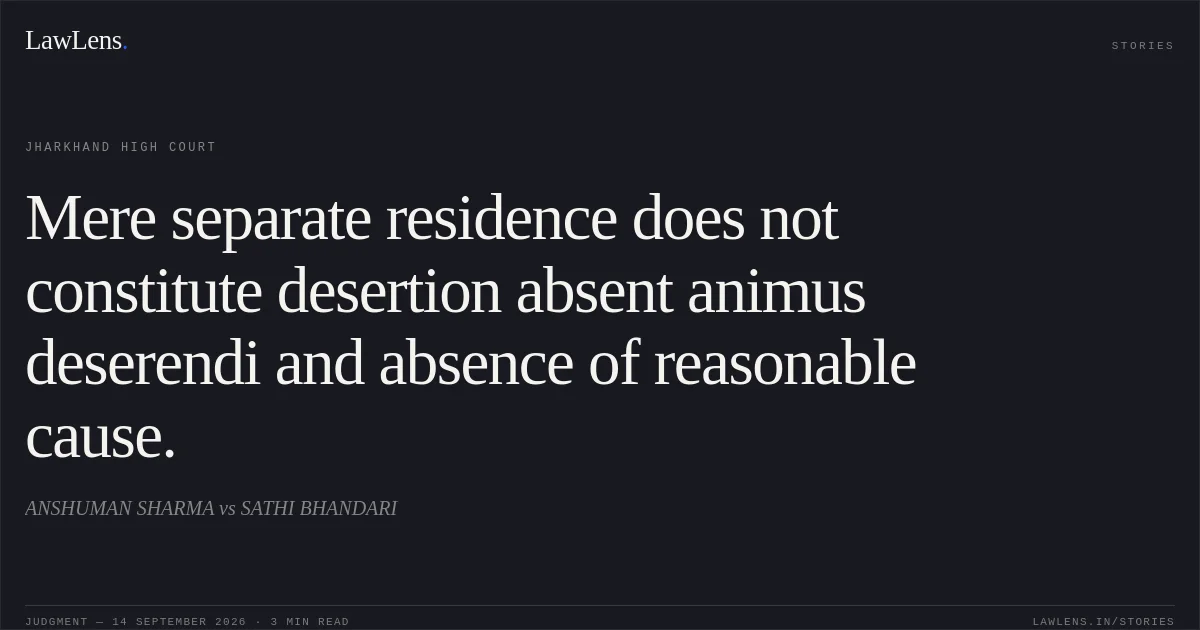
Source reference: para. 28“Desertion” requires proof of factum of separation and animus deserendi—an intention to permanently bring cohabitation to an end—along with absence of consent and absence of reasonable cause for the separation.
Source reference: paras. 43–53; Lachman Utamchand Kirpalani v. Meena, AIR 1964 SC 40; Debananda Tamuli v. Kakumoni Kataky, (2022) 5 SCC 459For cruelty, the Court relied principally on Samar Ghosh v. Jaya Ghosh, (2007) 4 SCC 511, Shobha Rani v. Madhukar Reddi, (1988) 1 SCC 105, V. Bhagat v. D. Bhagat, (1994) 1 SCC 337, Vijay Kumar Ramchandra Bhate v. Neela Vijay Kumar Bhate, (2003) 6 SCC 334, Joydeep Majumdar v. Bharti Jaiswal Majumdar, (2021) 3 SCC 742, and other authorities, holding that cruelty must be grave, weighty, and of such a nature that the aggrieved spouse cannot reasonably be expected to continue the matrimonial relationship; ordinary quarrels, trivial irritations, or normal wear and tear do not suffice.
Source reference: paras. 29–42The Court further applied the principle that appellate interference on the ground of perversity is justified only where the finding is unsupported by evidence, based on irrelevant material, or so irrational that no reasonable court could have reached it.
Source reference: paras. 55–59; Arulvelu v. State, (2009) 10 SCC 206; Damodar Lal v. Sohan Devi, (2016) 14 SCC 197Reasoning
The Court held that the husband failed to establish cruelty because his testimony contained only a bald allegation that the wife had behaved cruelly, without identifying any specific incident or conduct satisfying the requirement of grave and weighty matrimonial cruelty.
Source reference: paras. 60–62His supporting witnesses merely repeated his version and added no material evidence.
Source reference: para. 23On desertion, the Court found that physical separation alone was insufficient.
Source reference: no citationAlthough the parties had lived separately, the wife consistently asserted that she wished to resume cohabitation, had denied voluntarily abandoning the husband, and had attributed the separation to the husband’s conduct.
Source reference: paras. 25–27, 64–65Her willingness was also reiterated during the appeal, including after mediation had failed.
Source reference: paras. 25–27, 64–65The husband’s admission that he had taken the wife back on several occasions further weakened the allegation of a permanent intention on her part to end cohabitation.
Source reference: para. 22The Court consequently concluded that the separation resulted from compelling circumstances and was not voluntary desertion accompanied by animus deserendi.
Source reference: paras. 65–67Since the Family Court had consciously assessed the pleadings and evidence and its findings were neither unsupported nor irrational, the High Court found no perversity or legal error warranting appellate interference.
Source reference: para. 68Holding
The High Court answered both issues against the appellant.
The husband failed to prove either cruelty under Section 27(1)(d) or desertion under Section 27(1)(b) of the Special Marriage Act, 1954.
Source reference: paras. 60–69The Family Court’s dismissal of the divorce suit was upheld as legally and factually sound.
Source reference: paras. 60–69Accordingly, the appeal was dismissed, and any pending interlocutory application was disposed of.
Source reference: paras. 69–71Acts & Sections Cited
4 provisions across 4 statutes referred to in this judgment. Each provision opens on LawLens.
Family Courts Act, 19841
Special Marriage Act, 19541
Hindu Adoptions and Maintenance Act, 19561
Code of Criminal Procedure, 19731
Original Court PDF
ANSHUMAN SHARMAvsSATHI BHANDARI
Click to open original judgment
Original judgment, available to read, download and summarize on LawLens.in