Facts
Respondent No. 2 complained that accused No. 1 agreed to sell him eight cents of land for ₹3,50,000, received ₹3,00,000 as advance, and later refused to execute the sale deed. The petitioner, accused No. 2, signed the sale agreement; the complaint also alleged that he colluded with accused No. 1 and joined in mortgaging the property documents, but did not specifically allege that he received any of the advance payment
Source reference: pp. 2–3, 6–7; paras. 2, 8After the Magistrate referred the complaint for investigation under Section 156(3) Cr.P.C., police filed a ‘B’ report. The Magistrate rejected it, recorded the complainant’s sworn statement, and took cognizance under Sections 417 and 420 read with Section 34 IPC. The petitioner sought to quash the proceedings
Source reference: pp. 4–5; para. 3The judgment identifies the case as C.C. No. 1713/2023 in its opening and procedural history, but the operative order refers to C.C. No. 1712/2023
Source reference: pp. 2, 4, 8; paras. 1, 3, 9Issues
1. Whether the complaint and accompanying material disclosed a prima facie case against the petitioner for offences under Sections 417 and 420 read with Section 34 IPC
Source reference: pp. 6–8; paras. 8–92. Whether continuation of the criminal proceedings against the petitioner, in light of the ‘B’ report and the civil nature of the dispute, amounted to an abuse of process
Source reference: p. 8; para. 9Law Applied
Section 482 Cr.P.C. empowers the High Court to quash criminal proceedings where the allegations, taken at face value, do not disclose an offence against the accused or where continuation of the proceedings would amount to an abuse of the process of court.
Source reference: pp. 2, 8; paras. 1, 9The offences alleged were cheating under Sections 417 and 420 IPC, read with Section 34 IPC concerning acts done in furtherance of common intention. The complaint had been referred for investigation under Section 156(3) Cr.P.C. No precedent was cited in the judgment
Source reference: pp. 2, 4–5, 8; paras. 1, 3, 5, 9Reasoning
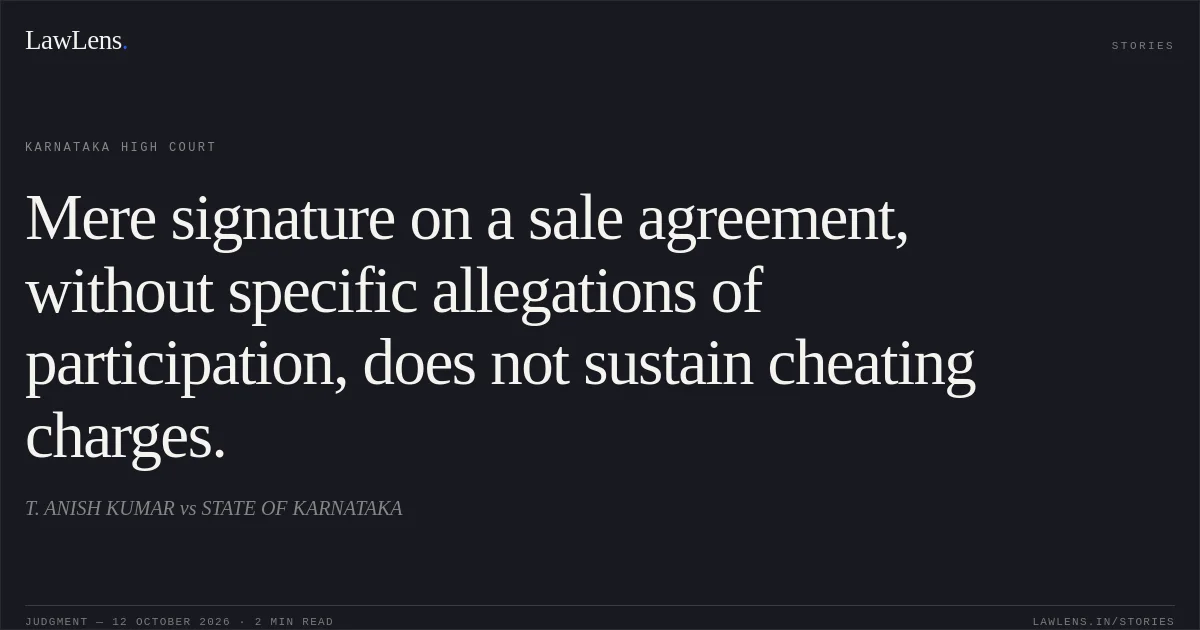
The Court noted that the sale agreement was between respondent No. 2 and accused No. 1, and that the petitioner’s established involvement was signing the agreement. The complaint did not specifically allege that the petitioner received the advance consideration.
Source reference: pp. 6–8; paras. 8–9The police statements recorded in the ‘B’ report also indicated that, apart from signing the agreement, the petitioner had not supported or participated in accused No. 1’s alleged conduct. The Court held that the complaint’s general allegations of collusion and the existence of a civil dispute did not, on the material before it, establish a specific criminal role for the petitioner. It further found that the Magistrate had rejected the ‘B’ report by reiterating the complaint’s allegations without adequately addressing the material concerning the petitioner
Source reference: pp. 6–8; paras. 8–9Holding
The Court allowed the petition and quashed the proceedings against the petitioner under Sections 417 and 420 read with Section 34 IPC, finding that no offence was made out against him and that continuation of the proceedings would be an abuse of process
The Court allowed the petition and quashed the proceedings against the petitioner under Sections 417 and 420 read with Section 34 IPC
Source reference: p. 8; para. 9Acts & Sections Cited
8 provisions across 2 statutes referred to in this judgment. Each provision opens on LawLens.
Code of Criminal Procedure, 19732
Indian Penal Code, 18606
Original Court PDF
T. ANISH KUMARvsSTATE OF KARNATAKA
Click to open original judgment
Original judgment, available to read, download and summarize on LawLens.in


